
Modified HDPE Solution for Steel Wire Rope and Cable Applications
Modified HDPE material routes for coated steel wire rope, marine cables, fatigue-resistant cable compounds and conductive sensing applications.
Buyer and engineer FAQ
Questions engineers often ask about this material route
Where can HDPE with a conductive plastic requirement be used?
Typical fields include ESD trays, electronic housings, fixtures, EMI parts and antistatic logistics parts. For this article, DEYU would first confirm the working environment, wall thickness, expected lifetime and whether conductive PE matches the part geometry or needs formulation adjustment.
What are the main performance indicators for the "conductive plastic" target on HDPE?
Focus on surface resistance, volume resistance, dispersion uniformity, impact strength and molding stability. Buyers should ask for data on molded parts, not only pellet data, because gate position, filler orientation and thickness can change the final value.
What should engineers watch during injection molding or processing?
For HDPE, a practical starting window is 180-230°C melt / 20-55°C mold. Avoid excessive filler loading, control weld lines and verify resistance on the molded part. Final parameters should follow part thickness, gate design and the actual machine.
What details help DEYU recommend conductive PE more accurately?
Send the current resin or grade, drawing or photo, wall thickness, annual quantity, target standard, failure mode and required color. If a reference grade already passed one test but failed in production, include both data sets.
For a precise recommendation, share the part drawing, base resin, target performance, processing method and test standard with DEYU.
In industrial fields such as steel wire rope manufacturing, marine cables, oilfield drilling, and heavy lifting, high-density polyethylene (HDPE) – with its excellent chemical resistance, good processing flowability, and low specific gravity – is rapidly penetrating from traditional “plastic coating protective layers” towards “functional structural inner cores.” Facing new scenarios such as deep-sea oil extraction, intelligent cables, and military special ropes, which demand combined properties like cold-resistance and fatigue resistance, high strength and modulus, and ultra-high conductivity, general-purpose HDPE is no longer adequate, and specific modification technologies are required to redefine its performance boundaries.
Coated Steel Wire Rope and Modified HDPE: From “Protective Shell” to “Functional Core”
In the manufacture of multi-strand steel wire ropes, coating the inner strands with plastic is a core method to prevent “inter-wire contact wear.” As the most commonly used coating material, HDPE effectively isolates direct friction between wires, significantly reducing failure modes such as stress fatigue and wear fatigue. However, with the application of steel wire ropes in harsh conditions like polar regions and deep seas, traditional pure HDPE coatings show limitations in low-temperature impact resistance and environmental stress crack resistance.
The industry’s common approach is to blend HDPE with low-density polyethylene (LDPE), combined with elastomers, silane coupling agents, and anti-aging agents for systematic modification. This technical route greatly improves impact toughness in extremely cold environments down to -40°C, transforming the HDPE coating layer from a mere physical isolator into a functional inner core that enhances structural rigidity. In a domestic deep-sea drilling platform steel wire rope application, the modified HDPE inner core effectively suppressed wire wear under dynamic loads, significantly extending the service life of the rope.
High-Strength HDPE for Cables: Balancing High Strength, High Modulus, and Fatigue Resistance
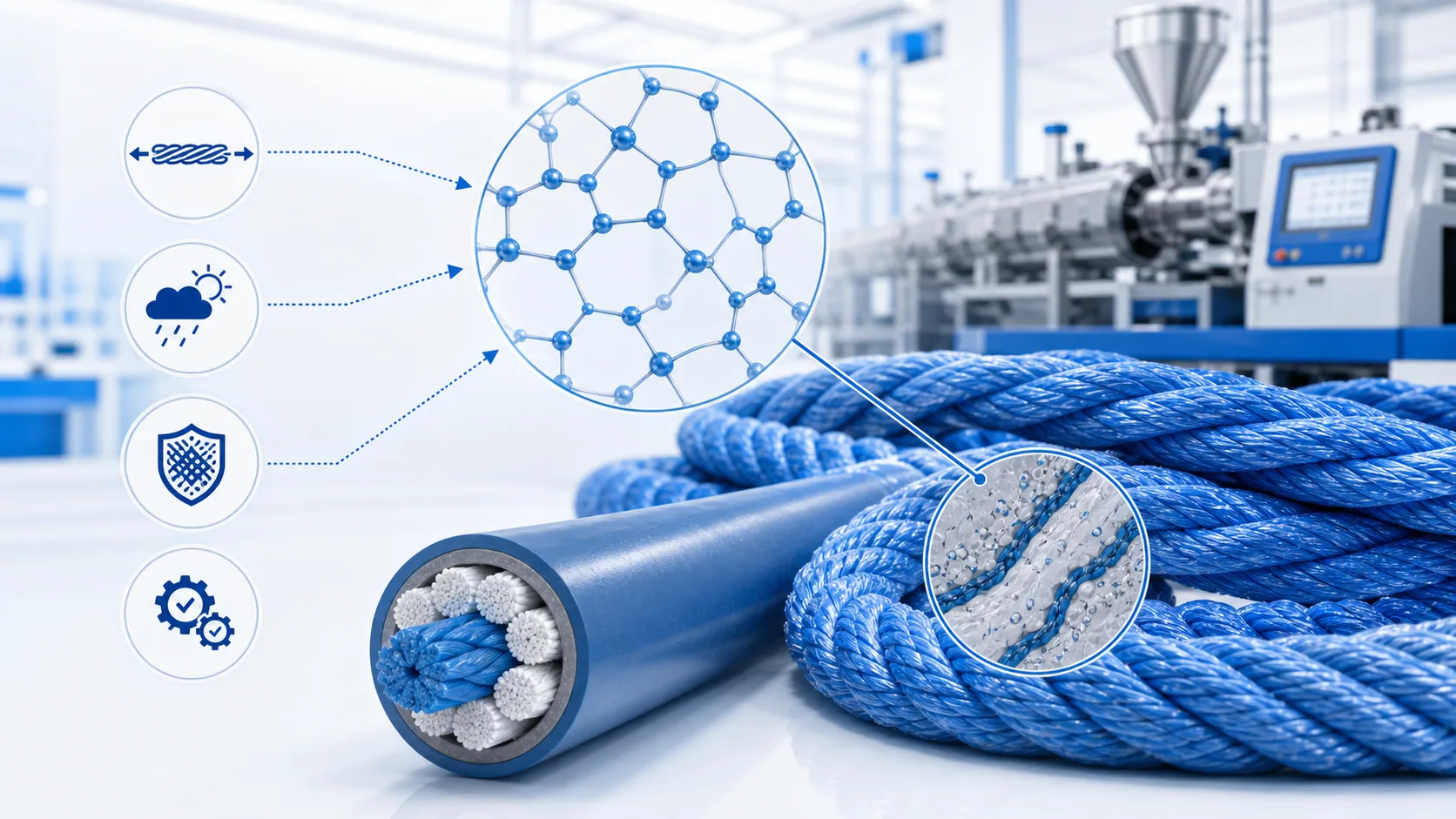
In marine mooring, fishing, and ocean engineering, polyethylene cables are increasingly replacing traditional steel cables due to their lightweight and corrosion-resistant properties. Yuyao Deyu Plastic has developed a high-strength HDPE cable compound series (DGK-HDPE-ROPE series) in this field. Compared with conventional injection-grade HDPE, these specialised grades have undergone specific molecular structure regulation, achieving ultra-high crystallinity and a uniform molecular weight distribution, which significantly improves the tensile knot strength and creep resistance of monofilaments, and can be directly extruded as inner cores without the need for coating, saving production costs.
The core technical advantage of the Yuyao Deyu Plastic DGK-HDPE-ROPE series lies in its special optimisation of fatigue resistance, particularly suitable for heavy-load scenarios such as ship towing and offshore drilling platform mooring that require long-term alternating stress. Currently, this series of special compounds has entered the validation phase in several large domestic manufacturing companies, focusing on solving the problem of internal heat accumulation in traditional polyethylene cables under high-frequency bending conditions, and filling the domestic gap for high-strength cable materials in deep-water mooring applications.
Conductive HDPE in Special Cables and Smart Sensing Applications
With the development of the Industrial Internet of Things, the demand for polymer cables with conductive functionality is becoming increasingly urgent. By uniformly dispersing conductive fillers such as conductive carbon black, carbon fibre, or carbon nanotubes into the HDPE matrix, conductive HDPE materials with surface resistivity as low as 10²–10⁵ Ω can be obtained, suitable for signal transmission or static charge dissipation in smart ropes.
Yuyao Deyu Plastic’s DGK-HDPE-DD series conductive HDPE compounds employ a high-structure conductive carbon black composite system, with surface resistivity stably controllable in the range of 10³–10⁸ Ω as required. Compared with conventional conductive PE, this series maintains good conductivity while preserving HDPE’s inherent environmental stress crack resistance and low-temperature toughness. In fields with extremely high explosion-proof requirements, such as oilfield drilling, this conductive HDPE is used as the inner core coating material for steel wire ropes, ensuring that charges generated by friction are quickly dissipated, eliminating the risk of combustion or explosion from electrostatic sparks. This series has already been applied in small batches to the manufacture of smart mooring cables and special explosion-proof steel wire ropes.
Frontier Exploration: Ultra-High Conductivity and Mechanical Enhancement of Steel-Fibre-Reinforced HDPE
For extremely demanding material requirements in “high-precision” fields such as military, aerospace, and deep-sea equipment, Yuyao Deyu Plastic is collaborating with relevant research institutes on the experimental development of steel-fibre-reinforced HDPE composites. Steel fibres possess an extremely high aspect ratio and metallic ductility, with intrinsic resistivity about one twentieth that of carbon fibres.
According to published academic research data, using fatty acid-based surface treatment agents to modify stainless steel fibres can significantly improve the “wetting” state between the fibres and the HDPE matrix, increasing the composite’s conductivity by more than one order of magnitude, raising notched impact strength by about 35%, while also notably improving the processing flowability of the composite system.
The experimental grade DGK-HDPE-GCF60L developed by Yuyao Deyu Plastic along this technical path, at high steel fibre loadings of 40–60 wt%, not only reduces surface resistivity to extremely low levels for efficient electromagnetic shielding, but also achieves a fusion of “metal-like strength” and “plastic processability.” Although steel-fibre composites are currently costly, their excellent performance in fatigue resistance, creep resistance, and dimensional stability gives them irreplaceable potential in cutting-edge applications such as airborne pod suspension cables and ultra-deepwater umbilical cables.
Core Product Matrix
| Technical Direction | Representative Grade | Technical Route | Core Characteristics | Main Application Areas |
|---|---|---|---|---|
| High-strength cable compound | DGK-HDPE-ROPE series | Molecular structure regulation, HDPE/LDPE blending + elastomer toughening | High tensile knot strength, creep resistance, fatigue resistance, cold resistance | Ship mooring lines, towlines, fishing ropes, inner cores and sheaths for multi-strand steel wire ropes |
| Conductive HDPE (anti-static / conductive grade) | DGK-HDPE-DD series | High-structure conductive carbon black composite | Surface resistivity 10³–10⁸ Ω, low-temperature resistance, ESCR resistance | Signal transmission in smart cables, inner cores for explosion-proof steel wire ropes |
| Steel-fibre-reinforced HDPE (experimental) | DGK-HDPE-GCF60L | 40–60% steel fibre + interface modification | Ultra-high conductivity, electromagnetic shielding, high strength and modulus | Military/aerial suspension cables, ultra-deepwater umbilical cables |
Selection Guide for Modified HDPE
HDPE modified plastics are undergoing a profound transformation from general packaging materials to high-end engineering structural materials. In the field of steel wire ropes, modified HDPE as a core inner-core component must possess combined functions such as high strength, cold resistance and fatigue resistance, conductivity, or ultra-high strength. Yuyao Deyu Plastic has achieved substantial technical breakthroughs in high-strength cable compounds, conductive HDPE, and experimental steel-fibre-reinforced HDPE. The above material solutions are available for small-batch rapid validation and can be customised and optimised according to specific operating parameters. Technical data and sample applications can be obtained through official channels.
Technical process illustration