
Bromine-Antimony vs Halogen-Free Flame Retardants: Differences, Modification Effects, and Plastic Material Selection Guide
Bromine-antimony and halogen-free flame-retardant systems can both help plastics reach flame-retardant targets, but they are suitable for different products.
Buyer and engineer FAQ
Questions engineers often ask about this material route
Where can ABS / PA / PBT / PC/ABS / PP / TPE / TPU with a flame-retardant plastic requirement be used?
Typical fields include electrical enclosures, battery parts, connectors, appliance housings and industrial covers. For this article, DEYU would first confirm the working environment, wall thickness, expected lifetime and whether flame-retardant plastics platform, DGK-PC FR3000 flame-retardant PC matches the part geometry or needs formulation adjustment.
What are the main performance indicators for the "flame-retardant plastic" target on ABS / PA / PBT / PC/ABS / PP / TPE / TPU?
Focus on UL94 rating, GWFI/GWIT when needed, CTI, mechanical retention, color stability and flame-retardant precipitation. Buyers should ask for data on molded parts, not only pellet data, because gate position, filler orientation and thickness can change the final value.
What should engineers watch during injection molding or processing?
For ABS / PA / PBT / PC/ABS / PP / TPE / TPU, a practical starting window is 210-245°C melt / 50-80°C mold. Avoid excessive residence time, use moderate screw speed and confirm the rating at the actual wall thickness. Final parameters should follow part thickness, gate design and the actual machine.
What details help DEYU recommend flame-retardant plastics platform, DGK-PC FR3000 flame-retardant PC more accurately?
Send the current resin or grade, drawing or photo, wall thickness, annual quantity, target standard, failure mode and required color. If a reference grade already passed one test but failed in production, include both data sets.
For a precise recommendation, share the part drawing, base resin, target performance, processing method and test standard with DEYU.
Procurement Summary
Bromine-antimony and halogen-free flame-retardant systems can both help plastics reach flame-retardant targets, but they are suitable for different products.
For related DEYU material options, start from the flame-retardant plastics platform and compare specific V-0 engineering grades such as DGK-PC FR3000 flame-retardant PC when thickness, UL94 rating, impact retention and processing stability must be validated together.
Bromine-antimony systems are usually more efficient, easier to reach V-0 at lower loading in many resin systems, and often provide better cost-performance. They are commonly used in ABS, HIPS, PP, PBT, PC/ABS, and some engineering plastics when customer specifications allow halogenated systems.
Halogen-free systems are preferred when customers require low halogen, lower corrosive gas risk, environmental compliance, or electronics / new energy / export-oriented specifications. They are common in PP, PA6, PA66, PBT, PC/ABS, TPU, and TPE, but often require higher additive loading and more careful balance of impact strength, flowability, moisture resistance, color, and long-term stability.
The key selection point is not simply “which one is better.” The correct question is:
What flame rating is required? At what thickness: 0.8 mm, 1.5 mm, 2.0 mm, or 3.0 mm? Is UL94 V-0, V-1, V-2, HB, 5VA, GWIT, GWFI, or CTI required? Does the part also require impact strength, UV resistance, anti-static performance, wear resistance, color matching, or low warpage? Does the customer restrict halogens or antimony?
1. Core Difference Between Bromine-Antimony and Halogen-Free Systems
| Item | Bromine-Antimony System | Halogen-Free System |
|---|---|---|
| Typical components | Brominated flame retardant + antimony trioxide | Phosphorus, nitrogen, mineral, intumescent, red phosphorus, or hybrid systems |
| Flame-retardant efficiency | Usually high | Medium to high, resin-dependent |
| Loading level | Often lower | Often higher |
| Mechanical retention | Often easier to retain | Needs careful formulation balance |
| Smoke / corrosive gas concern | Higher concern | Usually lower halogen-related concern |
| Color feasibility | Often good, but depends on system | Can be difficult with some systems |
| Processing stability | Mature route | More sensitive to moisture, dispersion, and processing |
| Cost | Often cost-effective | Often higher, especially high-performance grades |
| Typical use | Cost-sensitive industrial and electrical parts | Electronics, new energy, export, low-halogen applications |
Both routes must be validated by actual test thickness. “V-0” without thickness is not a complete material specification.
2. Bromine-Antimony Flame-Retardant Route
Bromine-antimony systems work through a gas-phase flame inhibition mechanism. In practical compounding, they are widely used because of high efficiency and mature production experience.
Main Advantages
easier to reach UL94 V-0 in many plastics; lower additive loading than many halogen-free systems; good cost-performance; less loss of flowability in selected formulations; suitable for ABS, PP, HIPS, PBT, PC/ABS, and selected engineering plastics.
Main Limitations
halogen restriction may apply in some industries; smoke and corrosive gas concerns during combustion; antimony trioxide may be restricted by some customer specifications; not always suitable for low-smoke, halogen-free, or export-oriented requirements.
Suitable Scenarios
electrical housings where halogen is allowed; industrial parts requiring stable V-0; cost-sensitive flame-retardant ABS or PP; black or colored industrial covers; applications where mechanical retention and cost are both important.
3. Halogen-Free Flame-Retardant Route
Halogen-free flame retardants usually rely on condensed-phase char formation, intumescent protection, phosphorus-nitrogen synergy, mineral dilution, or resin-specific flame-retardant chemistry.
Main Advantages
suitable for halogen-free specifications; lower halogen-related corrosive gas concern; preferred in many electronics, new energy, rail, export, and environmentally sensitive applications; can be combined with low-smoke requirements depending on system.
Main Limitations
higher loading may be needed; impact strength may decrease; flowability may become worse; water resistance and moisture sensitivity must be checked; some systems affect color, surface, or mold deposit; processing window can be narrower.
Suitable Scenarios
halogen-free PP electrical parts; halogen-free PA6 / PA66 connectors; halogen-free PBT electrical components; battery-related components; charging equipment; products with customer restrictions on halogen or antimony.
4. What Effects Can Flame-Retardant Modification Achieve?
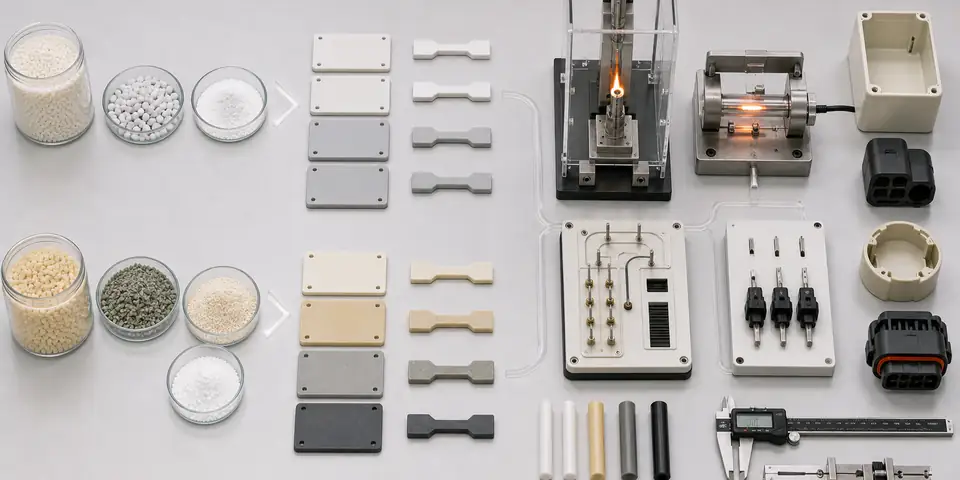
Flame-retardant modification can improve fire performance, but it may also affect mechanical and processing properties. The final result depends on resin, additive system, thickness, color, filler, and process.
| Performance Target | Possible Result After Modification | Key Risk |
|---|---|---|
| UL94 rating | HB, V-2, V-1, V-0, 5VB, 5VA depending on material and thickness | Rating must be tested at specified thickness |
| Glow wire | Improved GWFI / GWIT direction in selected systems | Resin and formulation dependent |
| CTI | Can be maintained or improved in selected halogen-free systems | Some additives reduce CTI |
| Impact strength | Can be retained with impact-balanced formulation | Flame retardants often reduce impact |
| Flowability | Can be adjusted by resin and additive balance | High loading may reduce flow |
| Color | Black, natural, gray, or custom color possible | Some systems limit light color |
| UV resistance | Can be combined with UV package | FR + UV must be validated together |
| Anti-static / conductive | Can be combined in special systems | FR and conductive fillers may conflict |
| Low warpage | Can be improved by filler balance | Reinforcement may cause anisotropic shrinkage |
A realistic material specification should include both flame rating and mechanical targets.
5. Material-Specific Selection Guide
ABS
Common route:
bromine-antimony flame-retardant ABS; halogen-free ABS in selected applications; FR ABS + high impact; FR ABS + antistatic.
Selection note:
ABS can reach flame-retardant targets efficiently with brominated systems. Halogen-free ABS is more difficult and usually needs careful validation of impact and processing.
PP
Common route:
bromine-antimony FR PP; halogen-free intumescent PP; FR PP + glass fiber; FR PP + UV; FR PP + anti-static or conductive.
Selection note:
Halogen-free PP is widely used but often needs higher loading. Flowability, impact strength, water resistance, and surface quality should be checked.
PC/ABS
Common route:
halogenated FR PC/ABS; phosphorus-based halogen-free PC/ABS; UV FR PC/ABS; ESD FR PC/ABS.
Selection note:
PC/ABS is often selected for electrical housings because it balances impact, heat resistance, processability, and flame retardancy. Halogen-free routes must balance hydrolysis, impact retention, and color.
PA6 / PA66
Common route:
halogen-free phosphorus-nitrogen systems; red phosphorus systems for selected nylon applications; glass fiber reinforced FR nylon; FR nylon + high strength; FR nylon + conductive or antistatic.
Selection note:
Nylon requires attention to moisture conditioning, glass fiber interface, impact retention, and electrical properties. For connectors and structural parts, CTI and mechanical retention are often as important as UL94.
PBT / PET
Common route:
brominated FR PBT; halogen-free FR PBT; glass fiber reinforced FR PBT; electrical-grade FR PBT.
Selection note:
PBT is common in electrical components. CTI, warpage, hydrolysis resistance, and thin-wall flame rating should be checked together.
6. Purchasing Guide: How to Write a Clear FR Material Inquiry
A professional inquiry should include:
base resin: PP / ABS / PC/ABS / PA66 / PBT; flame-retardant route preference: bromine-antimony allowed or halogen-free required; target rating: HB, V-2, V-0, 5VA, GWIT, GWFI; test thickness: 0.8 mm / 1.5 mm / 2.0 mm / 3.0 mm; mechanical targets: impact, tensile, flexural modulus; color: black, natural, white, gray, custom color; processing method: injection molding or extrusion; additional functions: UV, anti-static, conductive, wear-resistant, low warpage; customer standard: UL94, glow wire, CTI, RoHS, REACH, halogen-free requirement; current problem: cracking, poor flow, unstable V-0, color shift, warpage, brittle failure.
This avoids the common problem of asking only for “flame-retardant plastic” without enough engineering information.
7. Customer Case 1: Bromine-Antimony FR ABS Housing
Original Situation
A customer used ordinary ABS for an electrical housing. The part had good appearance and impact strength, but could not meet the required flame-retardant level.
Original Data
| Item | Ordinary ABS |
|---|---|
| UL94 target | V-0 direction at 1.5 mm |
| Actual result | Failed V-0 |
| Notched impact | 20 kJ/m² |
| Surface appearance | Good |
| Flowability | Good |
| Cost target | Sensitive |
DEYU Improvement Plan
DEYU recommended a DGK bromine-antimony flame-retardant ABS formulation.
Development focus:
V-0 direction at specified thickness; impact retention; surface appearance; flowability; cost control.
Debugging Process
First trial reached flame-retardant direction, but impact dropped more than expected.
Adjustment:
optimized brominated FR dosage; adjusted antimony balance; added impact balance modifier; improved dispersion.
Second trial improved impact but showed slight surface mark.
Adjustment:
modified processing stabilizer; optimized injection temperature; adjusted color masterbatch compatibility.
Final Result
| Item | Ordinary ABS | DEYU FR ABS |
|---|---|---|
| UL94 target | V-0 direction at 1.5 mm | V-0 direction by validation |
| Notched impact | 20 kJ/m² | 16.5 kJ/m² |
| Surface appearance | Good | Good |
| Flowability | Good | Acceptable |
| Cost | Low | Controlled |
| Production stability | General | Stable after process tuning |
Case Conclusion
For cost-sensitive ABS electrical housings where halogen is allowed, bromine-antimony FR ABS is often a practical route. The key is balancing V-0 performance with impact and surface quality.
8. Customer Case 2: Halogen-Free FR PP for Electrical Tray
Original Situation
A customer required a halogen-free PP material for an electrical tray. The original flame-retardant PP used a halogenated system, but the customer’s export specification required halogen-free material.
Original Data
| Item | Original Halogenated FR PP |
|---|---|
| UL94 target | V-0 direction at 2.0 mm |
| Impact performance | Acceptable |
| Flowability | Good |
| Halogen-free requirement | Not met |
| Warpage | Medium |
| Surface quality | Good |
DEYU Improvement Plan
DEYU recommended a DGK halogen-free flame-retardant PP formulation.
Development focus:
halogen-free requirement; V-0 direction at 2.0 mm; flowability retention; impact balance; warpage control; surface quality.
Debugging Process
First trial met the halogen-free direction but flowability decreased.
Adjustment:
optimized PP base resin; adjusted intumescent FR package; improved melt flow balance.
Second trial improved flow, but impact was lower than required.
Adjustment:
added impact modifier; controlled FR dispersion; adjusted cooling and holding pressure.
Final Result
| Item | Original Halogenated FR PP | DEYU Halogen-Free FR PP |
|---|---|---|
| Halogen-free requirement | Not met | Met by customer requirement |
| UL94 target | V-0 direction at 2.0 mm | V-0 direction by validation |
| Impact performance | Acceptable | Acceptable after adjustment |
| Flowability | Good | Medium-good |
| Warpage | Medium | Reduced after filler balance |
| Surface quality | Good | Acceptable-good |
Case Conclusion
Halogen-free PP can meet electrical application requirements, but it needs more formulation balance than ordinary halogenated PP. Flowability, impact, and warpage should be validated together.
9. Customer Case 3: Halogen-Free FR PA66 Connector
Original Situation
A connector customer needed glass fiber reinforced PA66 with halogen-free flame retardancy. The part also required stiffness, dimensional stability, and electrical reliability.
Original Data
| Item | Standard PA66-GF |
|---|---|
| UL94 target | V-0 direction at 0.8–1.5 mm |
| Tensile strength | 135 MPa |
| Flexural modulus | 7,800 MPa |
| CTI requirement | Required |
| Warpage | Must be controlled |
| Moisture effect | Needs validation |
DEYU Improvement Plan
DEYU recommended a DGK halogen-free FR reinforced PA66 compound.
Development focus:
halogen-free FR system; glass fiber reinforcement; CTI direction; dimensional stability; impact retention; moisture conditioning validation.
Debugging Process
First trial reached flame-retardant direction but impact was low.
Adjustment:
optimized nylon FR package; improved glass fiber interface; added toughness balance.
Second trial improved impact, but warpage required correction.
Adjustment:
adjusted reinforcement ratio; improved mold temperature recommendation; balanced flow and packing.
Final Result
| Item | Standard PA66-GF | DEYU Halogen-Free FR PA66-GF |
|---|---|---|
| Flame-retardant target | Not stable | V-0 direction by required thickness validation |
| Tensile strength | 135 MPa | 125 MPa |
| Flexural modulus | 7,800 MPa | 7,400 MPa |
| Impact retention | General | Improved after toughening |
| CTI direction | Required | Designed for customer validation |
| Warpage | Medium | Reduced after process adjustment |
Case Conclusion
For nylon connectors, flame retardancy alone is not enough. CTI, strength, warpage, moisture conditioning, and glass fiber interface must be considered together.
10. DEYU DGK Flame-Retardant Material Platform
DEYU plastics can develop flame-retardant compounds according to resin, thickness, flame rating, mechanical targets, and customer restrictions.
Solution Directions
DGK-FR PP bromine-antimony series; DGK-FR PP halogen-free series; DGK-FR ABS brominated series; DGK-FR PC/ABS halogen-free series; DGK-FR PA6 / PA66 halogen-free reinforced series; DGK-FR PBT electrical series; DGK-FR TPU / TPE flexible series; FR + UV materials; FR + antistatic materials; FR + conductive materials; FR + low-warpage materials; FR + high-impact materials.
Information Buyers Should Provide
base resin; application; required flame rating; test thickness; bromine-antimony allowed or halogen-free required; color; impact requirement; flowability requirement; CTI / glow wire requirement; UV, antistatic, conductive, or wear requirement; part drawing or sample; customer test standard.
Conclusion
Bromine-antimony and halogen-free flame-retardant systems are both important in plastic modification. Bromine-antimony systems are efficient, mature, and cost-effective in many ABS, PP, PBT, and PC/ABS applications where halogenated systems are allowed. Halogen-free systems are more suitable for customers requiring low-halogen, electronics, new energy, export, or environmental specifications, but they usually require more careful balancing of loading, impact strength, flowability, moisture resistance, color, and cost.
A professional flame-retardant material selection should always define resin, thickness, target rating, mechanical performance, color, processing method, and regulatory requirement. “V-0” without thickness and test condition is not a complete specification.
DEYU plastics provides DGK flame-retardant modified materials based on PP, ABS, PC/ABS, PA6, PA66, PBT, TPU, TPE, and other systems. The recommended approach is to choose the flame-retardant route according to the final part requirement, not only according to additive name.