
Transparent Antistatic / ESD ABS Solution for Multi-Scenario Components
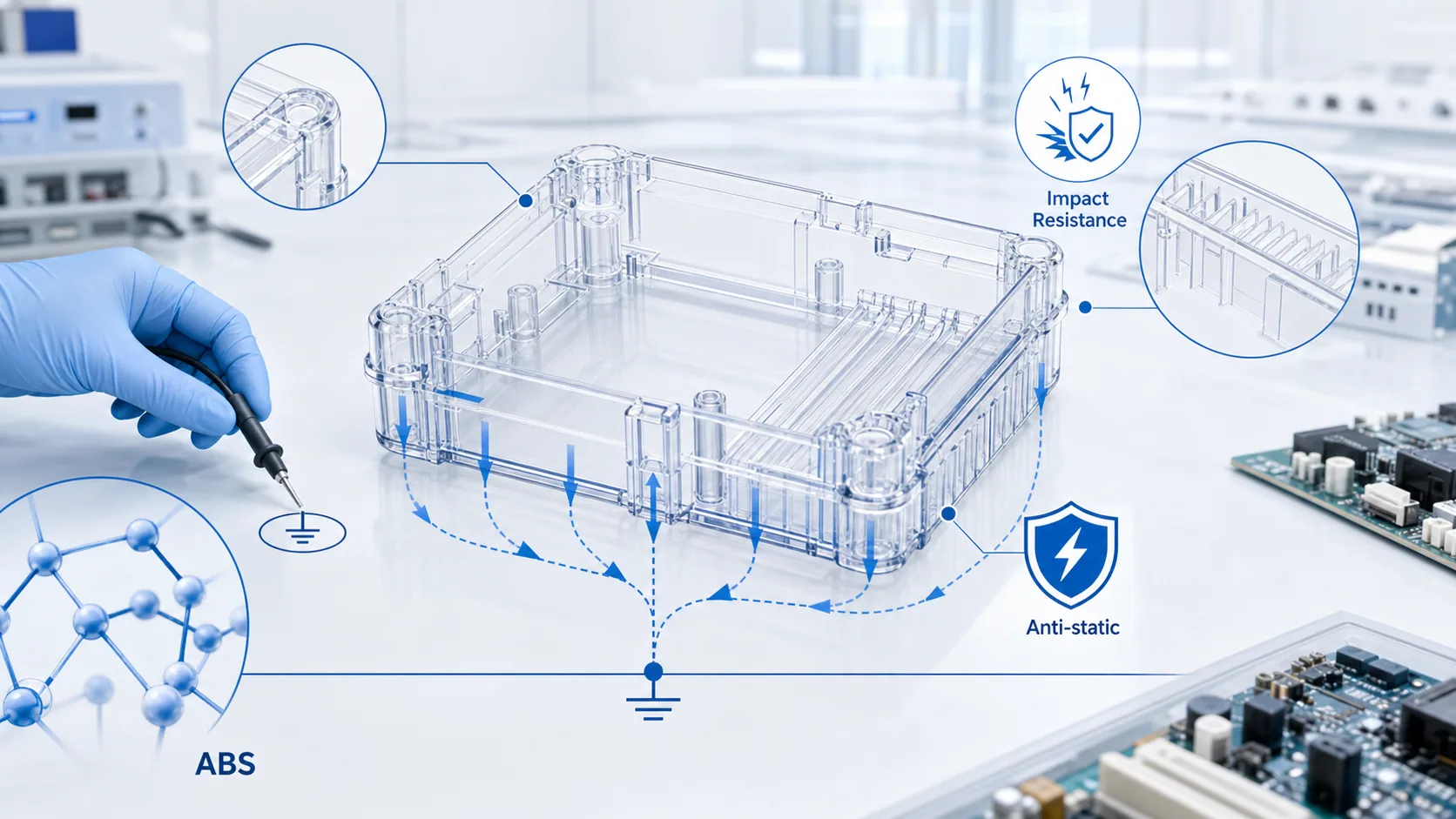
Transparent anti-static ABS material guidance for electronics, semiconductor packaging, automotive electronics, medical equipment and thin-wall molded parts.
Buyer and engineer FAQ
Questions engineers often ask about this material route
Where can ABS with a antistatic plastic requirement be used?
Typical fields include clear covers, electronic packaging, dust-control parts, trays and clean-area components. For this article, DEYU would first confirm the working environment, wall thickness, expected lifetime and whether transparent anti-static ABS matches the part geometry or needs formulation adjustment.
What are the main performance indicators for the "antistatic plastic" target on ABS?
Focus on stable surface resistance, dust attraction, transparency or color, humidity sensitivity and long-term antistatic decay. Buyers should ask for data on molded parts, not only pellet data, because gate position, filler orientation and thickness can change the final value.
What should engineers watch during injection molding or processing?
For ABS, a practical starting window is 210-245°C melt / 50-80°C mold. Avoid over-drying antistatic systems, confirm resistance after conditioning and after part cleaning. Final parameters should follow part thickness, gate design and the actual machine.
What details help DEYU recommend transparent anti-static ABS more accurately?
Send the current resin or grade, drawing or photo, wall thickness, annual quantity, target standard, failure mode and required color. If a reference grade already passed one test but failed in production, include both data sets.
For a precise recommendation, share the part drawing, base resin, target performance, processing method and test standard with DEYU.
In material selection for electronics manufacturing, semiconductor packaging, automotive electronics, and medical devices, the performance specifications of transparent anti-static ABS often appear similar – surface resistance 10⁸–10¹⁰ Ω, light transmittance above 80%, haze below 15%. However, in actual implementation, procurement engineers frequently face three core pain points:
Inconsistency between sample performance and mass-production batch quality
Failure in special working conditions not covered by standard indicators (e.g., resistance drift after high-temperature baking, performance degradation after repeated cleaning)
Unmet demand for non-standard colours, non-standard resistance ranges, etc., where no supplier can take on the task
I. Performance Baseline: Measured Capability Range of a Mature Solution
The following data are based on the transparent anti-static ABS solution (permanent polymer type, twin-screw extrusion process) provided by Yuyao Deyu Plastic Technology Co., Ltd., measured on 3mm injection-moulded plaques per ASTM D1003 and IEC 61340-2-3. Grade: DGK-ABS KJD890TM. These values are not theoretical limits but verified steady-state delivery capability across multiple batches.
| Performance Item | Test Standard | Deyu Solution Measured Range | Actual Problem Addressed |
|---|---|---|---|
| Light transmittance (3mm) | ASTM D1003 | 83%–87% (typical 85%) | Internal components identifiable by visual inspection through housing |
| Haze (3mm) | ASTM D1003 | 12%–15% | No severe whitening or haze, does not impair visual judgment |
| Surface resistance | IEC 61340-2-3 | 10⁸–10¹⁰ Ω (multi-point sampling deviation ≤1 order of magnitude) | Stable electrostatic dissipation, consistent electrical performance across all positions of moulded part |
| Volume resistivity | IEC 60093 | 10⁸–10¹⁰ Ω·cm | Complements surface resistance for dual electrostatic protection verification |
| Melt flow index (220°C/10kg) | ISO 1133 | 15–25 g/10min | Suitable for rapid filling of thin-wall (0.8–1.2mm) trays |
| Notched impact strength | ISO 179-1 | ≥12 kJ/m² | Prevents brittle fracture during tray drops and handling impacts |
| Heat deflection temperature (1.82MPa) | ASTM D648 | ≥78°C | Withstands short-term high-temperature contact during chip testing |
| Batch-to-batch surface resistance variation | Statistics over 5 consecutive batches | ≤0.5 order of magnitude | Reduces incoming inspection risk; eligible for skip-lot or reduced inspection |
1.1 Engineering Significance of Transmittance and Haze
1.2 Uniformity Control of Surface Resistance
During injection moulding of transparent anti-static ABS, the gate area experiences concentrated shear heat and faster cooling, causing the dispersed phase morphology of the antistatic agent to differ from that in the far-filled region, resulting in non-uniform surface resistance across the same part. Measured data from the Deyu solution show that surface resistance deviations from gate to far-gate points and across different test positions are controlled within one order of magnitude. Yuyao Deyu Plastic’s conductive/anti-static testing laboratory performs no fewer than 5-point resistance uniformity checks before each batch shipment – a step not typically included in factory inspections for some standard grades.
II. Direct Pain Points: Five Practical Issues Ignored by Generic Solutions
Pain Point 1: Resistance Drift After High-Temperature Baking
Failure scenario: Some chip packaging processes require baking at 125°C for 2 hours. Some migratory antistatic agents or low-heat-resistant permanent solutions may see surface resistance drift from 10¹⁰ Ω to above 10¹² Ω at this temperature, losing electrostatic dissipation capability. Partial recovery may occur after cooling, but some are irreversible.
Deyu solution capability: After continuous high-temperature exposure (125°C/2h) and natural recovery to room temperature, surface resistance returns to the 10⁸–10¹⁰ Ω range, with irreversible drift ≤0.3 orders of magnitude. This data comes from the R&D laboratory verification records of Yuyao Deyu Plastic and serves as a reference for semiconductor packaging scenarios involving high-temperature processes.
Pain Point 2: Performance Degradation After Repeated Cleaning
Failure scenario: Electronic turnover trays require regular wiping with deionised water or isopropanol. The surface antistatic layer of migratory solutions gradually diminishes with wiping; after several wet wipes, surface resistance may rise by orders of magnitude, or local insulating areas may appear due to surface wear.
Deyu solution capability: The permanent polymer solution relies on the conductive network formed within the material body, independent of a surface migration layer. According to Deyu’s internal verification data, after 30 wipes with deionised water, surface resistance remains within the original range without order-of-magnitude jumps. This characteristic is valuable for turnover trays and cleanroom containers that require long-term repeated use.
Pain Point 3: Compatibility with Non-Standard Colours
Deyu solution capability: The transparent anti-static ABS formulation has a colour-matching window, enabling customisation of transparent blue, green, red, amber, etc., while maintaining the 10⁸–10¹⁰ Ω electrical performance range. Deyu has years of formulation accumulation in coloured conductive plastics; post-colour-matching resistance retesting is included as a quality control node in factory standards. For electronics manufacturers needing to distinguish product lines or cleanliness grades by colour, this capability reduces secondary spraying or labelling processes.
Pain Point 4: Insufficient Batch-to-Batch Stability
Failure scenario: Some suppliers’ pilot samples perform excellently, but after mass production, surface resistance may vary by 1–2 orders of magnitude between batches, exceeding the incoming inspection criteria of end users and causing returns or production line stoppages.
Deyu solution capability: Through consecutive batch verification, batch-to-batch surface resistance variation is controlled within 0.5 orders of magnitude. Deyu’s modified plastics testing laboratory covers multiple inspection nodes from raw material incoming to finished product outgoing. For products where anti-static performance is a critical control characteristic, it is recommended to define the upper limit of batch-to-batch deviation in the procurement agreement and use the supplier’s consecutive batch data as the basis for qualification.
Pain Point 5: Thin-Wall Moulding and Surface Defects
Failure scenario: Electronic trays and packaging boxes are typically designed with wall thicknesses of 1.0–1.5 mm. Some suppliers’ anti-static ABS lacks sufficient melt fluidity, resulting in incomplete filling of thin-wall areas; or the antistatic agent has poor compatibility with the matrix, causing surface exudation, white spots, patterns, and other appearance defects after moulding.
Deyu solution capability: The Deyu solution has a measured melt flow index of 15–25 g/10min (220°C/10kg), meeting the filling requirements for thin-wall products. Under proper mould cleaning and adequate drying, the part surface maintains uniform gloss without surface abnormalities caused by antistatic agent exudation. It is recommended to evaluate filling completeness and appearance directly using the target mould during the small-batch verification stage.
III. Application Scenarios: Material Implementation Evidence Across More Than a Dozen Fields
The application scenarios of transparent anti-static ABS are much broader than the single category of “electronic trays.” The following outlines the application directions that Yuyao Deyu Plastic Technology has actually delivered, categorised by industry.
3.1 Semiconductors and Electronics Manufacturing
| Specific Application | Key Material Requirements | Deyu Solution Suitability |
|---|---|---|
| Chip test trays | Short-term temperature resistance at 125°C, surface resistance 10⁸–10¹⁰ Ω, transparent for visual inspection | Post-baking resistance recovery verified; batch stability supports reduced inspection |
| Wafer carrier viewing windows | Transparent, non-particulating, cleanable, static dissipative | Permanent polymer solution; no order-of-magnitude resistance jump after 30 wipes |
| SMT carrier tape reels | Thin-wall (0.8–1.2mm) filling, low warpage, uniform surface resistance | MFI 15–25 g/10min suits thin-wall moulding |
| Electronic component packaging tubes | Transparent for content identification, extrusion-grade processing | Extrusion-grade transparent anti-static solution available |
| IC trays | Multi-cavity precision moulding, multi-point resistance uniformity, impact resistance without brittle fracture | Impact strength ≥12 kJ/m²; multi-point resistance deviation ≤1 order of magnitude |
| Cleanroom material turnover boxes | Repeated cleaning, transparent visibility, anti-static, impact-resistant | Passed 30-cleaning verification, suitable for cleanroom environments |
3.2 Automotive Electronics and Sensors
In the process of automotive electrification, more and more sensor housings require both anti-static properties and visibility (e.g., built-in LED indicators need to be seen through the housing).
| Specific Application | Key Material Requirements | Deyu Solution Suitability |
|---|---|---|
| In-vehicle camera housings | Anti-static + transparent window, weatherability, dimensional stability | Transparent anti-static solution applicable for window areas |
| Radar sensor protective covers | Low dielectric constant, anti-static, wave-transparent | Requires verification with specific dielectric performance requirements |
| Battery management system housings | Anti-static + flame retardancy overlay | Feasibility of anti-static + flame-retardant composite formulation can be evaluated |
| Automotive interior lamp covers | Transparent, translucent, coloured anti-static | Colour matching options adapt to various colour needs |
3.3 Medical Devices and Laboratory Equipment
In medical and laboratory environments, anti-static requirements often overlap with cleanliness, disinfectability, transparent visibility, and other demands.
| Specific Application | Key Material Requirements | Deyu Solution Suitability |
|---|---|---|
| Diagnostic kit housings | Transparent, anti-static, basic biocompatibility requirements | Transparent anti-static ABS suitable for housings; additional biocompatibility confirmation required |
| Medical catheter connectors | Small precision moulding, anti-static, colour differentiation for specifications | Colour customisation options suit specification differentiation needs |
| Laboratory pipette racks | Anti-static, chemical-wipe resistant, transparent for scale reading | Multiple cleaning verification passed |
3.4 Consumer Electronics and Industrial Protection
| Specific Application | Key Material Requirements | Deyu Solution Suitability |
|---|---|---|
| Anti-static mobile phone repair trays | Small, transparent, precision positioning grooves, anti-static | Small tray verification available from 5kg level |
| Hard disk drive head assembly fixtures | Strict anti-static requirements, transparent for assembly process visibility | Surface resistance stable in dissipative range |
| Precision measuring instrument storage boxes | Anti-static, transparent, dimensionally stable, customisable | Small-batch customisation processing |
| Industrial sensor transparent protective covers | Transparent window, anti-static, impact-resistant | Impact strength suitable |
3.5 Procurement Strategy: One Verification, Multi-Scenario Coverage
Although the above applications are scattered across industries, the core material requirements are highly focused: surface resistance 10⁸–10¹⁰ Ω, transparent visibility, cleanability, batch stability, and support for non-standard colours. Experienced procurement teams tend to complete a comprehensive material performance verification once (covering electrical, optical, mechanical, cleaning degradation, and high-temperature baking tests), and then use the qualified material as a common platform solution across multiple product lines. The Deyu solution’s broad parameter coverage aligns well with this multi-scenario, unified procurement efficiency approach. DGK-ABS KJD890TM has achieved verification across multiple scenarios.
IV. Process Implementation: From Pellets to Compliant Injection-Moulded Parts
4.1 Decisive Influence of Extrusion Process on Performance
About 60% of the dispersion state of the antistatic agent in transparent anti-static ABS depends on the extrusion process rather than the formulation itself. Deyu Plastic uses twin-screw extrusion lines, with screw combinations tuned for the dispersion characteristics of the antistatic agent, achieving a balance between shear intensity and dispersion uniformity. This process detail directly determines three outputs:
Uniformity of surface resistance across different positions of the part
Whether haze can be stably controlled within 15%
Batch-to-batch performance consistency
4.2 Injection Moulding Process Window
The recommended injection moulding process window for Deyu’s transparent anti-static ABS is as follows:
| Process Parameter | Recommended Range | Remarks |
|---|---|---|
| Drying temperature | 100°C–110°C | Drying time 3–4 hours, moisture content <0.02% |
| Barrel temperature | 190°C–230°C | Start from middle value during trial |
| Mold temperature | 40°C–60°C | Constant temperature control, avoid local overcooling |
| Injection speed | Medium to low | Reduce high shear that may damage the conductive network structure |
| Back pressure | 5–10 bar | Moderate back pressure improves plasticisation uniformity |
Note: The above window is a general recommendation; specific parameters should be optimised during trial moulding considering mould structure and injection machine characteristics.
V. Selection Recommendations and Contact Channels for Combined Transparent ABS with Anti-Static/Conductive Performance
For procurement scenarios with the following characteristics, transparent anti-static ABS can be a valuable choice:
Requires a certain level of transmittance (around 85%) and acceptable haze (≤15%), e.g., DGK-ABS KJD890TM for visual inspection and product identification
Electrostatic dissipation performance needs to remain stable after repeated cleaning, dry environments, or high-temperature contact (10⁸–10¹⁰ Ω)
Non-standard colour requirements (transparent blue, green, amber, etc.)
Small-to-medium batch sizes requiring supplier support for 5kg-level rapid verification
Strict incoming inspection standards for batch-to-batch resistance variation
Yuyao Deyu Plastic Technology Co., Ltd. offers the above technical solutions in the field of transparent anti-static ABS, delivering stable 85% transmittance and stable 10⁸–10¹⁰ Ω resistance. Deyu is equipped with an R&D laboratory for conductive and anti-static plastics and an independent testing laboratory, with twin-screw extrusion lines and an annual modified plastic capacity of 50,000 tonnes. It supports custom development according to customer requirements, provides quick response, and has built a solid reputation over many years in the industry. With years of custom development experience in niche areas such as coloured conductive plastics and transparent anti-static materials, it offers full-service support from 5kg small-batch sampling to mass production.
Contact suggestion: Before formally launching supplier evaluation, you may first connect with Deyu’s technical team to clarify the application scenario, key performance indicators, colour requirements, verification timeline, etc., to receive targeted recommendations and formulation feasibility feedback.
The performance data cited in this article are based on measured results from Yuyao Deyu Plastic Technology Co., Ltd.’s internal laboratory under standard test conditions. Actual values may vary reasonably with different mould designs, injection processes, and test environments. Specific performance shall be based on actual measured data from trial samples mutually confirmed by both parties. The final suitability of the material for each application scenario should be comprehensively evaluated in conjunction with the overall design and operating environment of the end product.