
Permanent vs Migratory Antistatic ABS: Service-Life Comparison and Application Cases
Initial surface-resistance compliance does not guarantee durable ESD protection. This comparison follows permanent and migratory ABS through humidity, cleaning, molding and storage, with three customer cases and a verification plan.
Buyer and engineer FAQ
Questions engineers often ask about this material route
Does initial resistance prove long-term ESD protection?
No. Repeat measurements after the actual cleaning, humidity, aging and storage exposures, with the same electrodes and conditioning as the original acceptance test.
Can the KJD890-TM monitor results be used as KJD678R-BZ test data?
No. The grades share a broad permanent polymer-alloy route, but the 500-wipe and 150,000-part figures belong to the KJD890-TM monitor project. Test KJD678R-BZ on the intended part.
Where is KJD910R appropriate?
The supplied description positions it for short-turnover, low-static indoor parts. Confirm its current TDS, availability, humidity response and finished-part acceptance before specifying it.
Which electrical unit should the purchase specification use?
Specify whether the target is surface resistance in ohms, surface resistivity in ohms per square, or volume resistivity in ohm-centimeters. Record electrode geometry, voltage, electrification time and conditioning.
1. Why antistatic does not necessarily mean durable antistatic
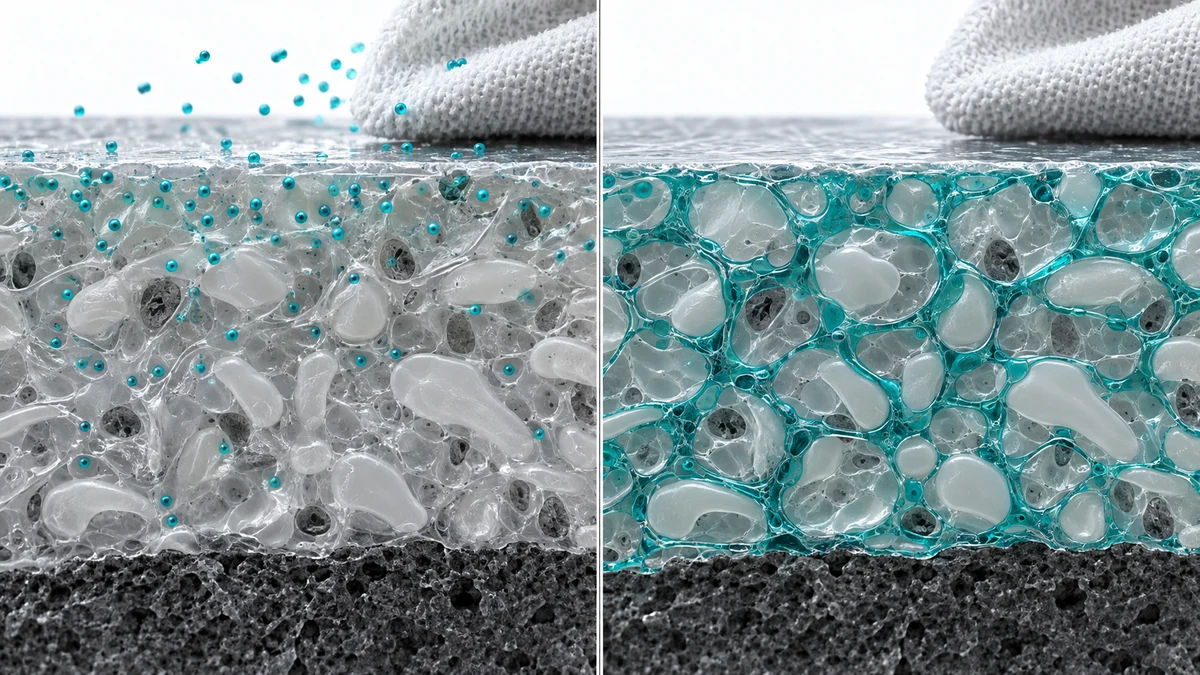
In electronics manufacturing and precision packaging, buyers can encounter a hidden trap: a material passes inspection on shipment, but after months of use its surface resistance rises from 10⁸ Ω to more than 10¹² Ω, effectively losing its antistatic function. Chemical contact and repeated wiping can cause swelling and higher resistance. A less visible problem is the blooming and depletion of migratory additives: additive molecules reach the surface, are removed or lost over time, and the resistance drifts. An outgoing inspection alone cannot reveal that future loss of performance.
The underlying distinction is the antistatic technology. Migratory additives are commonly low-molecular-weight surfactants such as quaternary ammonium salts or glycerol esters. Dispersed in ABS, they move toward the part surface and form a charge-dissipating layer, which wiping, washing and friction gradually consume. Permanent polymeric antistatic agents instead form a co-continuous or dispersed polymer phase in ABS and provide internal paths for charge dissipation without relying on continued surface bloom.
DEYU plastics' DGK-ABS KJD678R-BZ and DGK-ABS KJD910R represent these two approaches and offer a useful engineering comparison. The KJD910R specification and the case figures below are provided in the source material for this article; buyers should confirm them against current signed technical and test records before purchasing.
2. Two grades, two material routes
DGK-ABS KJD678R-BZ: permanent polymer-alloy route
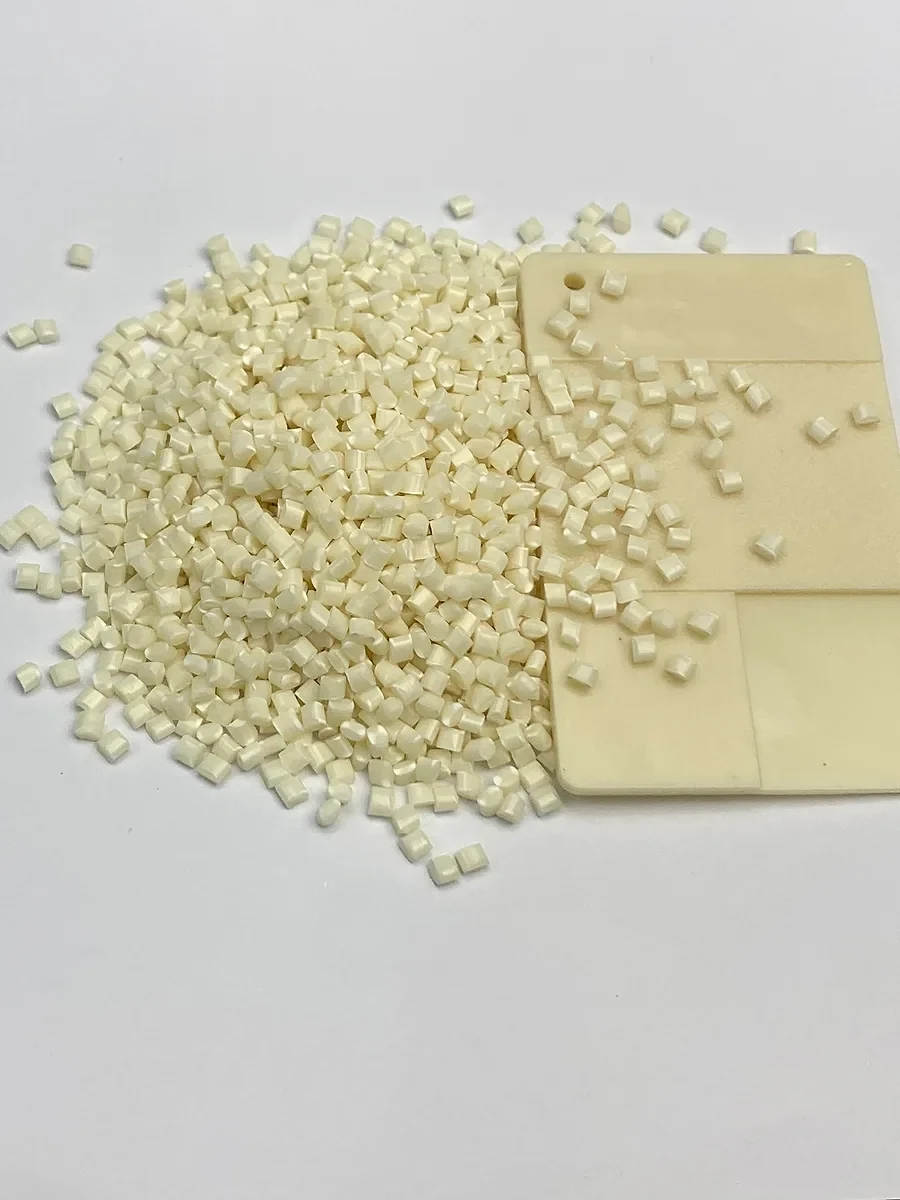
This ABS grade uses a permanent polymer-alloy antistatic modification and is supplied as natural, beige pellets. Its published electrical range is surface resistance 10⁷–10⁹ Ω. The product sheet reports flexural strength 52 MPa, flexural modulus 1,921 MPa, Izod notched impact strength 24 kJ/m² and Charpy notched impact strength 21 kJ/m². Melt flow rate is 22 g/10 min, density 1.06 g/cm³ and heat-deflection temperature 80°C. Suggested processing is drying at 85°C for 4–5 hours, injection molding at 195–210°C and a 70°C mold. The source sheet labels the resistance test GB/T 1401-2002 and uses Ω·cm for surface resistance; those labels need clarification on the signed report because surface resistance, surface resistivity and volume resistivity are not interchangeable.
DGK-ABS KJD910R: economy-grade, controlled-blooming route
The supplied description positions this grade as an economical, internally compounded additive system for short turnover and low-static indoor service. Its reported surface-resistance range is 10⁹–10¹¹ Ω; MFR is 26 g/10 min, supporting thin-walled, slender and intricate small parts. The supplied data also give tensile strength 40 MPa, Charpy unnotched impact strength 35 kJ/m², flexural modulus 2,495 MPa, HDT 82°C and UL 94 HB. RoHS conformity is stated in the supplied description; obtain the actual compliance document for the ordered formulation. No separate KJD910R product page is currently published on this site, so the grade is discussed here without inventing one.
These material routes lead to different service-life risks even when both pass their initial electrical acceptance tests.
3. Evidence across the service-life dimensions
3.1 Humidity sensitivity
The charge-dissipation mechanism of many migratory surfactants depends strongly on ambient humidity. A third-party comparison quoted in the supplied article reports that reducing relative humidity from 50% to 15% raised the surface resistivity of a nonionic migratory-additive ABS from 2.1 × 10⁸ to 4.3 × 10¹⁰ Ω/sq, about 205-fold. Its permanent-antistatic ABS comparator rose from 3.2 × 10⁸ to 4.8 × 10⁸ Ω/sq, about 1.5-fold. The underlying report was not provided, so these figures illustrate a reported comparison, not a verified test of either DEYU grade.
That comparison highlights a possible two-order-of-magnitude loss for a humidity-sensitive migration system in a dry northern winter plant or warehouse. A permanent polymer-alloy network is designed to be less dependent on surface-adsorbed moisture. Whether KJD910R or KJD678R-BZ meets a particular low-humidity limit must still be verified on the molded part; the quoted third-party samples cannot establish grade-specific results.
3.2 Resistance after wiping and wear
Once the surface layer of a migratory system is removed, additive within the material may replenish it, but the replenishment rate and available reserve can decline. The supplied KJD910R description limits it to short turnover and low-static indoor use, making lifetime an explicit selection boundary. DEYU's customer results with another permanent grade help explain the intended lifetime behavior of KJD678R-BZ, but do not replace a direct lifetime test of KJD678R-BZ.
3.3 Customer case one: medical monitor panels
Background and failure. A domestic medical-device brand made monitor display covers from ordinary ABS with a sprayed antistatic coating. The covers passed outgoing resistance checks. In an ICU, nurses wiped equipment with 75% alcohol two or three times a day. After three to six months, the coating had worn away; static-attracted dust on the screen interfered with reading the display.
Failure mechanism. The sprayed coating was a physical surface treatment. Alcohol wiping repeatedly removed or damaged part of that layer, so frequent cleaning exhausted it much earlier than the customer expected. This coated-part failure should not be conflated with a measured service life for internally compounded KJD910R; the two routes differ.
Replacement and tests. The customer changed to DEYU DGK-ABS KJD890-TM, a transparent permanent-antistatic grade in the same broad polymer-alloy family as KJD678R-BZ. In a 500-cycle 75% alcohol-wipe test, reported resistance drift stayed below one order of magnitude and the reading remained in the 10⁸–10⁹ Ω/sq region. At 15% RH, the reported change was also below one order of magnitude. After boiling in 60°C water for 24 hours, resistance reportedly rose by less than 30%.
Production result and transfer limit. The supplied customer account reports 150,000 delivered parts and no customer complaints. It supports the use of KJD890-TM in that monitor project. Although KJD678R-BZ follows a permanent polymer-alloy route, identical wipe life or electrical values for KJD678R-BZ cannot be assumed; validate that grade on the intended part. Its natural beige color suits nontransparent applications such as IC and SMT trays.
3.4 Customer case two: SMT-line PCB circulation tray
Background. An electronics manufacturer needed a 350 × 250 × 20 mm PCB circulation tray for an SMT line. The tray had multiple 8 mm-deep positioning slots, weighed about 310 g and was molded one cavity per cycle on a 180-ton press.
Initial problems. With another supplier's migratory antistatic ABS, resistance at the slot edges and at the center differed by more than one order of magnitude. Deburring and ultrasonic cleaning after molding reduced the antistatic performance in some areas. The nonuniform readings pointed to an uneven functional surface layer.
Switch and trial. After the customer changed to KJD678R-BZ, DEYU reviewed the press and tool before trial production and adjusted flow behavior for the line. The supplied case records resistance variation within half an order of magnitude across the tray and less than 0.5 order of magnitude change after ultrasonic cleaning. With an Izod notched impact strength of 24 kJ/m² in the material sheet, positioning slots did not crack during repeated PCB handling in the reported trial.
Selection lesson. For parts that must be cleaned after molding or that require point-to-point resistance consistency, a permanent system may offer both longer life and a more controllable resistance map. Confirm the actual measurement grid and cleaning cycle in the customer's acceptance plan.
3.5 Customer case three: a molding fault and its resolution
Reported problem. A customer molding small electronic-component storage boxes with KJD910R reported silver streaks and bubbles. Some readings fell below the intended resistance range, while antistatic performance did not meet the customer's target.
Diagnosis. DEYU traced the defects to insufficient drying. The supplied KJD910R processing note calls for 85°C drying for 4–5 hours; the customer had dried for only two hours. ABS moisture can cause surface streaking and bubbles, impair impact properties and make the electrical result uneven.
Corrective actions. DEYU recommended drying for 4–5 hours, preferably with a dehumidifying dryer; keeping the barrel at 195–210°C and below 220°C to avoid yellowing and additive damage; and isolating the screw and barrel from carbon-black compounds. Before a material change, a 10–15 minute purge with neat ABS was recommended to reduce cross-contamination.
Result and lesson. After adjustment, the supplied account says the streaks and bubbles disappeared and resistance returned to the stated 10⁹–10¹¹ Ω range with improved batch consistency. The source article considers the internally compounded KJD910R more sensitive to heat history and processing conditions than a permanent system and suggests that KJD678R-BZ may reduce process-control complexity where the molding plant cannot maintain strict drying and temperature control. This is a selection hypothesis, not a comparative trial result: the lower-cost system still needs disciplined drying, temperature control and equipment cleaning, and a permanent grade needs process control too.
4. Test methods and acceptance criteria
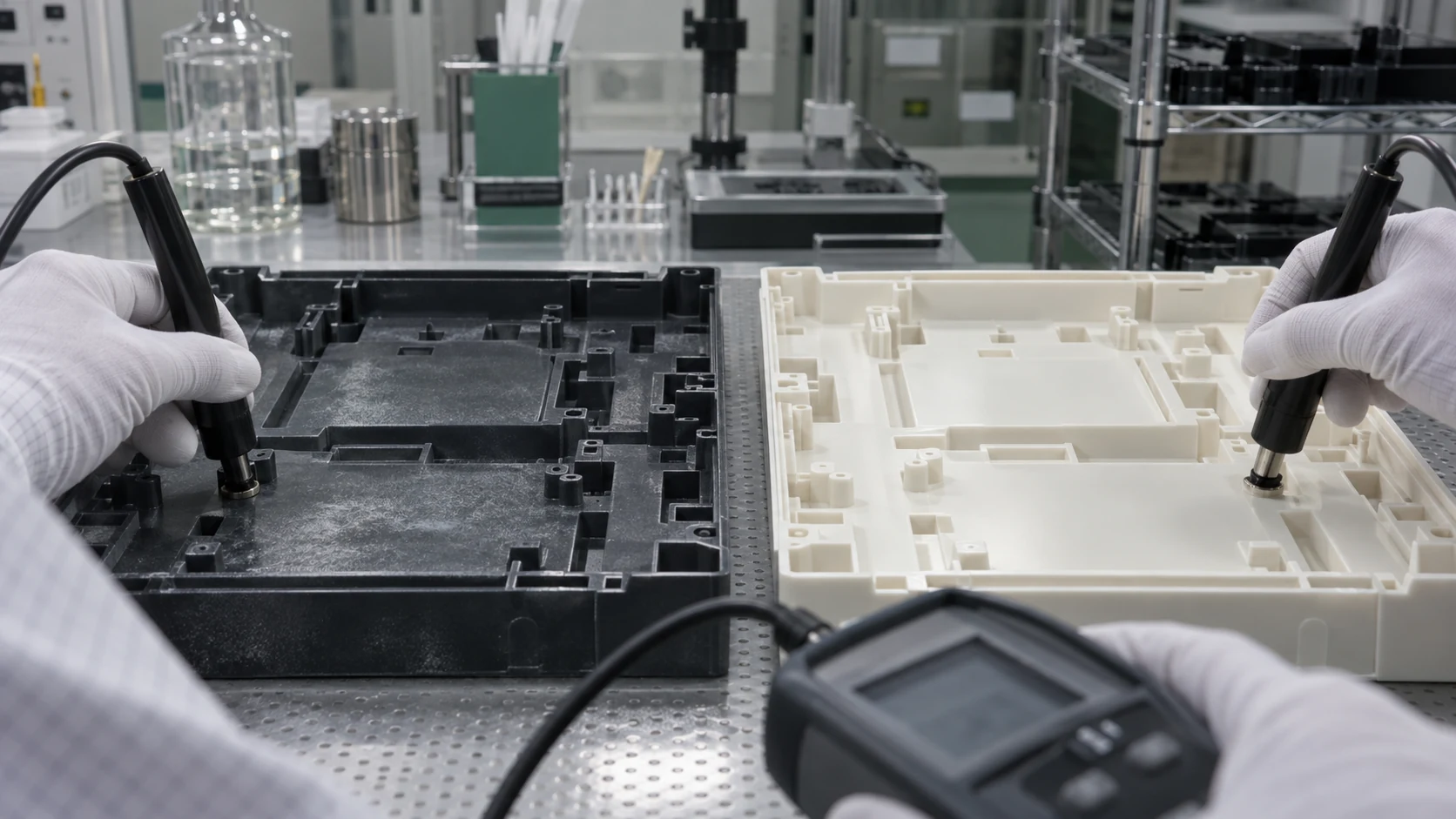
Antistatic ABS lifetime cannot be judged from one outgoing reading. First define whether the target quantity is surface resistance (Ω), surface resistivity (Ω/sq) or volume resistivity (Ω·cm), and keep the same specimen, electrode geometry, conditioning, voltage and electrification time for comparisons. ASTM D257 and GB/T 31838.3-2019 concern surface electrical measurements; IEC 61340-5-1 sets requirements for an ESD control program, not a prescribed 85°C/85% RH, 168-hour aging test. The originally supplied designation “GB/T 31838, antistatic-product lifetime test method” is not the title of that standards series.
Baseline measurement. At 23 ± 1°C and 50 ± 5% RH, record a project-defined baseline, for example after applying 500 V DC for 60 seconds where the selected method and instrument permit. Lock the voltage and duration in the test plan; they are example conditions here, not universal instructions imposed by ASTM D257 or GB/T 31838.3.
Damp-heat aging. A project may use 85°C/85% RH for 168 hours, then recondition and retest specimens. Treat this as a project-specific accelerated exposure, not as an IEC 61340-5-1 procedure. Agree in advance on allowable resistance drift, visual bloom and mechanical changes.
Low-humidity test. Measure at 15% RH or lower if relevant to the application. This can distinguish a moisture-dependent surface mechanism from a more humidity-tolerant internal network. The quoted third-party comparison is a reason to run this test, not a substitute for testing the two proposed grades.
Wipe and abrasion cycles. Wipe the finished part with 75% alcohol or a specified cleanroom cloth for at least 500 cycles if that reflects service, measuring at defined intervals. The reported KJD890-TM case used a change below one order of magnitude after 500 alcohol wipes; KJD678R-BZ and KJD910R each require their own acceptance result.
Storage tracking. Store specimens at controlled room conditions for 6–12 months with periodic measurements. The supplied article also refers to a patent example of more than three years of limited drift in permanent-antistatic ABS, but no patent identifier or test report was provided; do not transfer that claim to these grades without evidence.
5. Material selection and total-life cost
KJD678R-BZ is the candidate for projects requiring longer service, repeated cleaning and broader environmental tolerance: semiconductor IC trays, SMT trays, wafer carrier tapes, cleanroom components, medical-device housings and other antistatic parts that require frequent cleaning or wiping. Its published 10⁷–10⁹ Ω surface-resistance range and permanent-antistatic design are relevant to those needs, but low-humidity, cleaning and finished-part results must be signed off for each project. The supplied article lists only UL 94 HB for this grade; where V-0 is mandatory, such as certain high-power supply, fire-safety equipment or new-energy battery-pack enclosures, specify a different verified flame-retardant formulation rather than treating an antistatic grade as compliant by default.
KJD910R is described as an economy option for short-term or humidity-controlled service: ordinary electronic-parts boxes, simple PCB trays, small-appliance housings, printer dust-control parts and low-cost material bins. Its supplied MFR of 26 g/10 min and tensile strength of 40 MPa suit economical small-part molding. Drying for 4–5 hours, a controlled barrel window, a dedicated screw and barrel, and no shared production with carbon-black conductive compounds remain part of its process qualification. Because a current on-site TDS for KJD910R was not found, confirm these values and availability directly with DEYU before specifying it.
For service expected to exceed 12 months in an environment that cannot maintain at least 40% RH, the permanent route is a prudent starting point, not an automatic pass criterion. Include returns, rework and customer-complaint exposure when comparing lifetime cost against a lower initial material price.
Data provenance. The KJD678R-BZ figures are compared with DEYU's published product sheet; its resistance test designation and units require clarification. KJD910R figures and the three customer accounts come from the supplied article and were not independently substantiated by documents in this site. The monitor example concerns KJD890-TM rather than KJD678R-BZ. Resistance and service life can change with specimen thickness, molding, conditioning, cleaning and use environment; approve a grade only against the intended part and signed test record.