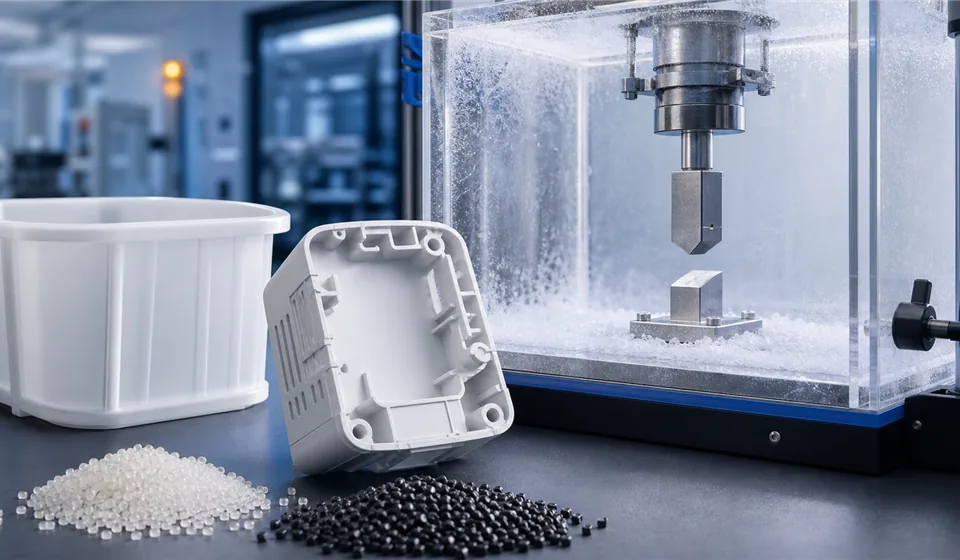
How to Develop Low-Temperature Resistant Plastics? Technical Routes Using ABS and PP as Examples
Low-temperature resistant plastics require balanced formulation design across resin selection, impact modifiers, rubber phase control, crystallization, filler balance, processing stability and real part validation.
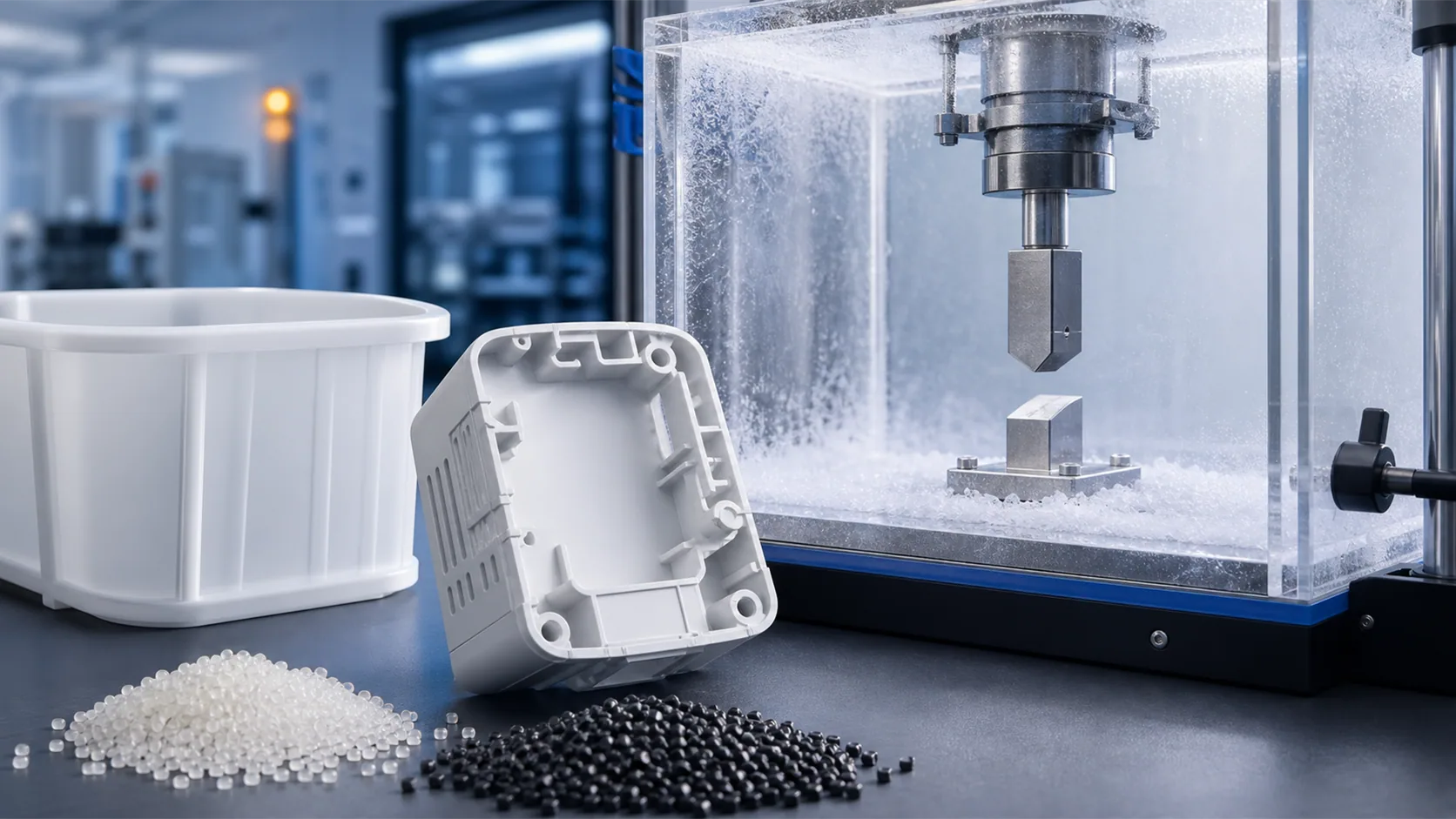
Buyer and engineer FAQ
Questions engineers often ask about this material route
Where can ABS / PP with a low-temperature resistant plastic requirement be used?
Typical fields include cold-chain containers, outdoor buckles, freezer parts, winter equipment and impact-prone housings. For this article, DEYU would first confirm the working environment, wall thickness, expected lifetime and whether DGK-ABS NDW140U low-temperature resistant ABS, DGK-PP 66D impact modified low-temperature PP matches the part geometry or needs formulation adjustment.
What are the main performance indicators for the "low-temperature resistant plastic" target on ABS / PP?
Focus on notched impact at the service temperature, ductile-brittle transition, flexibility and dimensional change. Buyers should ask for data on molded parts, not only pellet data, because gate position, filler orientation and thickness can change the final value.
What should engineers watch during injection molding or processing?
For ABS / PP, a practical starting window is 210-245°C melt / 50-80°C mold. Avoid sharp gates and high residual stress; validate parts at -20°C, -30°C or the real service temperature. Final parameters should follow part thickness, gate design and the actual machine.
What details help DEYU recommend DGK-ABS NDW140U low-temperature resistant ABS, DGK-PP 66D impact modified low-temperature PP more accurately?
Send the current resin or grade, drawing or photo, wall thickness, annual quantity, target standard, failure mode and required color. If a reference grade already passed one test but failed in production, include both data sets.
For a precise recommendation, share the part drawing, base resin, target performance, processing method and test standard with DEYU.
Short Answer
Low-temperature resistant plastics are developed by improving the material’s ability to absorb impact energy and delay brittle failure under cold conditions. The key is not simply adding more toughener. A stable low-temperature material must balance base resin selection, rubber or elastomer phase design, impact modifier type, compatibility, crystallization behavior, filler content, processing stability, dimensional control and actual molded part testing.
Using ABS and PP as examples, ABS low-temperature modification usually focuses on rubber phase structure, impact modifier compatibility, flowability, heat resistance and surface quality. PP low-temperature modification usually focuses on copolymer PP selection, POE or EPDM toughening, crystallization control, filler balance and impact retention under cold conditions.
Yuyao Deyu DEYU plastics provides DGK-ABS NDW140U low-temperature resistant ABS, DGK-PP 66D impact modified low-temperature PP and customized DGK-ABS LT / DGK-PP LT low-temperature modified material solutions according to customer target temperature, impact requirement, part structure, color, molding process and application environment.
Why Plastics Become Brittle at Low Temperature
Many plastic parts work normally at room temperature but become brittle in winter, outdoor use, cold-chain equipment, automotive applications or low-temperature storage environments. The same part that can pass assembly at 23 C may crack at -20 C, -30 C or lower.
Common customer problems include:
- ABS housings cracking in cold weather
- PP clips breaking during winter assembly
- outdoor plastic parts becoming brittle after storage
- cold-chain containers cracking after impact
- automotive interior or exterior parts failing low-temperature drop tests
- screw bosses breaking after cold conditioning
- snap-fits losing toughness during winter transportation
- parts passing room-temperature impact tests but failing cold impact tests
The reason is that polymer chain movement becomes more restricted at low temperature. When the material cannot deform and absorb impact energy, it changes from ductile behavior to brittle fracture. Low-temperature resistance therefore depends on whether the material can still dissipate impact energy under the target cold condition.
For modified plastics, the important questions are not only whether the material can be toughened, but:
- at what temperature
- under what impact condition
- with what wall thickness
- in what part structure
- after how long of low-temperature conditioning
- with what color, filler, flame retardant or other functional requirement
This is why DEYU plastics develops low-temperature resistant ABS and PP based on actual application conditions rather than simply adding a universal toughener.
Main Technical Routes for Low-Temperature Resistant Plastics
1. Base Resin Selection
The first step is selecting the correct base resin. A poor base resin cannot be fully corrected by adding large amounts of toughener.
For ABS, low-temperature behavior is strongly related to rubber phase content, SAN matrix characteristics, rubber particle size and compatibility between phases. A general-purpose ABS grade may not be enough for outdoor, cold-region or high-impact applications. A high-impact ABS or low-temperature impact ABS base is usually preferred.
For PP, the difference between homopolymer PP and copolymer PP is critical. Homopolymer PP usually has higher stiffness but poorer low-temperature impact resistance. Copolymer PP, especially impact copolymer PP, is often a better starting point for low-temperature toughening.
The selection logic is straightforward:
- if the customer needs stiffness and moderate cold resistance, choose a balanced base resin
- if the customer needs strong low-temperature impact, choose a high-impact base resin
- if the customer needs both cold resistance and dimensional stability, the resin and filler system must be designed together
- if the customer needs cold resistance plus flame retardancy, weatherability or conductivity, the base resin must be selected with the functional system in mind
2. Impact Modifier Design
Impact modifiers are the core of low-temperature toughening. Their function is to create energy-absorbing zones inside the polymer matrix. Under impact, these zones can initiate controlled deformation, shear yielding, crazing or rubber particle cavitation, reducing brittle crack propagation.
Impact modifiers are not interchangeable. Some are suitable for ABS, some are better for PP, some improve low-temperature impact but reduce heat resistance, and some affect stiffness, gloss, color or flowability.
For ABS, common low-temperature toughening routes include high-rubber ABS, MBS-type impact modification, acrylic impact modification and rubber phase optimization.
For PP, common routes include POE toughening, EPDM toughening, impact copolymer PP selection, elastomer dispersion control and compatibilized toughening systems.
The key is to choose the modifier according to temperature target and part structure, not simply by dosage.
3. Compatibility and Dispersion Control
Low-temperature toughening only works when the toughening phase is well dispersed and compatible with the resin matrix.
If the toughener is poorly dispersed, the material may show unstable impact strength. If compatibility is too weak, the interface may fail easily. If compatibility is too strong, energy absorption may not be effective. If the toughener particle size is too large, surface quality and mechanical stability may suffer. If the particle size is too small or the phase structure is not suitable, low-temperature impact improvement may be limited.
In low-temperature materials, morphology control is often more important than simply increasing toughener content. DEYU’s development process focuses on modifier type, particle size and phase distribution, resin-modifier compatibility, dispersion during extrusion, processing temperature and final part impact behavior.
4. Crystallization Control
Crystallization behavior is very important for semi-crystalline plastics such as PP. Low-temperature toughness is affected by crystallinity, crystal size, crystal form, cooling rate and filler interaction.
If PP crystallinity is too high or the crystal structure is too rigid, the material may become brittle at low temperature. If crystallization is controlled properly, the material can retain stiffness while improving cold impact resistance.
For PP low-temperature materials, formulation design may include:
- impact copolymer PP selection
- elastomer toughening
- nucleating system adjustment
- cooling and molding condition optimization
- filler content control
- balance between crystallinity and toughness
ABS is amorphous, so crystallization control is not the key issue. For ABS, rubber phase and matrix compatibility are more important.
5. Filler and Reinforcement Balance
Fillers and reinforcement can improve stiffness, dimensional stability, heat resistance and cost control, but they may reduce low-temperature impact strength if not properly controlled.
Common examples include talc-filled PP, glass fiber reinforced PP or ABS, mineral-filled materials, carbon fiber systems and flame-retardant compounds. Each can improve one performance target while increasing brittleness risk.
If the customer only asks for low-temperature resistance, the formulation can focus on impact. If the customer asks for low-temperature resistance plus stiffness, fillers must be carefully selected. If the customer asks for low-temperature resistance plus flame retardancy or conductivity, the functional system must be evaluated for impact loss.
6. Processing and Molded Part Validation
A low-temperature material cannot be judged only by pellets or standard test bars. The actual molded part is critical.
Low-temperature failure often occurs at:
- screw bosses
- snap-fits
- thin-wall corners
- weld lines
- gate areas
- sharp edges
- ribs
- stress concentration points
A material may pass standard low-temperature impact tests but still fail in a real part because of structure design, wall thickness, weld line position, internal stress or molding conditions.
DEYU recommends evaluating low-temperature notched impact, low-temperature drop test, screw boss tightening after cold conditioning, snap-fit assembly after cold conditioning, part impact at the target temperature, aging plus low-temperature impact and winter transportation simulation.
Low-Temperature ABS: Technical Routes and Application Logic
ABS is widely used in housings, appliance parts, automotive interior parts, office equipment, tools, control panels and structural appearance parts. It has good impact performance, processability, surface quality and dimensional stability.
However, not all ABS grades perform well at low temperature. Standard ABS may show brittle cracking in thin-wall housings, snap-fits, screw bosses and impact-loaded parts.
Low-temperature ABS is often needed for outdoor housings, cold-region appliance parts, automotive interior parts, battery and equipment housings, low-temperature storage products, tools and handles used in winter, and parts shipped or assembled in cold environments.
Route 1: High-Rubber ABS System
One direct method is using ABS with a higher rubber phase. The rubber phase helps absorb impact energy and delay crack propagation.
Advantages: good low-temperature impact improvement, good compatibility because the rubber phase is part of the ABS structure, suitable for housings and structural appearance parts, and relatively stable processability.
Risks: higher rubber content may reduce heat resistance, change surface gloss, reduce stiffness, change flowability or increase cost.
This route is suitable when the customer wants low-temperature impact improvement but still wants to stay within an ABS material system.
Route 2: MBS or Acrylic Impact Modification
Impact modifiers can be used to improve ABS low-temperature toughness. MBS-type systems can provide strong impact improvement, while acrylic impact modifiers may support weatherability and appearance requirements depending on formulation.
Advantages: flexible modification, clear impact improvement, adjustable surface and color performance, and suitability for cold-impact appearance parts.
Risks: modifier selection must match the ABS matrix. Excessive modifier may reduce stiffness and heat resistance. Some systems may affect UV stability, aging or processing stability.
Route 3: ABS/PC or PC/ABS Alloy Toughening
If standard ABS cannot meet low-temperature and heat resistance requirements at the same time, alloy systems can be considered, such as ABS/PC or PC/ABS.
Advantages: better impact toughness, better heat resistance than standard ABS, good dimensional stability and suitability for demanding structural housings.
Risks: higher cost, changed flowability, color matching work and a narrower processing window.
Low-Temperature ABS Selection Matrix
| Requirement | Recommended ABS Route | Main Benefit | Main Risk |
|---|---|---|---|
| Basic cold impact improvement | High-impact ABS | Simple and stable | Limited upgrade range |
| Strong low-temperature toughness | High-rubber ABS or modifier toughening | Better impact absorption | Lower stiffness or heat resistance |
| Appearance plus cold impact | Modifier-toughened ABS | Adjustable surface and toughness | Modifier compatibility |
| Cold impact plus heat resistance | ABS/PC or PC/ABS alloy | Better balanced performance | Higher cost |
| Outdoor cold application | ABS with weatherable toughening system | Better outdoor reliability | UV and color stability must be tested |
| Screw boss and snap-fit parts | High-toughness ABS formulation | Assembly reliability | Mold stress must be controlled |
Low-Temperature PP: Technical Routes and Application Logic
PP is widely used because of its low density, chemical resistance, cost advantage, easy processing and good fatigue resistance. It is used in automotive parts, containers, appliance components, outdoor parts, packaging, cold-chain parts and industrial products.
However, PP is more sensitive to low-temperature impact than many customers expect. Standard homopolymer PP can become brittle in cold conditions. For clips, hinges, containers, housings and impact parts, low-temperature toughening is often necessary.
Route 1: Impact Copolymer PP
Impact copolymer PP is often a better base for low-temperature applications than homopolymer PP because it contains rubbery phases that improve impact resistance.
Advantages: better low-temperature impact than homopolymer PP, good cost-performance balance, suitability for many injection molded parts and a stable base for further toughening.
Risks: lower stiffness than homopolymer PP, possible surface gloss change, lower heat resistance, and shrinkage or warpage that must be controlled.
Route 2: POE Toughening
POE is one of the most common toughening systems for PP. It improves impact resistance by forming a dispersed elastomer phase in the PP matrix.
Advantages: strong low-temperature impact improvement, flexible formulation adjustment, good injection molding suitability and good fit for containers, clips, covers and impact parts.
Risks: stiffness decreases, heat deformation resistance may decrease, flowability may change, surface may become softer and excessive POE can reduce dimensional stability.
Route 3: EPDM Toughening
EPDM can also improve PP low-temperature impact performance, especially in applications requiring rubber-like impact absorption.
Advantages: good cold impact improvement and usefulness in certain automotive or outdoor applications.
Risks: compatibility and dispersion must be controlled. Stiffness loss may be obvious, and processing or surface quality requires validation.
Route 4: Filler-Controlled Low-Temperature PP
Many PP products contain talc, calcium carbonate, glass fiber or other fillers. Fillers can improve rigidity, dimensional stability and cost, but may reduce low-temperature impact. A low-temperature PP formulation with fillers must balance filler type, filler particle size, filler content, elastomer content, compatibilizer, PP base resin and molding conditions.
Low-Temperature PP Selection Matrix
| Requirement | Recommended PP Route | Main Benefit | Main Risk |
|---|---|---|---|
| Basic cold resistance | Impact copolymer PP | Good cost-performance balance | Lower stiffness |
| Strong cold impact | PP plus POE | Clear toughness improvement | Stiffness and heat resistance drop |
| Elastic cold response | PP plus EPDM | Better impact absorption | Compatibility and surface control |
| Cold resistance plus stiffness | Copolymer PP plus controlled filler plus elastomer | Balanced performance | Formulation complexity |
| Outdoor cold PP | Toughened PP plus UV package | Cold impact and weathering balance | UV system compatibility |
| Automotive PP part | Impact copolymer PP plus elastomer plus filler balance | Structure and impact balance | Requires part validation |
| Cold-chain container | PP plus POE or impact copolymer PP | Drop resistance | Creep and stiffness must be checked |
ABS vs PP Low-Temperature Modification
ABS and PP require different low-temperature modification strategies.
ABS is an amorphous material. Its low-temperature toughness is mainly related to rubber phase design, impact modifier compatibility and matrix behavior. ABS is often selected when appearance, dimensional stability, surface quality and impact balance are important.
PP is a semi-crystalline material. Its low-temperature toughness depends strongly on crystallization, copolymer structure, elastomer toughening, filler balance and molding conditions. PP is often selected when low density, chemical resistance, cost, fatigue resistance and flexible application design are important.
| Comparison Item | Low-Temperature ABS | Low-Temperature PP |
|---|---|---|
| Material structure | Amorphous | Semi-crystalline |
| Main toughening focus | Rubber phase and impact modifier | Copolymer structure, elastomer and crystallization |
| Typical tougheners | High-rubber ABS, MBS, acrylic modifiers, PC alloy | POE, EPDM, impact copolymer PP |
| Failure risk | Housing crack, screw boss crack, snap-fit break | Clip break, hinge crack, container drop failure |
| Appearance | Usually better | Depends on filler and elastomer |
| Chemical resistance | Moderate | Better |
| Density | Higher than PP | Lower |
| Best use | Housings, appearance parts, structural covers | Containers, automotive parts, clips, outdoor PP parts |
| Key validation | Low-temp impact, drop, screw boss and appearance | Low-temp drop, flexural impact, clip and hinge test |
Validation Method for Low-Temperature Materials
Standard tests help compare grades and screen formulations. Common directions include low-temperature notched impact, Charpy or Izod impact at target temperature, brittleness temperature testing, tensile performance after cold conditioning, flexural performance at low temperature and aging plus low-temperature impact.
Real part testing is more important for final approval. It should include low-temperature drop test, screw boss tightening after cold conditioning, snap-fit assembly after cold conditioning, hinge bending after low-temperature storage, transportation simulation, winter installation simulation, low-temperature impact on actual part thickness and testing at weld lines, corners, ribs and gate areas.
A low-temperature material should not be selected only from a data sheet. A part with sharp corners, thin walls, poor gate location or internal stress can still crack even if the material has good test-bar impact strength.
DEYU Low-Temperature Resistant Material Solutions
DGK-ABS LT Low-Temperature Toughened Series
This series is designed for ABS parts that require improved cold impact resistance, housing toughness, screw boss reliability and surface quality.
Development directions include high-impact ABS, low-temperature toughened ABS, ABS with modifier toughening, ABS/PC low-temperature impact alloy, weatherable low-temperature ABS, low-temperature ABS for housings, and low-temperature ABS for screw boss and snap-fit parts.
Suitable applications include outdoor housings, appliance parts, cold-region equipment covers, automotive interior parts, tool housings, electrical control housings and low-temperature storage product parts.
DGK-PP LT Low-Temperature Impact Modified Series
This series is designed for PP products that require cold impact resistance, drop resistance, flexibility and cost balance.
Development directions include impact copolymer PP, PP plus POE low-temperature toughened system, PP plus EPDM cold impact system, filled low-temperature PP, low-temperature PP for cold-chain products, outdoor cold-resistant PP and automotive low-temperature PP.
Suitable applications include cold-chain containers, storage boxes, outdoor PP parts, automotive PP components, clips and fasteners, industrial covers, appliance PP parts, and hinge or flexural parts.
Application Case: Low-Temperature ABS Housing
A customer produced an equipment housing using standard ABS. The part passed room-temperature assembly, but during winter storage and transportation, screw bosses cracked and corners showed brittle failure after impact.
Customer requirements:
- material system: ABS
- color: black
- process: injection molding
- part structure: housing with screw bosses and ribs
- target: improve low-temperature impact and screw boss reliability
- condition: winter transportation and cold-region use
DEYU analyzed the part and found that the failure was caused by a combination of material brittleness, screw boss stress concentration and molding internal stress.
The first trial improved low-temperature impact but reduced stiffness slightly. The second trial adjusted rubber phase and modifier balance to improve screw boss toughness. The third trial optimized flowability and molding stress. After small-batch validation, screw boss cracking decreased, corner impact performance improved and the housing remained moldable with acceptable surface quality.
Application Case: Low-Temperature PP Container
A customer produced a PP storage container used in cold-chain transportation. Standard PP had good cost and stiffness, but the container cracked during low-temperature drop testing.
Customer requirements:
- material system: PP
- color: natural or customized color
- process: injection molding
- part structure: container with ribs and handles
- target: improve low-temperature drop resistance
- additional requirement: maintain stiffness and avoid excessive softness
DEYU recommended an impact copolymer PP plus elastomer toughening route. The first trial improved drop resistance but the container became too soft. The second trial adjusted POE content and PP base resin to balance toughness and rigidity. The third trial optimized filler level and processing stability.
After customer testing, the container showed improved low-temperature drop performance while maintaining acceptable stiffness and molding stability.
Information Customers Should Provide
To develop a suitable low-temperature material, DEYU recommends customers provide:
- target low temperature
- test method or customer standard
- current material
- current failure mode
- product photo or drawing
- wall thickness
- snap-fit, screw boss, hinge or rib structure
- drop height or impact requirement
- whether the part is used outdoors
- whether UV, flame retardancy, conductivity or color stability is required
- molding process and gate position
- whether the part failed after storage, transport, assembly or real use
With this information, DEYU can decide whether the project should use DGK-ABS LT, DGK-PP LT, ABS/PC alloy, PP plus POE, PP plus EPDM, filled low-temperature PP or another low-temperature resistant modified solution.
FAQ
1. Can ABS be made low-temperature resistant?
Yes. ABS can be improved through high-impact ABS selection, rubber phase optimization, MBS or acrylic impact modification, and ABS/PC or PC/ABS alloy systems. The final choice depends on impact target, appearance, heat resistance and part structure.
2. Can PP be made cold resistant?
Yes. PP can be improved by selecting impact copolymer PP, adding POE or EPDM elastomer, adjusting crystallization and controlling filler content. Homopolymer PP is usually not the best starting point for strong low-temperature impact requirements.
3. Is adding more toughener always better?
No. Excessive toughener can reduce stiffness, heat resistance, dimensional stability, surface quality and flowability. The correct formulation must balance toughness with the part’s real functional requirements.
4. Which is better for low-temperature use, ABS or PP?
It depends on the part. ABS is often better for appearance housings, dimensional stability and surface quality. PP is often better for low density, chemical resistance, fatigue resistance, containers and cost-sensitive parts.
5. What tests are recommended?
Recommended tests include low-temperature notched impact, low-temperature drop testing, screw boss tightening, snap-fit assembly, hinge bending, aging plus low-temperature impact and real part testing at the customer’s target temperature.
6. Can low-temperature materials also be flame-retardant or UV-resistant?
Yes, but the formulation must be designed as a complete system. Flame retardants, UV stabilizers, conductive fillers and reinforcement can all affect impact strength, so the combined property set must be validated together.
7. Can DEYU customize low-temperature ABS and PP?
Yes. Yuyao Deyu DEYU plastics can customize DGK-ABS LT and DGK-PP LT solutions based on target temperature, impact requirement, color, flowability, part structure, molding process and application environment.
Conclusion
Low-temperature resistant plastics are not developed by adding a universal toughener. They require a complete formulation strategy based on resin structure, impact modifier, phase morphology, crystallization, filler balance, processing and real part testing.
ABS and PP show different low-temperature modification logic. ABS focuses on rubber phase, impact modifier compatibility, appearance and housing toughness. PP focuses on copolymer structure, elastomer toughening, crystallization, filler balance and drop performance.
Yuyao Deyu DEYU plastics provides DGK-ABS LT and DGK-PP LT low-temperature resistant modified material solutions. For ABS housings, appliance parts, automotive interior parts, PP containers, outdoor PP parts, cold-chain products, clips and low-temperature structural components, DEYU can support formulation development, small-batch trials and application-based validation.