
Light-Blocking PC vs Light-Diffusing PC: Definitions, Testing Methods and Material Selection Logic
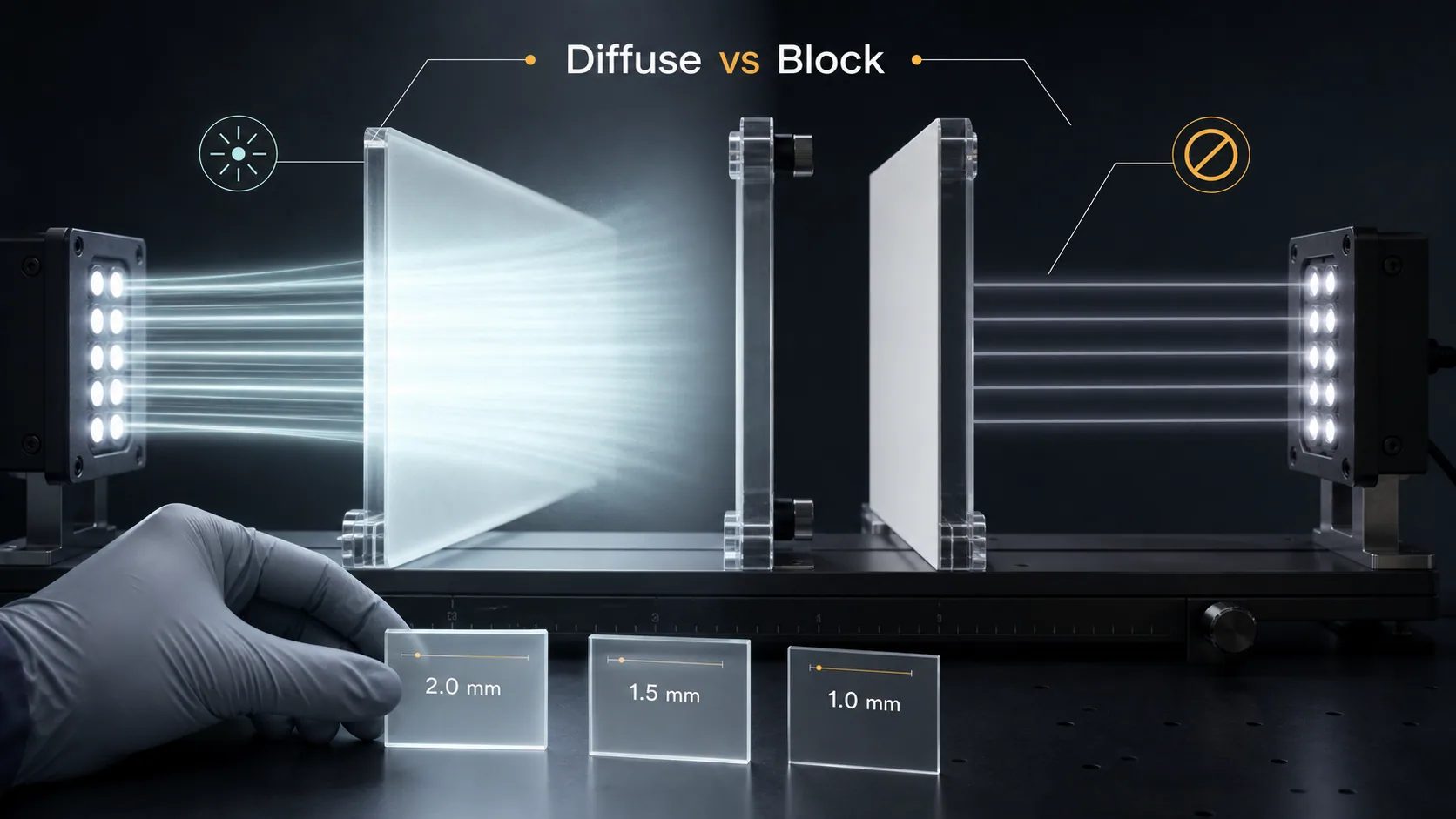
Light-diffusing PC transmits and scatters LED light for uniform illumination, while light-blocking PC prevents leakage at defined wall thicknesses such as 2.0 mm, 1.5 mm and 1.0 mm.
Buyer and engineer FAQ
Questions engineers often ask about this material route
Where can PC with a light-blocking plastic requirement be used?
Typical fields include optical housings, sensor covers, LED barriers, cosmetic packaging and opaque precision parts. For this article, DEYU would first confirm the working environment, wall thickness, expected lifetime and whether DGK-PC F295AA light-diffusion PC, DGK-PC FR3000 flame-retardant PC matches the part geometry or needs formulation adjustment.
What are the main performance indicators for the "light-blocking plastic" target on PC?
Focus on optical density, light leakage, wall-thickness sensitivity, color consistency and surface appearance. Buyers should ask for data on molded parts, not only pellet data, because gate position, filler orientation and thickness can change the final value.
What should engineers watch during injection molding or processing?
For PC, a practical starting window is 270-310°C melt / 80-110°C mold, dry before molding. Avoid pigment agglomeration, control shear and check light blocking at the thinnest wall. Final parameters should follow part thickness, gate design and the actual machine.
What details help DEYU recommend DGK-PC F295AA light-diffusion PC, DGK-PC FR3000 flame-retardant PC more accurately?
Send the current resin or grade, drawing or photo, wall thickness, annual quantity, target standard, failure mode and required color. If a reference grade already passed one test but failed in production, include both data sets.
For a precise recommendation, share the part drawing, base resin, target performance, processing method and test standard with DEYU.
Short Answer
Light-diffusing PC and light-blocking PC are two different optical modification directions for polycarbonate.
Light-diffusing PC allows light to pass through while scattering it. Its purpose is to make LED light softer, more uniform and less glaring. It is usually evaluated by light transmittance, haze, diffusion uniformity, LED hot spot hiding, luminance distribution, color shift and actual lamp testing.
Light-blocking PC is designed to prevent light from passing through the part. Its purpose is to stop LED light leakage, hide lamp beads, block bright spots and prevent light from penetrating thin walls, ribs, edges, screw bosses or areas close to light sources. It is usually evaluated by thickness-based shielding tests such as 2.0 mm, 1.5 mm and 1.0 mm light blocking.
Yuyao Deyu DEYU plastics provides DGK-PC F295AA light-diffusion PC and customized DGK-PC light-blocking solutions according to part thickness, LED distance, brightness, color, flame retardancy and molding process. When flame retardancy is required together with PC optical or housing performance, DGK-PC FR3000 flame-retardant PC can also be used as a development base.
Why Diffusion and Blocking Must Not Be Confused
In LED-related plastic parts, customers often use words such as transparent, translucent, diffusing, milky white, opaque, light shielding and no light leakage. These words sound similar, but they represent very different material requirements.
A light-diffusing PC part should transmit light and spread it evenly. A light-blocking PC part should stop light from passing through.
If these two concepts are confused, material selection can easily fail. For example, a customer may say they want white PC. But white PC can mean white translucent PC for LED diffusion, milky white PC for soft light transmission, high-haze PC diffuser material, white opaque PC for hiding internal structures or white light-blocking PC for preventing LED leakage near lamp beads.
Light-diffusing PC needs controlled transmission. Light-blocking PC needs controlled opacity. For lighting covers, LED lamp shades, appliance panels, automotive interior lighting parts, electronic housings, button light guides and indicator windows, the optical target must be defined before formulation.
DEYU usually asks two questions first: should the material let light pass through and diffuse it, or should the material block light completely at a specified thickness?
1. What Is Light-Diffusing PC?
Light-diffusing PC is polycarbonate modified with light-diffusing agents or an optical diffusion system. It allows light transmission while scattering light inside the material.
The final effect is not clear transparency, but soft and uniform light. A standard transparent PC sheet lets light pass through directly, so the LED point behind it may remain visible. A light-diffusing PC sheet scatters the LED light, making the light surface more even and reducing hot spots.
Light-diffusing PC is commonly used in LED lamp covers, diffuser plates, appliance display windows, light guide covers, indicator light covers, automotive interior lighting parts, electronic light-transmitting panels and decorative lighting components.
The key value is balancing light transmission and diffusion. If transmittance is too high and haze is too low, LED beads may be visible. If haze is too high and transmittance is too low, the light output may become weak. If the diffusion system is not uniform, the part may show light spots, dark zones or cloudy appearance.
2. How to Evaluate Light-Diffusing PC
Light-diffusing PC should not be judged only by visual appearance. It needs both optical data and actual lamp testing.
Light transmittance measures how much light passes through the PC sample. For diffuser applications, the correct value is not always the highest value. It depends on the required brightness, LED distance, wall thickness and hot spot hiding target.
Haze measures the degree of light scattering. Higher haze usually means stronger diffusion and better LED point hiding. Lower haze means light passes more directly and the part looks clearer. A good diffuser needs enough haze to hide the lamp bead while keeping enough transmittance for brightness.
LED hot spot hiding is a practical test. A sample or molded part is placed above an LED board to check whether LED beads remain visible. The result depends on LED brightness, LED spacing, distance from LED to PC, sample thickness, diffusion agent content, surface texture and part shape.
Luminance uniformity evaluates whether the light surface is even. This is especially important for linear lamps, large-area panels, display light windows, appliance indicator areas and decorative lighting parts.
Color shift and appearance also matter. Diffusion agents, pigments, flame retardants and processing temperature can affect the final white tone, yellowing tendency, gloss, black spots, flow marks and batch consistency.
3. What Is Light-Blocking PC?
Light-blocking PC is PC material designed to prevent light from penetrating the plastic part. It is also called opaque PC, light-shielding PC or no-light-leakage PC.
Its goal is not to diffuse light, but to block it. It is used in LED housings, appliance panels, display frames, automotive light-shielding structures, electronic housings, buttons, indicator structures, internal partitions near LEDs and parts requiring no backlight leakage.
In many LED products, light leakage is a serious problem. Light may pass through thin walls, ribs, edges, screw bosses or areas close to LED beads. Even if a part looks opaque under room light, it may still leak light when a high-brightness LED is placed behind it.
Therefore, light-blocking PC cannot be evaluated only by looking at the part under normal light. It must be tested under the actual light source.
4. How to Evaluate Light-Blocking PC
Light-blocking PC evaluation must be linked to thickness, LED position, brightness, color and part structure.
The most practical definition is thickness-based light blocking: no visible leakage at 2.0 mm, 1.5 mm, 1.0 mm or the actual molded wall thickness under a specified LED condition. A material that blocks light at 2.0 mm may still leak at 1.5 mm. A material that blocks light at 1.5 mm may still fail at 1.0 mm.
LED proximity testing is also critical. A material may pass when the LED is 20 mm away but fail when the LED is 3 mm away. Near the LED bead, light intensity is high, and small thickness changes or dispersion differences can create visible bright points.
Visual light leakage testing should be done in a dark room or controlled light box. The evaluator checks visible lamp bead outline, bright points, edge leakage, rib or boss leakage, uneven penetration and color change under backlight. The LED type, voltage, distance, observation angle and sample thickness should be fixed.
Instrumental transmittance or optical density data can help quantify shielding, but final approval should always use the actual molded part because real parts include flow marks, weld lines, thin corners, ribs, screw bosses, gates, internal stress and assembly gaps.
5. Key Differences
Light-diffusing PC controls how light passes through. Light-blocking PC controls whether light can pass through at all.
Light-diffusing PC focuses on transmittance, haze, diffusion uniformity and LED hot spot hiding. Its typical appearance is milky white, translucent or frosted. Its risk is insufficient brightness, uneven diffusion or visible LED points.
Light-blocking PC focuses on thickness-based opacity, low transmission and no visible leakage. Its typical appearance is black, white opaque or colored opaque. Its risk is thin-wall leakage, poor toughness, higher filler loading, color instability or poor flow.
For mixed optical parts, it is often better to separate the functions. A lamp cover may use a diffusing window and a blocking frame. A button may use a translucent symbol and an opaque surrounding area. An appliance panel may require light transmission only at icons and light blocking elsewhere. This can require two-color molding, local thickness design, printing, coating or different PC materials in different zones.
6. Why White Light-Blocking PC Is More Difficult
Black light-blocking PC is usually easier because black pigments absorb visible light efficiently. White light-blocking PC is more difficult because customers often want a clean white external appearance while blocking high-brightness LED light inside.
The formulation must balance white pigments, light-blocking agents, PC resin, impact modifiers, dispersants and processing stability. White light-blocking PC may face thin-wall leakage, LED bright point exposure, yellowing during processing, lower impact strength, reduced flowability, surface flow marks, color inconsistency and higher material cost.
If the part is close to the LED bead, the challenge becomes greater. A white PC material that blocks light at 2.0 mm may fail at 1.5 mm, and a 1.5 mm solution may fail at 1.0 mm. Therefore, white light-blocking PC must always define the wall thickness and LED condition.
7. Thickness Levels for Light-Blocking PC
2.0 mm light-blocking PC is a common starting level for appliance housings, display frames, internal covers and LED partitions with enough wall thickness. The main focus is basic opacity, color stability, impact strength, flowability and surface quality.
1.5 mm light-blocking PC is more demanding and is common in thinner panels, LED indicator housings, automotive interior light-shielding parts, electronic frames and button structures close to LEDs. At this level, opacity, dispersion, thin-wall toughness and no visible bright points near the LED become more important.
1.0 mm light-blocking PC is a high-difficulty target, especially for white or light-colored PC. It is used in thin LED partitions, indicator button structures, compact electronic housings, light-shielding ribs and small appliance panels. Final judgment must be based on actual LED testing and the real part structure.
8. DEYU DGK-PC Optical Material Solutions
DEYU’s DGK-PC light-diffusing series focuses on light transmission and uniform diffusion. It can be adjusted for high transmittance, high haze, milky white tone, LED hot spot hiding, low yellowing, flame retardancy, thin-wall diffuser parts and custom diffusion levels based on LED layout.
DGK-PC light-blocking solutions focus on preventing light leakage. They can be customized for black light blocking, white light blocking, 2.0 mm shielding, 1.5 mm shielding, 1.0 mm shielding, LED-proximity shielding, thin-wall light shielding, flame-retardant light-blocking PC and colored opaque PC.
For optical PC development, DEYU recommends that customers provide the part drawing, target wall thickness, LED type and brightness, distance from LED bead to plastic wall, light color, part color, flame-retardant requirement, outdoor weatherability requirement, sample part, LED board layout, target transmittance or haze, light leakage standard, molding process, gate position and surface texture.
Customer Case: 1.5 mm White PC Panel Near LED Beads
A customer produced a white PC control panel for an appliance product. The panel looked opaque under normal room light, but after the LED board was installed behind it, several bright spots appeared near the LED beads.
The light-sensitive area was about 1.5 mm thick, the LED was close to the plastic wall, and the target was no visible light leakage while keeping white appearance, impact strength and stable injection molding.
DEYU analyzed the sample and found that the original material only provided visual whiteness, not true light blocking. The pigment system was not enough to block high-brightness LED light at 1.5 mm thickness.
DEYU developed a DGK-PC white light-blocking formulation. The first trial improved opacity but slightly reduced flowability. The second trial adjusted light-blocking agents and pigment dispersion. The third trial balanced toughness and processing stability.
After LED proximity testing, visible bright spots were significantly reduced in the 1.5 mm area, and the molded panel kept acceptable white appearance and molding performance.
Conclusion
Light-diffusing PC and light-blocking PC are two different optical material directions. Light-diffusing PC allows light to pass through and scatter, creating a softer and more uniform light surface. It is evaluated by transmittance, haze, LED hot spot hiding, luminance uniformity, color tone and real lamp testing.
Light-blocking PC prevents light from passing through. It is evaluated by specified thickness, LED proximity, visual leakage, low transmittance and real molded part testing. A light-blocking requirement should clearly define whether the target is 2.0 mm, 1.5 mm, 1.0 mm or no leakage in the actual part.
Selection Table: Light-Blocking PC or Light-Diffusing PC
The key question is whether the part must stop light or manage light. A sensor cover, display frame or optical barrier usually needs light-blocking PC with high opacity at the actual wall thickness. An LED diffuser, lamp cover or indicator window needs light-diffusing PC that spreads light without creating obvious hot spots. Both materials may look white, but the optical target is opposite.
| Part requirement | Better route | Main test method | Risk to avoid |
|---|---|---|---|
| Prevent sensor light leakage | Light-blocking PC or PC/ABS | Transmission at final wall thickness | Only checking color chip opacity |
| Hide internal LED or electronics | High-opacity white or black light-shielding PC | Backlight inspection and thickness comparison | Thin ribs and corners becoming translucent |
| Spread LED light evenly | Light-diffusing PC | Haze, transmission and visual hot-spot test | Too much pigment reducing brightness |
| Outdoor optical cover | UV-stabilized PC optical route | UV aging, color shift and impact check | Yellowing or brittleness after weathering |
For engineers searching light-blocking plastic, opaque PC, light-shielding polycarbonate or light-diffusing PC, the important data is not only resin type. DEYU normally asks for wall thickness, target color, light source, viewing direction, transmission limit and molding process before recommending pigment, diffuser and stabilizer systems.
For LED covers, appliance panels, electronic housings, automotive light-shielding parts, indicator structures and thin-wall PC components near LEDs, Yuyao Deyu DEYU plastics can develop DGK-PC materials according to optical target, wall thickness, color, LED condition, flame retardancy and injection molding requirements.