
How to Improve Carbon Fiber Quality and Reduce Cost? Technical Routes and DEYU plastics Solutions
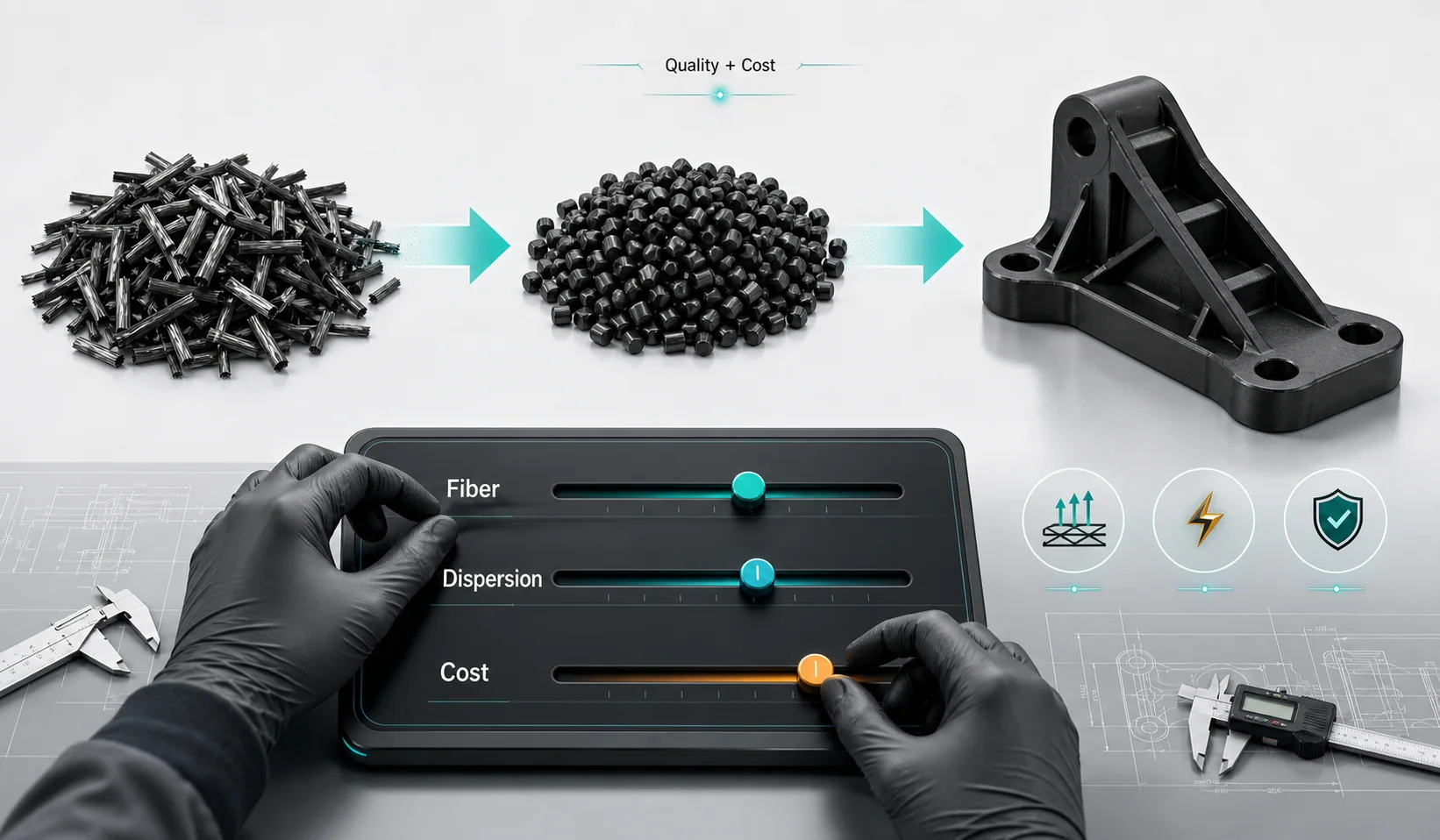
Improving carbon fiber reinforced compound quality while reducing cost requires control of fiber grade, surface treatment, sizing compatibility, fiber length, dispersion, base resin, carbon fiber content, processing and final part validation.
Buyer and engineer FAQ
Questions engineers often ask about this material route
Where can modified plastic with a reinforced plastic requirement be used?
Typical fields include structural brackets, high-stiffness housings, supports, clips and metal-replacement parts. For this article, DEYU would first confirm the working environment, wall thickness, expected lifetime and whether DGK-ABS CF15L carbon fiber reinforced ABS, DGK-PA66 CF15L-CF40L customizable carbon fiber PA66 matches the part geometry or needs formulation adjustment.
What are the main performance indicators for the "reinforced plastic" target?
Focus on tensile strength, flexural modulus, impact balance, warpage, fiber orientation and screw holding. Buyers should ask for data on molded parts, not only pellet data, because gate position, filler orientation and thickness can change the final value.
What should engineers watch during injection molding or processing?
Control fiber breakage, gate direction and mold temperature; dry PA/PBT/PC blends before molding. Start from the base-resin processing window, then adjust by molded-part resistance, appearance and mechanical data.
What details help DEYU recommend DGK-ABS CF15L carbon fiber reinforced ABS, DGK-PA66 CF15L-CF40L customizable carbon fiber PA66 more accurately?
Send the current resin or grade, drawing or photo, wall thickness, annual quantity, target standard, failure mode and required color. If a reference grade already passed one test but failed in production, include both data sets.
For a precise recommendation, share the part drawing, base resin, target performance, processing method and test standard with DEYU.
Short Answer
Improving the quality of carbon fiber reinforced plastics and reducing cost are not two separate tasks. A practical solution must balance carbon fiber grade, surface treatment, sizing compatibility, fiber length, dispersion, base resin, carbon fiber content, molding stability, target conductivity, mechanical performance and validation on the real part. Higher carbon fiber content does not always mean better performance, and cheaper fiber does not always mean lower total cost.
Yuyao Deyu DEYU plastics improves carbon fiber compound quality through in-house fiber preparation, laboratory formulation control, flexible carbon fiber content adjustment and production delivery. Existing product directions include DGK-ABS CF15L carbon fiber reinforced ABS and DGK-PA66 CF15L-CF40L customizable carbon fiber PA66, with formulation adjustment around stiffness, conductivity, impact strength, warpage and cost.
Why Quality and Cost Must Be Solved Together
Carbon fiber reinforced plastics are used because they can increase stiffness, strength, dimensional stability, electrical conductivity, heat deformation resistance and lightweight performance. In automotive parts, industrial equipment, electrical components, precision machinery, robotic structures, tool housings and high-performance engineering plastics, carbon fiber gives value that ordinary fillers or glass fiber cannot always provide.
But carbon fiber compounds often face two linked problems.
The first problem is quality stability. If the fiber is selected poorly, treated incorrectly, dispersed unevenly or mismatched with the resin, the final material may show unstable strength, poor surface appearance, brittleness, warpage, uneven conductivity or difficult injection molding.
The second problem is cost. Carbon fiber is more expensive than many traditional fillers. If the formulation only increases fiber loading without a clear application target, material price rises while the molded part may not work better. In some cases, excessive fiber reduces impact toughness, flowability and production stability.
The real question is not “how much fiber should be added.” The useful question is:
how can the right carbon fiber be used in the right resin, at the right loading, with the right dispersion and processing stability, to reach the customer’s target at a reasonable total cost?
1. What Defines a High-Quality Carbon Fiber Plastic?
A high-quality carbon fiber reinforced plastic is not only a material with a high tensile strength value on a data sheet. In real production, quality should be judged by several practical indicators:
- stable mechanical strength
- high and repeatable stiffness
- good fiber dispersion
- acceptable impact toughness
- stable conductivity when required
- controlled shrinkage and warpage
- stable injection molding
- acceptable surface appearance
- batch-to-batch repeatability
- performance in the real part, not only in standard test bars
Many customers compare only carbon fiber percentage. For example, 30% carbon fiber may look better than 20%. In practice, if the 30% material is too brittle, flows poorly, warps severely or costs too much, it may not be the best solution.
The correct sequence is to define the target first: higher stiffness, conductivity, lower weight, dimensional stability, impact toughness, heat resistance, wear resistance, metal replacement or glass-fiber replacement. Only after that should the carbon fiber system be designed.
2. Main Routes to Improve Quality and Reduce Cost
Route 1: Select the Right Fiber Grade, Not the Most Expensive One
A higher-grade carbon fiber can provide higher strength or modulus, but not every injection-molded plastic part needs the most expensive fiber. For many thermoplastic compounds, final performance depends strongly on retained fiber length, dispersion, resin compatibility and molding conditions.
DEYU selects carbon fiber according to application:
- structural parts need stiffness and strength
- conductive parts need stable resistance
- precision parts need dimensional stability and warpage control
- wear parts need interaction with the counter surface
- thin-wall parts need flowability and controlled dispersion
The goal is not the highest-priced fiber. The goal is the fiber that gives the most useful performance in the customer’s real part.
Route 2: Improve Surface Treatment and Resin Compatibility
Carbon fiber does not bond equally well with every polymer. The interface between fiber and resin is critical. If interfacial bonding is weak, the fiber cannot transfer load effectively. The compound may show lower strength, weaker impact performance and unstable mechanical behavior.
Different resins need different interface strategies. PA6 and PA66 require attention to adhesion, moisture sensitivity, toughness and processing temperature. POM needs stable dispersion and friction balance. PC and PC/ABS need a balance between toughness and surface appearance. PPS, PPA and PEEK need fiber treatment that can tolerate high processing temperatures.
DEYU improves compound quality by matching fiber treatment, compatibilizer, lubricant and process aids to the selected resin system. A better interface can deliver more useful performance at the same carbon fiber loading, which is often more cost-effective than simply adding more fiber.
Route 3: Control Fiber Length and Dispersion
Fiber length and dispersion are decisive in thermoplastic carbon fiber compounds. If fibers become too short during compounding, reinforcement efficiency drops. If fibers are too long or distributed poorly, the material may have poor flow, surface defects, unstable conductivity or molding difficulties.
Dispersion affects strength, modulus, conductivity, surface quality, warpage, weld-line strength, batch stability and processability. DEYU controls carbon fiber preparation and compounding parameters to balance retained fiber length with uniform dispersion.
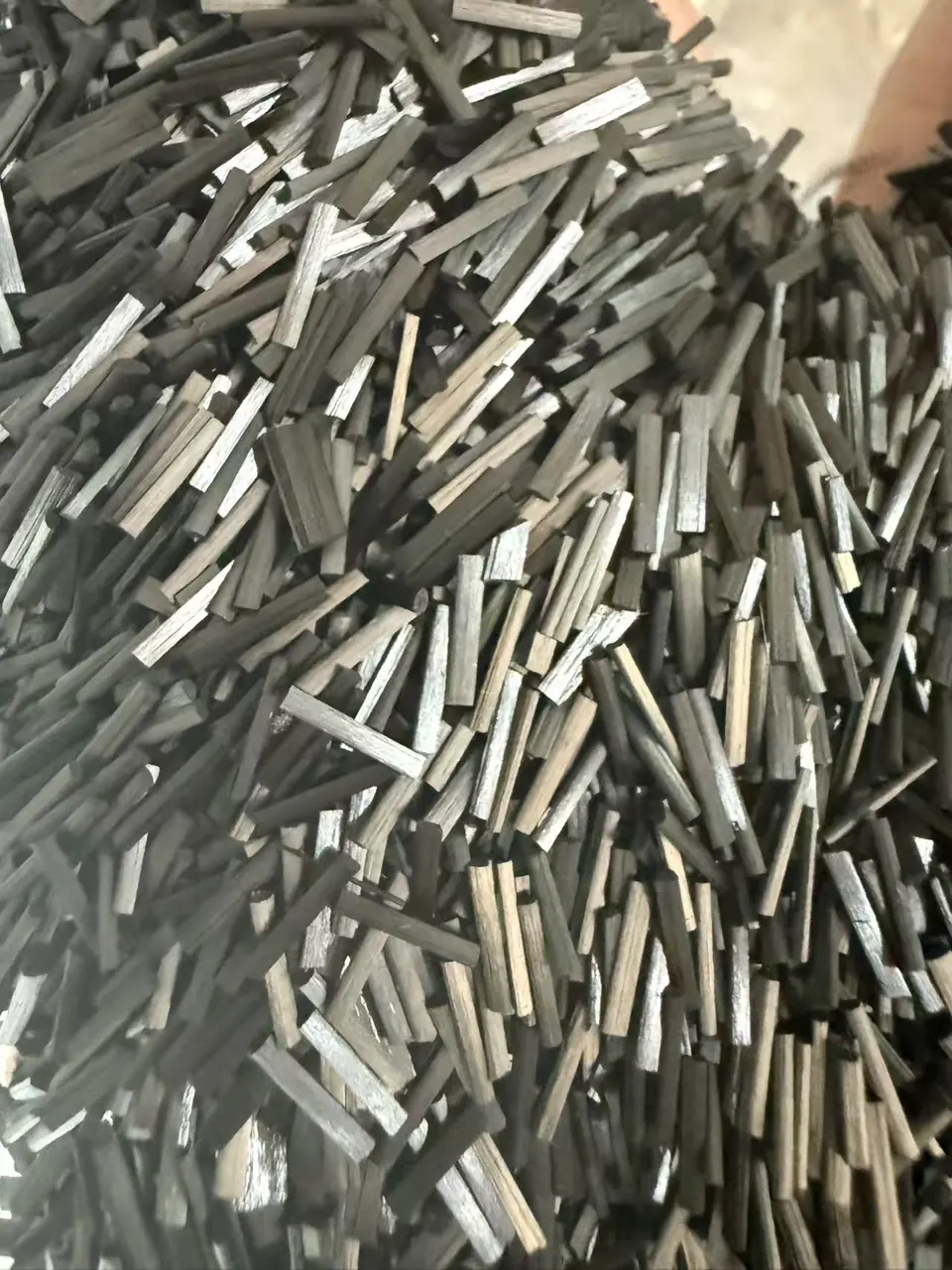
The best compound is not the one with the longest fibers in the pellet. It is the one where the right fiber length distribution remains effective after compounding and molding.
Route 4: Optimize Carbon Fiber Content Instead of Maximizing It
Increasing carbon fiber content can raise stiffness, strength, conductivity and dimensional stability, but it also raises cost and may reduce impact toughness and flowability.
High loading can create new problems:
- higher material price
- more brittleness
- lower impact strength
- difficult injection molding
- higher screw and tool wear
- stronger anisotropy
- warpage risk
- rougher surface
- weak weld lines
Cost reduction often comes from finding the minimum effective carbon fiber content. For a conductive part, the target is the required resistance range, not the maximum fiber level. For a bracket, the target is stiffness and deformation control. For a precision part, the target is dimensional stability and low warpage.
Route 5: Choose the Right Base Resin
Carbon fiber cannot solve every material problem. The base resin defines the upper boundary of heat resistance, chemical resistance, toughness, processability, moisture sensitivity and cost.
PA66 with carbon fiber fits high-strength structural applications. POM with carbon fiber can be useful for precision parts with dimensional stability and conductivity requirements. PPS, PPA and PEEK support higher-temperature applications. PP with carbon fiber can be considered when lightweight performance and cost balance matter. ABS or PC/ABS with carbon fiber can support housings that need stiffness, conductivity and moldability.
Choosing the correct resin platform can reduce cost more effectively than only reducing carbon fiber percentage.
Route 6: Improve Processing Stability
A carbon fiber compound that performs well in the lab but molds poorly is not a successful material. Poor processing can cause short shot, flow marks, warpage, unstable dimensions, weak weld lines, unstable conductivity, high scrap rate, slow cycle time and tool contamination.
DEYU develops carbon fiber compounds with production in mind. Flowability, lubrication, fiber dispersion, thermal stability and moldability must be considered together. A material with a slightly higher price per kilogram can still reduce total cost if it lowers scrap, trial adjustments and production interruptions.
Route 7: Use Functional Composite Design
Many parts need more than stiffness. Carbon fiber can be combined with PTFE for low friction, MoS2 for solid lubrication, aramid for wear support, flame retardants for electrical or automotive parts, antistatic systems for resistance control or impact modifiers for assembly reliability.
This kind of composite design may reduce cost because the formulation does not rely only on very high carbon fiber content. The material is built around the full part requirement, not a single reinforcement number.
3. Comparison of Improvement Routes
| Route | Main Target | Quality Benefit | Cost Benefit | Risk Without Control |
|---|---|---|---|---|
| Fiber grade selection | Match fiber to application | More stable properties | Avoid overpaying for unnecessary fiber level | Low-grade fiber can create unstable strength |
| Surface treatment | Improve fiber-resin interface | Better strength and toughness | More performance at same loading | Poor adhesion and brittleness |
| Fiber length and dispersion | Keep reinforcement efficient | Better stiffness, conductivity and repeatability | Less defect and scrap | Fiber breakage or poor flow |
| Content optimization | Avoid over-formulation | Balanced part performance | Lower material cost | Too little fiber misses target |
| Base resin selection | Choose the right platform | Better heat, toughness and chemical balance | Avoid wrong material direction | Fiber cannot fix wrong resin |
| Processing stability | Support mass production | Stable molding and dimensions | Lower scrap and trial cost | Warpage, short shot, rough surface |
| Functional composite design | Combine fiber with additives | Application-specific performance | Avoid excessive fiber loading | Function conflict if not balanced |
This comparison shows why quality improvement and cost reduction are not opposite goals. With the right formulation logic, material quality can improve while total cost decreases.
4. DEYU plastics Advantages
In-House Carbon Fiber Preparation
DEYU can prepare and process carbon fiber internally. This helps control fiber selection, cutting, surface adaptation, dispersion strategy and compound design around the customer’s resin and part.
For customers, this provides more flexible carbon fiber content, better dispersion control, better compatibility with different resins, faster small-batch trials and a smoother transition from laboratory formula to production.
Laboratory Formulation and Production Delivery
Carbon fiber compounds require laboratory precision, but customers need production delivery. DEYU combines both. During development, the team can adjust carbon fiber content, dispersion, resin compatibility, flowability, conductivity, impact toughness and surface quality. During production, the focus moves to batch repeatability, extrusion stability, pellet quality and molding feedback.
Wide Resin Coverage
DEYU can develop carbon fiber materials based on PA6, PA66, POM, PC, ABS, PP, PPS, PPA, PEEK, PC/ABS, TPU and other special systems. This coverage matters because each customer needs a different balance of price, processing, heat resistance, dimensional stability, conductivity and toughness.
5. Application Examples
PA66 Carbon Fiber Industrial Bracket
A customer used glass-fiber reinforced PA66 for an industrial bracket. Basic strength was acceptable, but the bracket deformed under load. DEYU developed a balanced PA66 carbon fiber compound with controlled fiber content and toughness adjustment. The formulation improved stiffness, reduced deformation, maintained screw-hole assembly reliability and supported stable molding.
Conductive POM Carbon Fiber Precision Part
A customer needed POM with dimensional stability and controlled conductivity. Standard conductive fillers affected flow and surface quality. DEYU developed a POM carbon fiber formulation focused on surface resistance, stable molding, lower warpage and acceptable surface appearance. The fiber content was not maximized. The conductive network and dispersion were optimized instead.
Lightweight Carbon Fiber Compound for Metal Replacement
A customer wanted to reduce weight in a small metal structural part while keeping enough stiffness. DEYU evaluated thermoplastic carbon fiber options and developed a compound based on load, wall thickness and molding method. The result helped reduce weight, simplify processing, preserve structural support and reduce secondary machining.
6. Related DEYU Product Directions
DGK-ABS CF15L Carbon Fiber Reinforced ABS
DGK-ABS CF15L is suitable for injection-molded ABS parts requiring stiffness, strength and controlled conductivity. It can be considered for conductive housings, equipment covers and structural components where ABS processability must be retained.
DGK-PA66 CF15L-CF40L Carbon Fiber Reinforced PA66
DGK-PA66 CF15L-CF40L is a customizable PA66 carbon fiber series. Fiber loading can be adjusted around stiffness, strength, conductivity, molding and cost requirements. It is suitable for automotive parts, brackets, structural supports, conductive components and high-strength molded PA66 parts.
Information DEYU Recommends Customers Provide
To develop a carbon fiber compound accurately, DEYU recommends providing the product application, current material, preferred resin, target stiffness or strength, conductivity target, impact requirement, working temperature, wall thickness, mold and gate information, processing method, surface requirement, dimensional tolerance, and whether wear resistance, flame retardancy or antistatic function is also needed.
With this information, DEYU can select the right resin platform and carbon fiber system, then develop a balanced formulation for customer validation.
Conclusion
Improving carbon fiber compound quality and reducing cost depend on formulation efficiency. Effective routes include selecting the right fiber grade, improving interface compatibility, controlling fiber length and dispersion, optimizing carbon fiber content, choosing the correct base resin, improving processing stability and using functional composite design instead of simply increasing fiber loading.
Yuyao Deyu DEYU plastics provides a flexible DGK platform for carbon fiber reinforced plastics. With in-house carbon fiber preparation, laboratory formulation control, broad resin coverage, flexible fiber content adjustment and production delivery, DEYU helps customers improve part performance while controlling the total cost of material and manufacturing.