
How to Choose Flame-Retardant PP? Selection Logic and DEYU plastics Solutions
Flame-retardant PP selection guide covering V-0 thickness, halogen-free requirements, glow wire testing, color stability, impact strength, blooming risk and production validation.
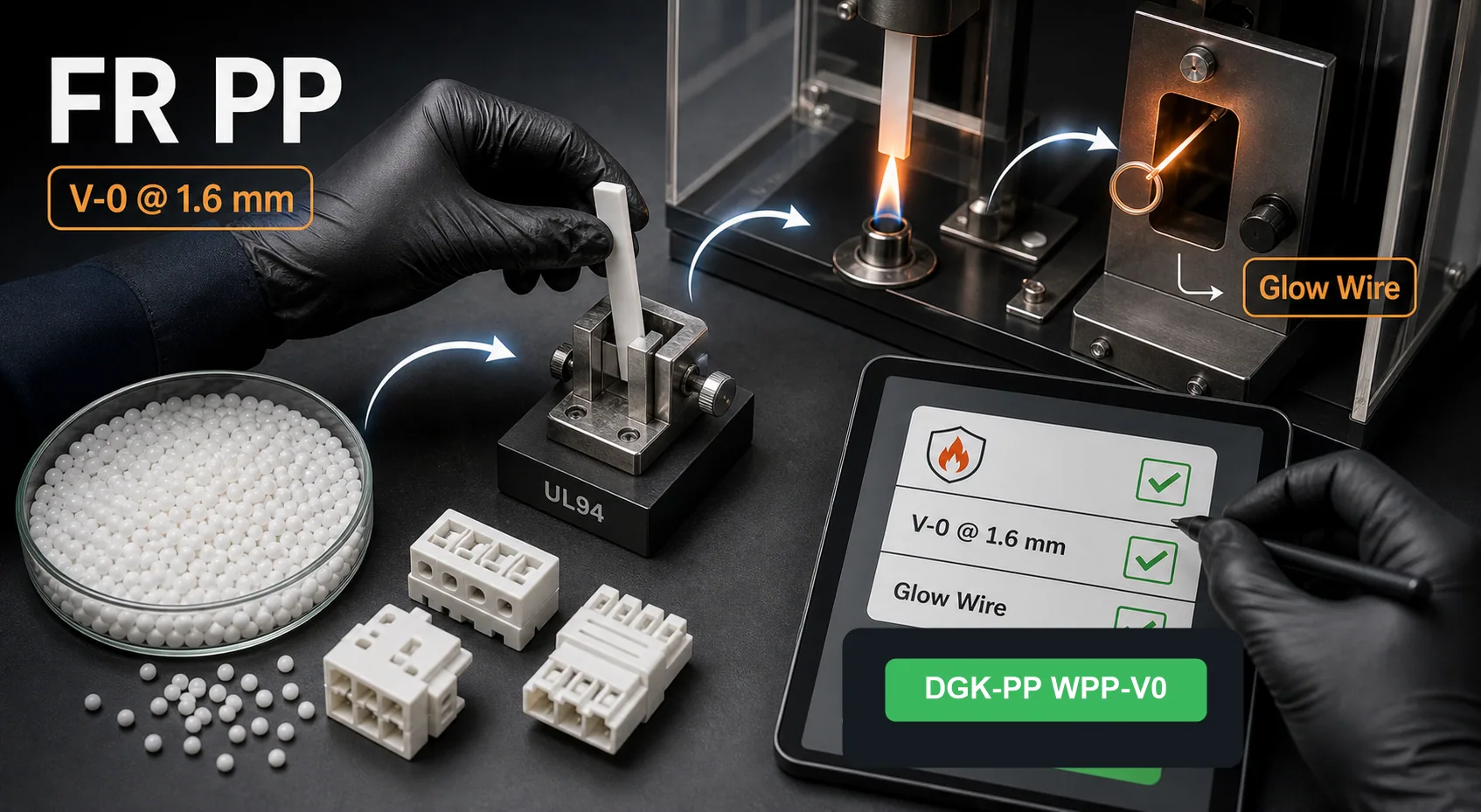
Buyer and engineer FAQ
Questions engineers often ask about this material route
Where can PP with a flame-retardant plastic requirement be used?
Typical fields include electrical enclosures, battery parts, connectors, appliance housings and industrial covers. For this article, DEYU would first confirm the working environment, wall thickness, expected lifetime and whether DGK-PP WPP-V0 halogen-free flame-retardant PP matches the part geometry or needs formulation adjustment.
What are the main performance indicators for the "flame-retardant plastic" target on PP?
Focus on UL94 rating, GWFI/GWIT when needed, CTI, mechanical retention, color stability and flame-retardant precipitation. Buyers should ask for data on molded parts, not only pellet data, because gate position, filler orientation and thickness can change the final value.
What should engineers watch during injection molding or processing?
For PP, a practical starting window is 190-230°C melt / 30-60°C mold. Avoid excessive residence time, use moderate screw speed and confirm the rating at the actual wall thickness. Final parameters should follow part thickness, gate design and the actual machine.
What details help DEYU recommend DGK-PP WPP-V0 halogen-free flame-retardant PP more accurately?
Send the current resin or grade, drawing or photo, wall thickness, annual quantity, target standard, failure mode and required color. If a reference grade already passed one test but failed in production, include both data sets.
For a precise recommendation, share the part drawing, base resin, target performance, processing method and test standard with DEYU.
Short Answer
Flame-retardant PP should not be selected only by asking whether it can reach V-0. A reliable selection must consider flame-retardant grade, test thickness, product color, impact strength, glow wire requirements, halogen-free requirements, processing temperature, blooming risk, cost, and actual part structure. Yuyao Deyu DEYU plastics provides DGK-PP WPP-V0 halogen-free flame-retardant PP and customized DGK-PP FR modified polypropylene solutions for electrical housings, appliance parts, coil bobbins, connectors, automotive interior components, and industrial structural parts.
Introduction: Why Flame-Retardant PP Selection Is Often Difficult
PP, or polypropylene, is widely used in home appliance parts, electrical housings, coil bobbins, connectors, automotive interior components, industrial structures, fan parts, tool boxes, turnover boxes, and small equipment housings. It has low density, good chemical resistance, good processability, stable electrical properties, and competitive cost.
However, standard PP is easy to burn and may melt and drip during combustion. When PP parts are used in electrical, electronic, home appliance, lighting, automotive, or industrial equipment applications, flame-retardant modification is often required.
Customers often ask:
- Do you have V-0 flame-retardant PP?
- Can it be halogen-free?
- Can it pass glow wire testing?
- Can 1.0 mm thin-wall PP reach flame retardancy?
- Will white flame-retardant PP turn yellow?
- Will impact strength drop after flame-retardant modification?
These questions point to the same core issue: flame-retardant PP is not only about flame rating. It is a balance among flame retardancy, mechanical performance, processing, color stability, environmental requirements, and cost.
1. Main Technical Routes for Flame-Retardant PP
1. Halogen Flame-Retardant PP: High Efficiency and Mature Processing
Halogen flame-retardant PP usually offers high flame-retardant efficiency. It can achieve higher flame ratings with a relatively controllable addition level and a mature processing window.
Advantages
- high flame-retardant efficiency
- easier thin-wall flame retardancy
- mature processing window
- relatively controllable cost
- suitable for black, dark-colored, and internal electrical structural parts
Points to consider
- environmental regulations and customer restricted substance lists must be confirmed
- some systems may involve smoke density, odor, or corrosion concerns
- light-colored parts may face color stability issues
- compatibility with antioxidants, glass fiber, fillers, and pigments must be verified
Suitable applications
Electrical internal parts, black structural parts, coil bobbins, connector housings, industrial equipment components, and cost-sensitive flame-retardant projects.
2. Halogen-Free Intumescent Flame-Retardant PP
Halogen-free intumescent flame-retardant PP usually uses phosphorus-nitrogen synergistic systems. During burning, the system forms an expanded char layer to isolate heat and oxygen.
Advantages
- suitable for many customers requiring halogen-free or low-halogen materials
- more suitable for products with environmental and low-smoke expectations
- can be used for white, light-colored, appliance, and indoor electrical parts
Points to consider
- higher addition level may affect impact strength and flowability
- sensitive to moisture, processing temperature, and screw shear
- some systems may show blooming, moisture absorption, surface stickiness, or storage stability issues
- thin-wall V-0 is more difficult
- flame-retardant retention after thermal aging should be verified
Suitable applications
White appliance parts, export electrical products, environmentally oriented equipment housings, halogen-free flame-retardant PP structural parts, and indoor electrical components.
3. Mineral Flame-Retardant PP
Mineral flame-retardant systems may include magnesium hydroxide, aluminum hydroxide, or similar inorganic systems. They usually require a higher loading level to show obvious flame-retardant effects.
Advantages
- stable raw material supply
- relatively mild smoke performance
- suitable for some filled or thick-wall parts
- can improve rigidity and dimensional stability
Points to consider
- high loading increases density
- impact strength and flowability may decrease
- thin-wall flame retardancy is more difficult
- surface gloss and toughness require formulation adjustment
Suitable applications
Thick-wall structural parts, filled flame-retardant PP, low-cost industrial parts, and applications less sensitive to material density.
4. Compound Flame-Retardant PP
Many projects require more than flame retardancy. Typical combined requirements include flame retardancy plus glass fiber reinforcement, high impact strength, heat resistance, UV resistance, anti-static performance, low odor, white color stability, or thin-wall molding.
These projects cannot be solved by one type of flame retardant alone. A balanced system of PP base resin, flame retardant, compatibilizer, toughener, antioxidant, lubricant, pigment, and processing stabilizer is required.
DEYU plastics usually confirms the customer’s must-have requirements and adjustable requirements first. For example, UL94 V-0 may be a must-have requirement, while a small color difference may be adjustable. In another project, white color stability may be the must-have requirement, while cost can be slightly increased. This priority sorting makes formulation development more accurate.
2. Eight Questions Before Selecting Flame-Retardant PP
1. What flame-retardant grade is required?
The customer should confirm whether the target is HB, V-2, V-1, or V-0. Different grades require different formulation difficulty and cost.
2. What is the test thickness?
The same material may perform differently at 3.0 mm, 1.6 mm, 1.0 mm, or 0.8 mm. V-0 must always be discussed together with thickness.
3. Is halogen-free required?
Halogen-free and halogen flame-retardant PP are not simple replacements for each other. Halogen-free systems are more environmentally oriented, while halogen systems usually have higher efficiency and easier processing.
4. Is glow wire testing required?
Appliance, electrical, connector, and power-related parts often require glow wire testing. Passing UL94 does not automatically mean the final part will pass glow wire testing. Actual part testing is necessary.
5. What is the product color?
Black flame-retardant PP is usually easier to formulate. White, light gray, and natural colors require more attention to yellowing, color shift, blooming, and batch consistency.
6. Is high impact strength or low-temperature toughness required?
Flame retardants may reduce PP toughness. Parts with snap-fits, screw bosses, thin walls, or drop requirements must be tested for mechanical reliability after flame-retardant modification.
7. Is glass fiber reinforcement or filler required?
Glass fiber can improve stiffness and heat resistance, but it may affect burning behavior, surface appearance, weld line strength, and warpage.
8. What are the cost and mass production stability requirements?
A laboratory sample reaching the target flame rating does not mean the material is stable for mass production. Batch consistency, molding window, blooming, mold contamination, color stability, and long-term storage should also be evaluated.
3. Ten Application Scenarios for Flame-Retardant PP
Scenario 1: Internal Structural Parts for Home Appliances
Typical products include washing machine internal parts, air conditioner structural parts, refrigerator electrical brackets, small appliance supports, air duct parts, and internal control box supports.
Common issues: These parts usually require flame retardancy, heat resistance, dimensional stability, and assembly reliability. Appearance may not be the top priority, but cracking and unstable molding must be avoided.
Selection focus: flame-retardant grade, heat deflection temperature, screw boss strength, long-term thermal aging, and batch stability.
Recommended validation: UL94 test bars, glow wire testing, impact retention after thermal aging, screw tightening test, and final assembly validation.
DEYU suggestion: For appliance internal flame-retardant PP, halogen or halogen-free systems can be selected according to environmental requirements. If halogen-free and low odor are required, color, odor, and blooming should be tested in advance.
Scenario 2: Electrical Housings and Control Boxes
Typical products include electrical control boxes, distribution boxes, low-voltage electrical housings, switch boxes, power supply housings, and instrument cases.
Common issues: These products often require flame retardancy, heat resistance, dimensional stability, and structural strength. Standard flame-retardant PP may show unstable thin-wall flame performance, screw boss cracking, surface blooming, or molding shrinkage issues.
Selection focus: V-0 thickness, glow wire requirement, thin-wall flowability, screw boss strength, and impact retention after flame-retardant modification.
Recommended validation: UL94 testing at 1.6 mm or actual wall thickness, finished-part glow wire testing, drop test, repeated screw tightening, and high-low temperature cycling.
DEYU suggestion: For control box flame-retardant PP, standard test bars are not enough. Actual housing thickness, gate location, ribs, and screw boss structure must be verified.
Scenario 3: Coil Bobbins, Relays, and Connector Parts
Typical products include coil bobbins, relay housings, connector housings, terminal holders, and small electrical insulation parts.
Common issues: These parts are usually small, thin-walled, and dimensionally precise. They require flame retardancy, electrical insulation, heat resistance, and stable molding.
Selection focus: thin-wall flame retardancy, electrical properties, dimensional stability, low blooming, flowability, and mold contamination risk.
Recommended validation: 0.8-1.6 mm flame testing, tracking resistance, thermal aging, shrinkage measurement, and continuous molding observation.
DEYU suggestion: For connectors and coil bobbins, low blooming and thin-wall molding stability should be prioritized. If dimensional accuracy and heat resistance requirements are higher, PBT or PA may also be evaluated.
Scenario 4: White and Light-Colored Appearance Parts
Typical products include white appliance housings, light gray control panels, office equipment components, smart device housings, and auxiliary medical equipment housings.
Common issues: White flame-retardant PP may show yellowing, color difference, dull surface, blooming, or batch instability. Some flame retardants have an obvious impact on color.
Selection focus: whiteness, yellowing resistance, surface blooming, batch color consistency, flame-retardant grade, and color change after thermal aging.
Recommended validation: color difference before and after aging, high-temperature storage, surface wiping test, flame testing, and injection temperature window testing.
DEYU suggestion: White halogen-free flame-retardant PP should not be judged only by initial color. Thermal aging and storage color stability must also be verified. DEYU can match the flame-retardant system according to the customer’s color plate.
Scenario 5: Black Flame-Retardant PP Structural Parts
Typical products include black electrical brackets, tool boxes, industrial equipment housings, control boxes, fan brackets, and internal load-bearing parts.
Common issues: Black flame-retardant PP is generally easier to formulate, but impact strength, weld line strength, long-term thermal aging, and surface quality still need attention. If glass fiber is added, warpage and fiber exposure may occur.
Selection focus: flame-retardant efficiency, impact strength, stiffness, dimensional stability, weld line strength, and cost.
Recommended validation: UL94 testing, impact strength, flexural strength, weld line strength, drop testing, and actual assembly testing.
DEYU suggestion: Black structural parts can use halogen flame-retardant systems, high-efficiency compound systems, or glass fiber reinforced flame-retardant PP depending on cost and performance targets.
Scenario 6: Glass Fiber Reinforced Flame-Retardant PP
Typical products include glass fiber reinforced electrical brackets, fan blades, equipment supports, automotive functional parts, and industrial structural components.
Common issues: Glass fiber reinforced PP can improve stiffness, heat resistance, and dimensional stability. However, it may also cause fiber exposure, reduced weld line strength, warpage, and reduced impact strength. After adding flame retardants, formulation balance becomes more difficult.
Selection focus: glass fiber content, flame-retardant grade, warpage, weld line strength, surface quality, and long-term thermal aging.
Recommended validation: flame testing, heat deflection temperature, flexural strength, notched impact strength, warpage measurement, and final part assembly.
DEYU suggestion: Glass fiber reinforced flame-retardant PP requires coordinated adjustment of glass fiber, compatibilizer, flame retardant, and lubricant systems. Flame retardants should not be added directly to ordinary glass fiber PP without compatibility testing.
Scenario 7: Thin-Wall Flame-Retardant PP
Typical products include thin-wall electrical covers, small control boxes, connector housings, lightweight structural parts, and internal partitions of electronic devices.
Common issues: The thinner the wall, the more difficult it is to maintain stable flame retardancy. At the same time, the material must have enough flowability to avoid short shots, weld lines, or weak strength.
Selection focus: thin-wall V-0 thickness, high flowability, weld line strength, dripping control, mold venting, and injection window.
Recommended validation: flame testing at actual wall thickness, flow length testing, actual mold trial, weld line strength, and continuous injection stability.
DEYU suggestion: For thin-wall flame-retardant PP, the minimum wall thickness must be confirmed in advance. A 3.0 mm test result should not be used to predict 1.0 mm part performance.
Scenario 8: Flame-Retardant PP with UV Resistance
Typical products include outdoor electrical boxes, outdoor instrument housings, agricultural equipment housings, charging equipment external parts, and outdoor lighting components.
Common issues: Flame retardant systems and UV stabilizers may affect each other. Some flame retardants may reduce color stability and aged toughness. Some UV systems may affect flame-retardant performance.
Selection focus: flame-retardant grade, UV aging resistance, color retention, impact retention, outdoor service life, and exposure to rain and sunlight.
Recommended validation: flame testing, UV aging, flame-retardant retention after UV aging, impact retention after aging, color change, and outdoor exposure comparison.
DEYU suggestion: Flame-retardant plus UV-resistant PP should not be made by simply mixing flame-retardant masterbatch and UV masterbatch. A compatible compound formulation should be used.
Scenario 9: Flame-Retardant PP with Anti-Static Performance
Typical products include electronic packaging parts, internal equipment partitions, instrument housings, low-voltage electrical parts, and protective housings.
Common issues: Anti-static additives may migrate and affect flame retardancy, surface state, and long-term stability. Conductive fillers may affect impact strength, color, and flowability.
Selection focus: surface resistance, flame-retardant grade, blooming risk, humidity sensitivity, long-term stability, color, and appearance.
Recommended validation: surface resistance testing, flame testing, high-temperature and high-humidity storage, surface wiping test, resistance retention after aging, and actual part validation.
DEYU suggestion: For flame-retardant anti-static PP, the target resistance range must be confirmed first. Anti-static, static-dissipative, and conductive grades require very different formulations.
Scenario 10: Low-Odor and Environmentally Friendly Flame-Retardant PP
Typical products include automotive interior parts, indoor appliance parts, office equipment components, non-contact structural parts around children’s products, and export electrical components.
Common issues: Some customers require not only flame retardancy, but also low odor, low VOC, environmental compliance, and stable color. Ordinary flame-retardant systems may bring odor, blooming, or processing smoke issues.
Selection focus: halogen-free requirement, low odor, VOC, color stability, thermal aging, and restricted substance list.
Recommended validation: odor testing, VOC testing, thermal aging, flame testing, high-temperature storage, and surface blooming observation.
DEYU suggestion: Low-odor flame-retardant PP requires control of flame retardants, antioxidants, processing additives, and base resin. It cannot be solved only by deodorizing after production.
4. Customer Case: Flame-Retardant PP for an Electrical Control Box
Project Background
A customer produced an electrical control box using ordinary filled PP. The product was used as an internal electrical structural part. The customer wanted flame retardancy while maintaining good injection flowability and screw boss strength.
Initial requirements
- Material: flame-retardant PP
- Color: black
- Process: injection molding
- Structure: thin-wall housing with screw bosses and snap-fits
- Target: 1.6 mm V-0 direction
- Additional requirements: no screw boss cracking, no short shot, no obvious surface blooming
Original Material Problem
The customer’s original material had stable molding performance but insufficient flame retardancy. The customer tried directly adding flame-retardant masterbatch, but three issues appeared:
- Flame-retardant performance was unstable, with obvious dripping in some samples.
- Impact strength decreased, and snap-fit areas showed stress whitening.
- Slight blooming appeared on the mold surface during continuous molding, affecting surface consistency.
DEYU judged that this project could not be solved by simply adding flame-retardant masterbatch. A complete flame-retardant PP compound formulation was needed.
DEYU Formulation Adjustment Process
First trial: improving flame-retardant efficiency. A high-efficiency flame-retardant system was used to improve 1.6 mm flame-retardant performance. Flame retardancy improved significantly, but impact strength dropped and screw bosses still had cracking risk.
Second trial: balancing flame retardancy and toughness. The PP base resin, compatibilizer, and toughening system were adjusted while controlling the flame retardant addition level. Impact strength improved and screw boss cracking decreased, but slight surface blooming still appeared during continuous molding.
Third trial: processing stability and low blooming optimization. The lubricant system, antioxidant system, and flame retardant dispersion were further optimized. Continuous injection molding became stable; surface blooming decreased; screw boss tightening passed; snap-fits showed no obvious breakage after assembly.
Project Validation Data
The following data is from an anonymous project and should be used as reference only. Actual results depend on customer test conditions and official reports.
| Test Item | Original PP Solution | Direct FR Masterbatch Solution | DEYU DGK-PP FR Solution |
|---|---|---|---|
| 1.6 mm flame performance | Unstable, difficult to reach target | Improved, but obvious dripping | Stable V-0 direction validation |
| Notched impact strength | Good | Clearly reduced | Maintained at a higher level |
| Screw boss tightening | Basically stable | Cracking risk | No obvious cracking |
| Snap-fit assembly | Normal | Obvious whitening | Reduced whitening, no breakage |
| Continuous molding | Stable | Slight blooming | Stable molding, reduced blooming |
| Surface condition | Normal | Local haze | Improved surface consistency |
The customer finally used DEYU DGK-PP FR modified polypropylene for small-batch validation. The customer reported improved flame-retardant stability, molding stability, and assembly reliability.
5. Common Mistakes in Flame-Retardant PP Selection
Mistake 1: Asking for V-0 Without Mentioning Thickness
V-0 must always be discussed together with thickness. A material that reaches V-0 at 3.0 mm may not reach V-0 at 1.6 mm or 0.8 mm.
Mistake 2: Assuming Halogen-Free Is Always Better
Halogen-free flame-retardant PP is suitable for many environmental requirements, but it is not always the best choice for every project. Thin-wall, high-impact, low-cost, or special-color projects need balanced evaluation.
Mistake 3: Treating Flame-Retardant Masterbatch as a Universal Solution
Flame-retardant masterbatch may work for simple projects, but thin-wall, white, halogen-free, low-blooming, high-impact, glow wire, or multifunctional projects usually need a complete compound formulation.
Mistake 4: Ignoring Impact Strength Loss
Many PP parts must not only resist burning, but also survive assembly, dropping, screw tightening, and snap-fit use. Mechanical retention must be tested.
Mistake 5: Testing Only Standard Bars Instead of Final Parts
Part structure affects flame behavior. Wall thickness, ribs, gate location, weld lines, screw bosses, and air flow can all influence the final result.
6. DEYU Existing Flame-Retardant PP Solutions
Yuyao Deyu DEYU plastics has developed the DGK-PP FR flame-retardant modified polypropylene series for different application requirements.
Recommended Solution Direction
DGK-PP FR Flame-Retardant Modified Series
Customizable directions include:
- halogen flame-retardant PP
- halogen-free flame-retardant PP
- black flame-retardant PP
- white flame-retardant PP
- high-impact flame-retardant PP
- low-blooming flame-retardant PP
- glass fiber reinforced flame-retardant PP
- thin-wall flame-retardant PP
- flame retardancy plus UV resistance PP
- flame retardancy plus anti-static PP
- low-odor environmentally friendly flame-retardant PP
Suitable Applications
Home appliance internal structural parts, electrical control boxes, coil bobbins, connector components, low-voltage electrical housings, fan brackets, automotive interior functional parts, industrial equipment housings, tool boxes, and thin-wall electronic parts.
DEYU recommends that customers provide at least the following information when selecting flame-retardant PP:
- flame-retardant grade
- test thickness
- color
- halogen-free requirement
- glow wire requirement
- glass fiber or filler requirement
- impact strength requirement
- actual part photo or drawing
- wall thickness and gate location
- environmental or export requirements
The clearer the information, the more accurate the material selection and the shorter the trial cycle.
FAQ
1. Can PP reach V-0 flame retardancy?
Yes. PP can achieve V-0 direction through halogen flame-retardant systems, halogen-free intumescent systems, or compound flame-retardant systems. The actual result depends on thickness, color, part structure, flame-retardant system, and test standard.
2. Is halogen-free flame-retardant PP always better than halogen flame-retardant PP?
Not always. Halogen-free PP is more suitable for many environmental requirements, but it often has higher addition levels and may affect impact strength, flowability, blooming, and thin-wall flame retardancy. Halogen systems usually offer higher efficiency and easier processing, but environmental requirements must be confirmed.
3. Why does impact strength decrease after PP flame-retardant modification?
Flame retardants can change the continuity and toughness of the PP matrix. Some systems require high loading, which may reduce impact performance. Toughening, compatibilization, and dispersion optimization are needed.
4. Can flame-retardant PP be made in white color?
Yes, but white flame-retardant PP is more difficult than black. The flame retardant color, thermal stability, antioxidant system, pigment system, and processing temperature must all be controlled to avoid yellowing, dullness, and color difference.
5. Can flame-retardant PP also be UV-resistant?
Yes. However, the flame-retardant system and UV stabilization system may affect each other. Flame-retardant retention, color change, and impact retention after UV aging must be tested.
6. Can flame-retardant PP also be anti-static?
Yes. The target surface resistance range must be confirmed first. Anti-static, static-dissipative, and conductive PP use different formulations. Anti-static additives may also affect blooming and flame-retardant stability.
7. Can DEYU plastics customize flame-retardant PP?
Yes. Yuyao Deyu DEYU plastics can provide DGK-PP FR flame-retardant modified polypropylene solutions according to flame rating, thickness, color, environmental requirements, glow wire requirements, impact strength, and actual part structure. Small-batch trials and formulation adjustment are supported.
Conclusion
Flame-retardant PP selection is a balance among flame-retardant efficiency, mechanical performance, processing stability, color appearance, environmental requirements, and cost.
If a customer only says “we need flame-retardant PP,” it is difficult to determine the correct formulation direction. A more effective selection process is to confirm flame-retardant grade, test thickness, halogen-free requirement, color, glow wire requirement, impact strength requirement, and actual part structure before selecting the flame-retardant system.
Yuyao Deyu DEYU plastics recommends that customers provide product drawings, samples, wall thickness, color, flame-retardant standard, and service environment during the selection stage. DEYU can then provide DGK-PP FR flame-retardant modified polypropylene solutions to reduce trial errors and improve mass production reliability.
For flame-retardant PP, halogen-free flame-retardant PP, glass fiber reinforced flame-retardant PP, thin-wall flame-retardant PP, or flame-retardant plus UV-resistant PP solutions, customers can contact Yuyao Deyu DEYU plastics for small-batch trials and formulation validation.