
Flame-Retardant PP Selection Logic: Halogen, Halogen-Free, Glass Fiber and Color Stability
Flame-retardant PP selection guide for balancing halogen systems, halogen-free systems, glass fiber reinforcement, white color stability, V-0 thickness, glow wire testing, impact strength and production cost.
Buyer and engineer FAQ
Questions engineers often ask about this material route
Where can PP with a flame-retardant plastic requirement be used?
Typical fields include electrical enclosures, battery parts, connectors, appliance housings and industrial covers. For this article, DEYU would first confirm the working environment, wall thickness, expected lifetime and whether DGK-PP WPP-V0 halogen-free flame-retardant PP matches the part geometry or needs formulation adjustment.
What are the main performance indicators for the "flame-retardant plastic" target on PP?
Focus on UL94 rating, GWFI/GWIT when needed, CTI, mechanical retention, color stability and flame-retardant precipitation. Buyers should ask for data on molded parts, not only pellet data, because gate position, filler orientation and thickness can change the final value.
What should engineers watch during injection molding or processing?
For PP, a practical starting window is 190-230°C melt / 30-60°C mold. Avoid excessive residence time, use moderate screw speed and confirm the rating at the actual wall thickness. Final parameters should follow part thickness, gate design and the actual machine.
What details help DEYU recommend DGK-PP WPP-V0 halogen-free flame-retardant PP more accurately?
Send the current resin or grade, drawing or photo, wall thickness, annual quantity, target standard, failure mode and required color. If a reference grade already passed one test but failed in production, include both data sets.
For a precise recommendation, share the part drawing, base resin, target performance, processing method and test standard with DEYU.
Short Answer
Flame-retardant PP selection is not simply about choosing halogen or halogen-free systems, nor is it only about achieving UL94 V-0. A reliable formulation must balance flame-retardant efficiency, environmental compliance, part thickness, impact strength, glass fiber reinforcement, color stability, blooming risk, glow wire requirements, processing stability, and production cost. Yuyao Deyu DEYU plastics provides DGK-PP WPP-V0 halogen-free flame-retardant PP and customized DGK-PP FR modified polypropylene solutions according to the customer’s actual application, molded part structure, and validation requirements.
Why Flame-Retardant PP Should Not Be Judged Only by V-0
PP, or polypropylene, is widely used in appliances, electrical components, automotive parts, lighting, industrial equipment, and electronic structural parts because of its low density, good chemical resistance, good processability, stable electrical properties, and competitive cost.
However, standard PP burns easily. During combustion, it may melt, drip, and allow flame spread. To meet safety requirements in electrical, electronic, appliance, automotive, and industrial applications, PP often needs flame-retardant modification.
Customers often ask whether PP can reach V-0, whether it can be halogen-free, whether glass fiber reinforced PP can be flame-retardant, whether white flame-retardant PP will yellow, whether the material can pass glow wire testing, and whether impact strength will drop after flame-retardant modification.
All these questions are important, but looking at only one of them may lead to incorrect material selection.
The real challenge is not simply adding a flame retardant. Flame retardants can affect flowability, impact strength, color, odor, surface blooming, glass fiber dispersion, mold contamination, and cost. The more requirements a customer has, the more difficult the formulation balance becomes.
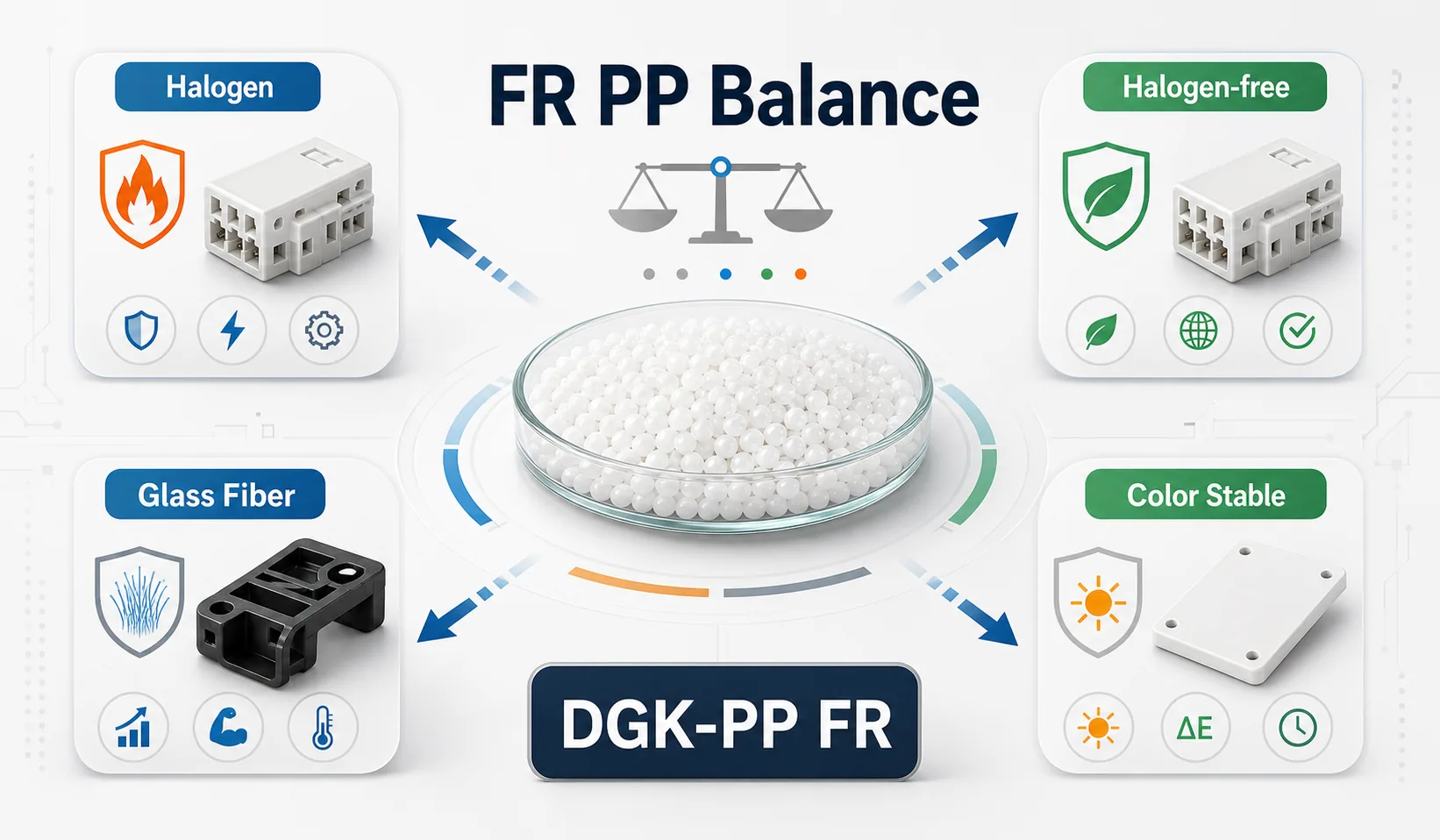
DEYU plastics usually evaluates four key directions first:
- Can the customer accept a halogen flame-retardant system?
- Is halogen-free, low-smoke, environmental, or export compliance required?
- Is glass fiber reinforcement, heat resistance, or dimensional stability required?
- Is the color white, light gray, natural, or another difficult color?
Only after these four points are clear can the correct flame-retardant PP formulation direction be determined.
1. Basic Logic for Selecting Flame-Retardant PP
Start with Flame Rating and Thickness
Flame rating must always be discussed together with thickness. A material that performs well at 3.0 mm may not pass at 1.6 mm, 1.0 mm, or 0.8 mm.
When consulting for flame-retardant PP, customers should clarify:
- test thickness
- minimum wall thickness of the actual part
- whether the test is based on standard test bars
- whether final molded part testing is required
- whether the part has ribs, snap-fits, screw bosses, thin walls, or large flat surfaces
DEYU suggestion: thickness is more important than the grade name alone. Without thickness, it is difficult to judge the correct flame-retardant system.
Then Check Environmental Requirements
If the product is used in export markets, electrical and electronic equipment, home appliances, automotive supply chains, or brand-name customer projects, it may need to comply with RoHS, REACH, halogen-free, low-halogen, red phosphorus restrictions, or customer-specific restricted substance lists.
A common selection logic is:
- if the customer does not restrict halogens and the product is a black internal structural part, halogen flame-retardant PP can be evaluated first
- if the customer requires halogen-free, low-smoke, export compliance, or white appearance, halogen-free flame-retardant PP is usually preferred
- if high stiffness, heat resistance, and dimensional stability are required, glass fiber reinforced flame-retardant PP should be evaluated
- if the customer needs white, light gray, or natural color, color stability must become a core requirement
Then Evaluate Mechanical Properties
After adding flame retardants, PP may lose impact strength, elongation, weld line strength, and low-temperature toughness. If the product has snap-fits, screw bosses, thin walls, drop requirements, assembly requirements, or vibration conditions, mechanical retention after flame-retardant modification must be validated.
Flame-retardant PP should also be evaluated for notched impact strength, flexural strength, screw boss tightening, repeated snap-fit assembly, drop performance, high-low temperature cycling, and mechanical retention after aging.
In real projects, DEYU often sees a common issue: the material passes flame testing, but snap-fits break during customer assembly. In this case, the problem is not flame rating. It is the lack of balance between the flame-retardant system and the toughness system.
Finally Check Production Stability
A qualified laboratory sample does not guarantee stable mass production. Flame-retardant PP must also be evaluated for blooming during continuous molding, mold deposit, batch color fluctuation, yellowing after screw residence time, short shot in thin-wall parts, flame retardant dispersion stability, frosting after long-term storage, and the impact of regrind ratio on flame retardancy.
2. Halogen Flame-Retardant PP
When It Is Suitable
Halogen flame-retardant PP usually has high flame-retardant efficiency, relatively controlled addition levels, and a better chance of achieving higher flame ratings at thinner thicknesses. It remains practical for black internal structural parts, electrical brackets, industrial components, connector housings, control boxes, and coil bobbins.
It is usually suitable when the customer does not require halogen-free material, the product is black or dark-colored, wall thickness is thin, cost control is important, the product is mainly an internal structural part, and stable flame retardancy with a wide processing window is required.
Advantages
For the same flame rating target, halogen systems often require a lower addition level and can better preserve flowability and processing stability.
Main advantages include easier V-0 direction formulation, better thin-wall potential, mature processing window, controllable cost, suitability for black and dark-colored parts, and friendly mass-production stability.
Risks
The key question is not whether halogen systems can be used, but whether the customer allows them. If the project requires halogen-free material, export compliance, brand environmental requirements, or specific restricted substance compliance, halogen systems may not be suitable.
Key points to check include RoHS or customer environmental lists, halogen content limits, smoke density, odor, thermal stability during processing, yellowing risk in light-colored parts, compatibility with antioxidants, lubricants, glass fiber, and pigments, and changes after long-term heat aging.
DEYU Suggestion
If the project is a black electrical internal part, control box, connector structure, or cost-sensitive flame-retardant PP application, and there is no halogen-free restriction, halogen flame-retardant PP is often efficient and cost-stable.
However, DEYU does not recommend choosing halogen systems only because they are cost-effective. A production-ready halogen flame-retardant PP still needs validation for thin-wall flame retardancy, impact retention, surface blooming, mold deposit, and continuous injection stability.
3. Halogen-Free Flame-Retardant PP
When It Is Suitable
Halogen-free flame-retardant PP is commonly used in appliances, electrical products, export products, indoor equipment, environmentally oriented structural parts, and white, light gray, or natural color applications. Many halogen-free systems use phosphorus-nitrogen intumescent technology, forming a char layer during burning to isolate heat and oxygen.
It is usually suitable when the customer clearly requires halogen-free material, the product is supplied to export markets or brand supply chains, the customer values environmental compliance, the product color is white or light-colored, or low smoke and low corrosion expectations are important.
Advantages
Halogen-free systems are more suitable for projects with higher environmental requirements. For many appliance, electronic, electrical, and export products, halogen-free flame-retardant PP is easier to align with customer expectations for eco-friendly materials.
Main advantages include suitability for halogen-free requirements, better alignment with white and light-color directions, easier control of smoke and corrosion concerns, and better fit for appliance, electrical, indoor structural, and export products.
Difficulties
The main difficulties come from higher loading and system sensitivity. To achieve higher flame ratings, halogen-free systems often require higher addition levels, which may affect PP flowability, impact strength, and surface condition.
Common issues include lower impact strength, lower flowability, more difficult thin-wall V-0, surface blooming or frosting, moisture-related processing instability, yellowing after heat aging in white parts, mold deposit during continuous injection, and burning fluctuation caused by poor flame retardant dispersion.
DEYU Suggestion
Halogen-free flame-retardant PP should not be selected only because it sounds more environmentally friendly. If the customer requires halogen-free, white color, high impact strength, thin-wall molding, low blooming, and V-0 at the same time, the project usually needs higher formulation cost, a narrower processing window, and a longer trial cycle.
In halogen-free flame-retardant PP projects, DEYU focuses on three balances: flame retardant loading versus flowability, flame-retardant system versus toughness system, and flame-retardant system versus color stability system.
4. Glass Fiber Reinforced Flame-Retardant PP
Glass fiber reinforced PP is often used for parts requiring high stiffness, heat resistance, dimensional stability, and structural strength, such as electrical brackets, fan structures, automotive functional parts, industrial equipment components, and low-voltage electrical structures.
Glass fiber itself is not a flame retardant. It can improve stiffness and heat resistance, but it changes burning behavior, melt dripping, char structure, surface quality, and weld line strength. Therefore, glass fiber reinforced flame-retardant PP is not simply glass fiber PP plus flame retardant. It is a compound formulation system.
Advantages
Glass fiber reinforced flame-retardant PP is suitable for projects requiring structural performance. It can provide higher stiffness, higher heat deflection temperature, better dimensional stability, lower creep deformation, and applicability to brackets, frames, holders, and load-bearing parts.
Difficulties
After adding glass fiber, flame-retardant PP faces more formulation conflicts:
- glass fiber may affect flame retardant dispersion
- fiber exposure may affect surface appearance
- weld line strength may decrease
- warpage may increase
- impact toughness may decrease
- flame retardant and glass fiber surface treatment may not be compatible
- white or light-colored glass fiber reinforced flame-retardant PP may show color difference and visible fiber more easily
DEYU Suggestion
Glass fiber reinforced flame-retardant PP must balance glass fiber content, flame-retardant system, compatibilizer system, and lubrication and processing stability system.
DEYU usually decides the glass fiber content according to part structure. If the customer prioritizes stiffness and heat resistance, glass fiber content can be increased. If assembly toughness and snap-fit strength are more important, glass fiber content should be controlled and supported with toughening and compatibilization.
5. Color Stability: The Underestimated Challenge
Black Flame-Retardant PP Still Has Color Issues
Many customers think black flame-retardant PP is simple. It is indeed easier to cover the natural color of flame retardants with black. However, black flame-retardant PP may still show grayish surface, batch color fluctuation, visible glass fiber, surface blooming, weld line whitening, darkening after heat aging, and mold deposit affecting surface quality during continuous molding.
Why White Flame-Retardant PP Is Difficult
White and light-colored flame-retardant PP is much more difficult than black. The flame retardant may have its own color; PP can change color during high-temperature processing; some halogen-free systems are sensitive to thermal stability; and titanium dioxide, pigments, antioxidants, and flame retardants may interact with each other.
White flame-retardant PP should not be judged only by initial whiteness. It should be evaluated for yellowing after heat aging, color drift during continuous injection, yellowing after machine stop and restart, frosting after storage, batch-to-batch color difference, and color consistency at different wall thicknesses.
DEYU Suggestion
Color-stable flame-retardant PP should be controlled from four aspects:
- color and thermal stability of the flame retardant itself
- antioxidant and processing stabilization system
- pigment, titanium dioxide, and dispersion system
- injection temperature, residence time, and mold venting
If white or light-colored flame-retardant PP is required, DEYU recommends that customers provide a color plate, target color code, actual wall thickness, and injection temperature range. This allows flame rating and color stability to be considered together during formulation development.
6. How to Balance the Four Directions
| Customer Priority | Preferred Direction | Main Advantage | Main Risk | DEYU Suggestion |
|---|---|---|---|---|
| Cost and flame-retardant efficiency | Halogen flame-retardant PP | High efficiency, easier thin-wall performance | Environmental list, smoke, light-color stability | Suitable for black internal structural parts |
| Halogen-free and export requirements | Halogen-free flame-retardant PP | More environmentally friendly, suitable for brand supply chains | Lower impact, blooming, lower flowability | Aging and continuous molding validation required |
| High stiffness and heat resistance | Glass fiber reinforced flame-retardant PP | High stiffness, dimensional stability | Fiber exposure, warpage, weak weld line | Compatibilizer and lubrication system required |
| White or light-color appearance | Color-stable flame-retardant PP | Better appearance consistency | Yellowing, frosting, batch color difference | Thermal aging and storage stability required |
| Thin-wall parts | High-efficiency FR plus high-flow PP | Better thin-wall molding | Dripping control, impact loss | Validate by actual thickness |
| Snap-fit and screw boss parts | High-impact flame-retardant PP | Better assembly reliability | Flame efficiency may be affected | Define impact retention target first |
| Outdoor electrical parts | Flame-retardant plus UV-resistant PP | Balanced flame retardancy and weathering | System interaction | Test flame retardancy after aging |
| Anti-static electrical parts | Flame-retardant plus anti-static PP | Functional compound solution | Migration, blooming, resistance fluctuation | Confirm resistance range first |
7. Customer Case: White Halogen-Free Glass Fiber Reinforced Flame-Retardant PP
Project Background
A customer produced an internal bracket for a home appliance using ordinary glass fiber reinforced PP. The part was installed inside an electrical appliance and needed good stiffness, heat resistance, flame retardancy, and dimensional stability. The customer also required an environmentally oriented material and preferred a halogen-free flame-retardant solution.
Initial requirements:
- material: halogen-free flame-retardant PP
- color: white
- structure: screw bosses and reinforcing ribs
- reinforcement: glass fiber reinforced for stiffness and dimensional stability
- flame target: 1.6 mm V-0 direction
- additional requirements: no obvious yellowing, no obvious blooming during continuous molding, no screw boss cracking
The difficulty was that halogen-free, white color, glass fiber reinforcement, flame retardancy, and screw boss strength all had to be balanced at the same time.
Problems with Previous Solutions
The first previous solution was ordinary halogen-free flame-retardant PP. It was close to the flame-retardant target, but stiffness was not enough and dimensional stability was insufficient.
The second was ordinary glass fiber reinforced PP with added flame-retardant masterbatch. Stiffness improved, but flame retardancy was unstable, the white color became yellowish, and slight blooming appeared on the mold and part surface during continuous molding.
DEYU identified the core conflicts:
- halogen-free flame retardants often require higher loading, which may affect impact and flow
- glass fiber improves stiffness but increases fiber exposure and weld line risk
- white systems are sensitive to flame retardant color and processing heat stability
- screw boss structures require toughness, not only stiffness
DEYU Adjustment Process
First trial: establishing a halogen-free flame-retardant base. DEYU first built a halogen-free intumescent flame-retardant system to establish stable flame-retardant performance around the 1.6 mm target. Flame retardancy improved clearly, but flowability decreased, white color showed slight yellowing, and screw boss tightening still had slight cracking risk.
Second trial: adding glass fiber and adjusting compatibilization. Glass fiber reinforcement was introduced and the compatibilizer system was adjusted to improve stiffness and dimensional stability. Flexural strength, heat resistance, and dimensional stability improved, but surface fiber exposure and weld line strength still needed optimization.
Third trial: optimizing color stability and low blooming. DEYU adjusted the antioxidant system, lubrication system, white pigment dispersion, and flame retardant dispersion to reduce processing yellowing and surface blooming. White color stability improved, surface blooming decreased during continuous molding, and part surface consistency improved.
Fourth trial: balancing screw boss toughness and glass fiber content. DEYU slightly adjusted glass fiber content and the toughness system according to the customer’s screw boss structure, avoiding cracking caused by excessive rigidity. Screw boss tightening passed, snap-fit assembly showed no obvious breakage, and flame retardancy, stiffness, color, and processing stability met the trial requirements.
Project Validation Data
The following data is from an anonymous project and is only used as a formulation logic example. Actual results should be based on the customer’s official test report.
| Test Item | Ordinary Halogen-Free FR PP | Glass Fiber PP + FR Masterbatch | DEYU DGK-PP FR Halogen-Free GF Solution |
|---|---|---|---|
| 1.6 mm flame performance | Close to target but fluctuating | Unstable | Stable V-0 direction validation |
| Flexural strength | Medium | Higher | Higher and more stable |
| Heat deflection performance | General | Improved | Clearly improved |
| White color stability | Slight yellowing | Obvious yellowing | Reduced yellowing |
| Surface blooming | Slight | More obvious | Clearly reduced |
| Screw boss tightening | Cracking risk | Higher cracking risk | No obvious cracking |
| Continuous molding stability | General | Mold deposit | Improved continuous molding |
The customer finally used DEYU DGK-PP FR halogen-free glass fiber reinforced flame-retardant PP for small-batch validation. According to customer feedback, stiffness, flame retardancy, color stability, and assembly reliability were more balanced than previous solutions and suitable for further mass-production evaluation.
8. DEYU Existing Solution Directions
Yuyao Deyu DEYU plastics has developed the DGK-PP FR flame-retardant modified polypropylene series, which can be adjusted according to different customer requirements.
Recommended Series
DGK-PP FR Flame-Retardant Modified Series
Available development directions include:
- halogen flame-retardant PP
- halogen-free flame-retardant PP
- black flame-retardant PP
- white flame-retardant PP
- high-impact flame-retardant PP
- low-blooming flame-retardant PP
- thin-wall flame-retardant PP
- glass fiber reinforced flame-retardant PP
- halogen-free glass fiber reinforced flame-retardant PP
- flame-retardant plus UV-resistant PP
- flame-retardant plus anti-static PP
- low-odor environmentally friendly flame-retardant PP
Suitable Applications
Home appliance internal brackets, electrical control boxes, coil bobbins, connector parts, low-voltage electrical housings, fan brackets, automotive interior functional parts, industrial equipment housings, tool boxes, white and light gray flame-retardant appearance parts, and thin-wall electronic and electrical components.
Information DEYU Recommends Customers Provide
To determine the flame-retardant PP solution more quickly, customers are advised to provide flame-retardant grade, test thickness, halogen-free requirement, color and color plate, glass fiber reinforcement requirement, target glass fiber content, glow wire requirement, impact, drop, snap-fit, or screw boss requirements, actual part photo or drawing, injection temperature, wall thickness, gate location, and environmental or export requirements.
FAQ
1. Is halogen flame-retardant PP better or halogen-free flame-retardant PP better?
There is no universal answer. Halogen flame-retardant PP usually has higher flame-retardant efficiency, better cost control, and a wider processing window. It is suitable for black internal parts and cost-sensitive projects. Halogen-free flame-retardant PP is more suitable for environmental, export, appliance, and light-colored applications, but it requires more attention to impact strength, flowability, blooming, and thin-wall flame retardancy.
2. Why does halogen-free flame-retardant PP lose impact strength more easily?
Halogen-free flame-retardant systems often require higher loading levels, which may affect the continuity and toughness of the PP matrix and reduce flowability. The PP base resin, toughening system, compatibilizer system, and flame retardant dispersion must be adjusted together.
3. Is glass fiber reinforced PP easier to make flame-retardant?
Not necessarily. Glass fiber improves stiffness and heat resistance, but it is not a flame retardant. It changes burning behavior, melt state, and char structure. Glass fiber reinforced flame-retardant PP therefore requires a dedicated compound formulation.
4. Why does white flame-retardant PP turn yellow easily?
White flame-retardant PP is affected by the natural color of the flame retardant, processing temperature, antioxidant system, pigment system, and heat aging. Halogen-free systems are especially sensitive if thermal stability and dispersion are not well controlled.
5. Can PP be halogen-free, glass fiber reinforced, and color-stable at the same time?
Yes, but the formulation is more difficult. Halogen-free systems, glass fiber reinforcement, and white or light-color stability affect each other. The flame-retardant system, glass fiber content, compatibilizer, antioxidant, lubricant, and color system must be optimized together and verified with actual molded parts.
6. If PP passes glow wire testing, does it automatically pass UL94?
No. UL94 and glow wire testing focus on different fire behaviors. UL94 mainly evaluates material burning behavior, while glow wire testing is closer to a heated source acting on the final part. Both should be tested separately according to customer requirements.
7. Can DEYU plastics customize flame-retardant PP according to customer parts?
Yes. Yuyao Deyu DEYU plastics can provide DGK-PP FR flame-retardant modified polypropylene solutions based on flame rating, thickness, color, halogen-free requirements, glass fiber reinforcement, impact strength, glow wire requirements, UV resistance, anti-static performance, and actual part structure. Small-batch trials and formulation adjustment are supported.
Conclusion
Flame-retardant PP selection is not a simple choice between halogen and halogen-free systems. It is a formulation balance based on the actual product.
If the customer values flame-retardant efficiency, thin-wall performance, and cost, halogen flame-retardant PP can be evaluated first. If the customer values environmental compliance, export requirements, low smoke, and brand supply chain requirements, halogen-free flame-retardant PP can be evaluated first. If the customer values stiffness, heat resistance, and dimensional stability, glass fiber reinforced flame-retardant PP should be evaluated. If the product is white, light gray, or natural color, color stability, thermal aging, and batch consistency must be treated as core requirements.
Yuyao Deyu DEYU plastics recommends that customers provide more than just “we need flame-retardant PP.” The flame rating, thickness, color, halogen-free requirement, glass fiber reinforcement, glow wire requirement, and actual part structure should be clarified. Based on these conditions, DEYU can provide DGK-PP FR flame-retardant modified polypropylene solutions to reduce trial errors and improve material selection and mass-production stability.