
DGK-PP DDL28 High-Conductive Polypropylene for Bipolar Plates and Electrode Components
DGK-PP DDL28 is DEYU plastics' ultra-high conductivity polypropylene compound, engineered for applications where conventional conductive plastics cannot deliver the required electrical performance. With electrical conductivity above 25 S/cm, this material should be evaluated by real part geometry, plate thickness, compression load, and the customer test method.
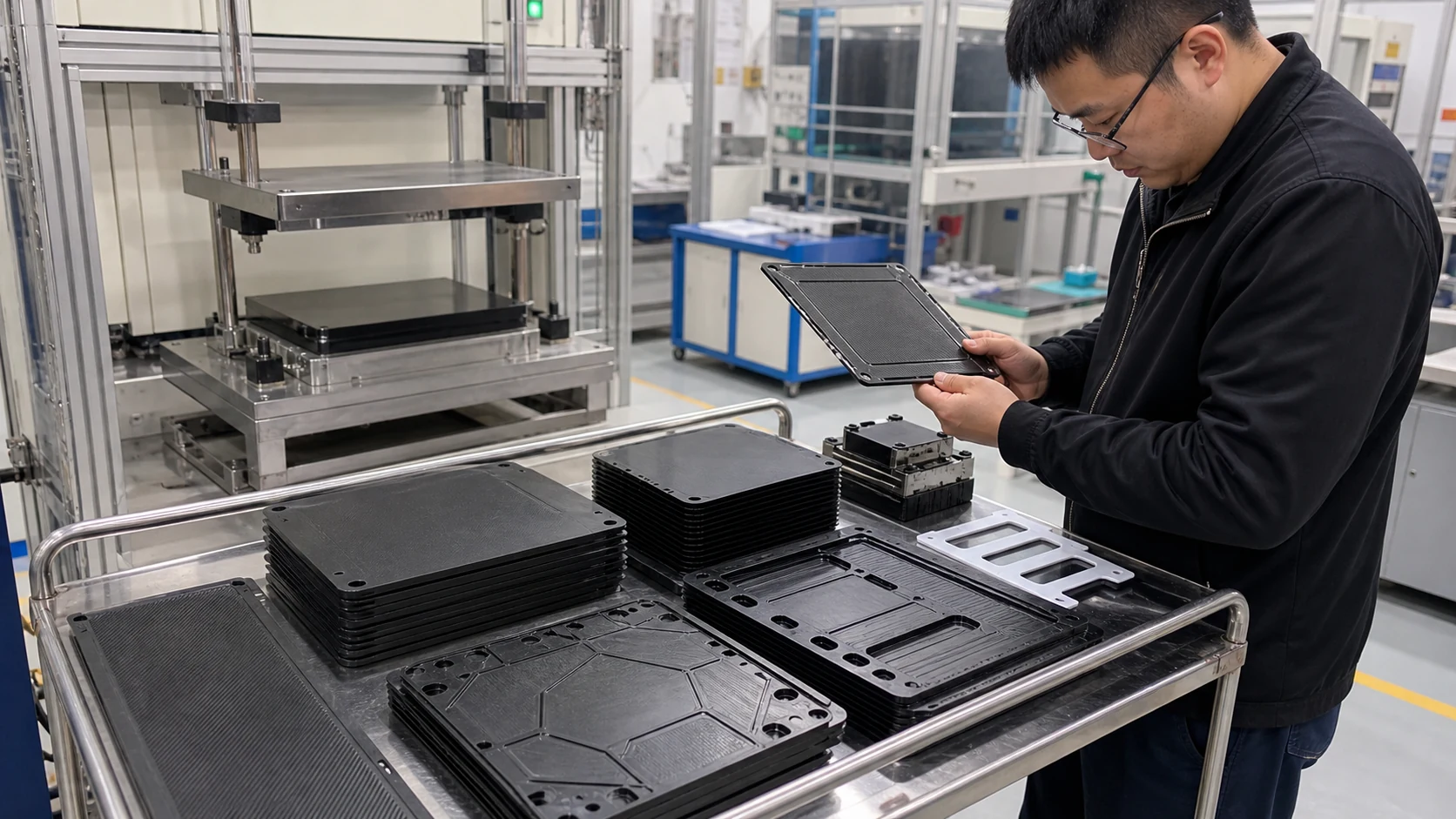
Buyer and engineer FAQ
Questions engineers often ask about this material route
Where can PP with a conductive plastic requirement be used?
Typical fields include ESD trays, electronic housings, fixtures, EMI parts and antistatic logistics parts. For this article, DEYU would first confirm the working environment, wall thickness, expected lifetime and whether conductive plastics product category, DGK-PP DD2-3A conductive PP matches the part geometry or needs formulation adjustment.
What are the main performance indicators for the "conductive plastic" target on PP?
Focus on surface resistance, volume resistance, dispersion uniformity, impact strength and molding stability. Buyers should ask for data on molded parts, not only pellet data, because gate position, filler orientation and thickness can change the final value.
What should engineers watch during injection molding or processing?
For PP, a practical starting window is 190-230°C melt / 30-60°C mold. Avoid excessive filler loading, control weld lines and verify resistance on the molded part. Final parameters should follow part thickness, gate design and the actual machine.
What details help DEYU recommend conductive plastics product category, DGK-PP DD2-3A conductive PP more accurately?
Send the current resin or grade, drawing or photo, wall thickness, annual quantity, target standard, failure mode and required color. If a reference grade already passed one test but failed in production, include both data sets.
For a precise recommendation, share the part drawing, base resin, target performance, processing method and test standard with DEYU.
Product Overview
DGK-PP DDL28 is DEYU plastics' ultra-high conductivity polypropylene compound, engineered for applications where conventional conductive plastics cannot deliver the required electrical performance. With electrical conductivity above 25 S/cm, this material should be evaluated by real part geometry, plate thickness, compression load, and the customer test method.
Related DEYU plastics material references for this selection topic: conductive plastics product category and DGK-PP DD2-3A conductive PP.
The product name "DDL28" reflects its core performance: "DD" denotes conductive, "L" indicates ultra-low resistivity, and "28" refers to its electrical conductivity of above 25 S/cm.
What >25 S/cm conductivity means in context:
| Material Type | Typical Volume Resistivity | Comparison to DDL28 |
|---|---|---|
| Standard conductive PP (carbon black) | 10² – 10³ Ω·cm | Thousands of times higher |
| High-conductivity reference level | 10⁰ – 10² Ω·cm | One order of magnitude higher |
| DGK-PP DDL28 | >25 S/cm | Baseline |
| Graphite | 0.01 – 0.1 Ω·cm | Comparable |
| Metal (aluminum, copper) | <10⁻⁴ Ω·cm | Still lower |
Traditional carbon black-filled conductive PP is often selected by resistance or conductivity range, but DDL28 should be evaluated by the customer test method, part thickness, filler dispersion, and molded-part stability.
Key applications:
Fuel cell bipolar plates (PEMFC)
Redox flow battery electrodes
Conductive structural components requiring high conductivity and part-level validation
Lightweight current collection and grounding components
Electrode plates for energy storage systems
Technical Foundation — Why DGK-PP DDL28 Achieves Ultra-High Conductivity
1. Advanced Hybrid Filler System
DGK-PP DDL28 achieves its ultra-low resistivity through a proprietary hybrid filler system that goes far beyond conventional carbon black loading. While standard conductive PP compounds rely on 15–20% carbon black to reach 10²–10³ Ω·cm, DDL28's advanced formulation creates a significantly more efficient conductive network.
The result: electrical conductivity above 25 S/cm, within the high-conductivity PP evaluation range for plate and electrode development.
2. PP Matrix — The Right Balance
Polypropylene was selected as the base resin for its unique combination of properties:
| Property | Value | Advantage |
|---|---|---|
| Density | ~0.90 g/cm³ | 80% lighter than metal; 50% lighter than graphite |
| Chemical resistance | Excellent (acids, alkalis, oils) | Survives aggressive PEM electrolyte environments |
| Processability | Wide processing window | Supports molding, extrusion, and compression molding |
| Cost | Low | Cost-effective compared to thermoset and metal alternatives |
3. Processing Flexibility
DGK-PP DDL28 supports multiple processing methods, making it adaptable to different manufacturing requirements:
| Processing Method | Suitability | Typical Applications |
|---|---|---|
| Compression molding | Excellent | Bipolar plates with flow channel structures |
| Extrusion | Excellent | Continuous production of sheets and profiles |
| Injection molding | Compatible | Complex structural components |
Compression molding is particularly suited for direct formation of bipolar plates with integrated flow channel structures — eliminating the need for costly CNC machining or secondary processing.
Product Data
Core Specifications:
| Property | Value | Test Method | Notes |
|---|---|---|---|
| Product Model | DGK-PP DDL28 | — | — |
| Base Resin | Polypropylene (PP) | — | — |
| Electrical Conductivity | ~>25 S/cm | — | — |
| Volume Resistivity | >25 S/cm | GB/T 1410 | Ultra-low — thousands of times lower than conventional conductive PP |
| Density | 0.90 – 0.94 g/cm³ | GB/T 1033 | 80% lighter than metal; 50% lighter than graphite |
| Processing Methods | Compression molding, extrusion, injection molding | — | Wide processing window |
| Appearance | Black | — | — |
| Packaging | 25 kg/bag | — | Standard industrial packaging |
| Storage | Dry, protected from light | — | Prevent moisture absorption affecting conductivity stability |
Material Comparison — How DDL28 Compares:
| Property | DGK-PP DDL28 | Standard Conductive PP | Graphite | Stainless Steel |
|---|---|---|---|---|
| Volume Resistivity (Ω·cm) | >25 S/cm | 10²–10³ | 0.01–0.1 | <10⁻⁴ |
| Density (g/cm³) | 0.90–0.94 | 0.95–1.02 | 1.8–2.0 | 7.8–8.0 |
| Corrosion Resistance | Excellent | Excellent | Excellent | Poor (in acidic PEM) |
| Processability | Excellent | Excellent | Poor (brittle, machining) | Good |
| Relative Weight | 1× | ~1.1× | 2× | 8× |
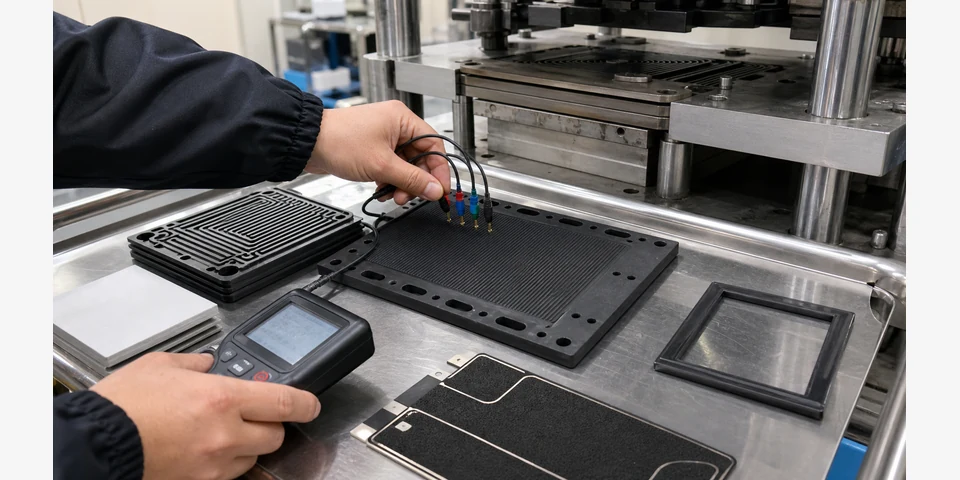
Application Deep Dive
1. Fuel Cell Bipolar Plates (PEMFC)
Bipolar plates are the backbone of proton exchange membrane fuel cells, accounting for 60–80% of total stack weight and 20–40% of manufacturing cost. They must collect and conduct current, separate oxidants and reductants, distribute reactant gases uniformly, manage heat and water, and provide structural support.
Why DGK-PP DDL28 for bipolar plates:
Ultra-high conductivity - >25 S/cm supports plate and electrode evaluation where the final requirement is confirmed by the customer test method
Chemical resistance — PP's inherent acid resistance survives the aggressive PEM electrolyte environment (pH 2–3, 60–80°C)
Weight reduction — 80% lighter than metal; 50% lighter than graphite
Processability — Compression molding directly forms flow channel structures, eliminating CNC machining
Cost-effective — Eliminates expensive coatings and graphitization processes
2. Redox Flow Battery Electrodes
In redox flow batteries, electrode plates must balance conductivity with chemical stability in aggressive electrolyte environments — sulfuric acid with vanadium ions in vanadium flow batteries, or bromine compounds in zinc-bromine systems.
Why DGK-PP DDL28 for flow battery electrodes:
Acid resistance — PP withstands acidic vanadium electrolyte environments
Ultra-low resistivity — Reduces internal resistance, improving battery efficiency
Dimensional stability — PP matrix maintains structural integrity in electrolyte immersion
3. Conductive Structural Components
Beyond energy applications, DGK-PP DDL28 serves as a lightweight alternative to metal in applications requiring both electrical conductivity and structural function:
Current collection components
Grounding and discharge components
EMI/RFI shielding structural parts
Lightweight conductive housings and enclosures
Processing Guidelines
Compression Molding (Recommended for Bipolar Plates):
Ideal for direct formation of flow channel structures
Eliminates secondary machining operations
Suitable for production of complex geometries
Extrusion:
Continuous production of sheets and profiles
Suitable for downstream welding and assembly
Compatible with roll-to-roll processing
Injection Molding:
Suitable for complex structural components
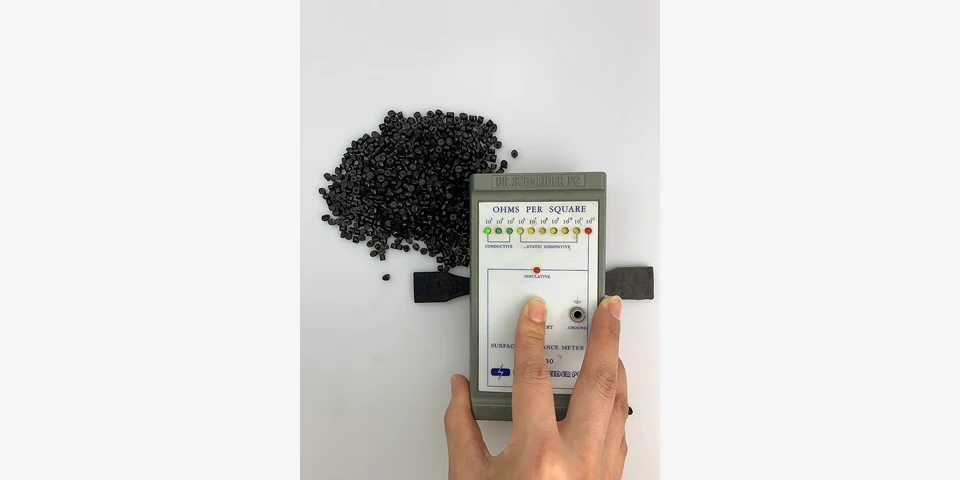
Supports high-volume production
Processing parameters must be optimized for filler dispersion
Key Processing Considerations:
Pre-drying recommended to prevent moisture-induced conductivity variation
Process parameters (temperature, pressure) must be adjusted for each processing method to ensure uniform filler dispersion
Small-batch trial recommended before full production to validate conductivity in the specific part geometry
Customer Validation Scenario
Context: A fuel cell stack manufacturer was developing a lightweight bipolar plate solution for automotive PEMFC applications. The initial material — a highly conductive graphite-filled thermoset composite — achieved the required conductivity (customer reference conductivity) but had three critical problems: (1) manufacturing costs were too high due to slow compression molding cycle times, (2) the plates were brittle with an elevated fracture risk during stack assembly, and (3) stack weight exceeded automotive targets (density 1.8 g/cm³).
Problem analysis:
| Issue | Root Cause | Impact |
|---|---|---|
| Slow production | Thermoset curing cycles | Manufacturing cost exceeded target by 40% |
| Brittle plates | High filler loading (80%+) in thermoset matrix | Elevated assembly fracture risk |
| Excessive weight | Density >1.8 g/cm³ | Stack weight above automotive targets |
DEYU solution — DGK-PP DDL28:
DEYU recommended switching to DGK-PP DDL28, offering:
Electrical conductivity above 25 S/cm - to be confirmed against the customer reference material
PP's inherent toughness — reducing fracture risk
Compression molding cycle time - process validation target
Density of 0.90–0.94 g/cm³ — 50% lighter than the thermoset
Validation Data Table (customer internal trial structure):
| Parameter | Graphite Thermoset | DGK-PP DDL28 | Target | Improvement |
|---|---|---|---|---|
| Volume Resistivity (Ω·cm) | customer reference conductivity | >25 S/cm | <0.05 | Comparable |
| Density (g/cm³) | 1.8–2.0 | 0.90–0.94 | <1.0 | -50% |
| Assembly Fracture Risk | Elevated risk | Lower-risk target | Confirm by project test | Validated on part geometry |
| Cycle Time (min) | 5–8 | 1.5–2 | <3 | Validation target |
| Corrosion Resistance | Excellent | Excellent | Pass | Comparable |
| Weight Reduction vs. Metal | 60% | 80% | Project target | +20% |
Result Interpretation:
DGK-PP DDL28 should be validated as a high-conductivity PP route above 25 S/cm. Final approval depends on plate thickness, compression load, flow-field geometry, molding method, and stack-level verification.
Next steps: Full production validation. DEYU can provide ongoing technical support and process optimization guidance.
Suitable Applications
| Application | Why DGK-PP DDL28 | Key Requirement |
|---|---|---|
| PEMFC bipolar plates | Ultra-high conductivity + corrosion resistance + light weight | >25 S/cm, acid resistance |
| Vanadium redox flow battery electrodes | Acid resistance + ultra-low resistivity | Chemical stability + conductivity |
| Zinc-bromine flow battery electrodes | Bromine resistance + conductivity | Chemical stability + conductivity |
| Current collection components | Metal-like conductivity in lightweight plastic | <0.05 Ω·cm, light weight |
| Conductive structural housings | Conductivity + structural integrity | Electrical function + mechanical strength |
| Grounding and discharge components | Low resistance path to ground | Project-specific conductivity target |
| Electrode plates for energy storage | Ultra-conductive for current collection | Project-specific conductivity target |
What Buyers Should Provide for Selection
To receive a precise recommendation for DGK-PP DDL28 applications, buyers should provide:
Target conductivity level - required level confirmed by test method
Application description — fuel cell bipolar plate, battery electrode, or structural component?
Part geometry — dimensions, flow channel complexity, wall thickness
Processing method — compression molding, extrusion, or injection molding
Environmental conditions — electrolyte chemistry, temperature range, chemical exposure
Production volume — annual quantity and target cycle time
Weight targets — maximum allowable density
Mechanical requirements — flexural strength, impact resistance targets
Cost targets — material cost per kilogram or per part
DEYU can support with:
Material selection for specific energy and structural applications
Process recommendations for compression molding, extrusion, and injection molding
Small-batch validation (25–100 kg) with full electrical and mechanical testing
Technical support during production scale-up
In-process quality monitoring protocols
Conclusion
DGK-PP DDL28 represents a high-conductivity route in conductive polypropylene technology. With electrical conductivity above 25 S/cm, it can support lightweight, corrosion-resistant conductive structural components, while final suitability must be confirmed by part-level testing.
Key takeaways:
Ultra-high conductivity - >25 S/cm, within the high-conductivity evaluation range and requiring part-level validation
Lightweight advantage — density of 0.90–0.94 g/cm³ — 80% lighter than metal, 50% lighter than graphite. Enables significant weight reduction in fuel cell stacks and battery systems
Chemical resistance — PP's inherent acid and alkali resistance makes DDL28 suitable for aggressive electrolyte environments in PEMFC and redox flow batteries
Processing flexibility — compatible with compression molding (flow channel structures), extrusion (continuous sheets), and injection molding (complex components)
Application-proven — validated in fuel cell bipolar plates, redox flow battery electrodes, and conductive structural components
Not for every application — for applications requiring only conventional ESD protection (10⁶–10⁹ Ω) or moderate conductivity (10³–10⁵ Ω), DEYU offers more cost-effective grades
DGK-PP DDL28 is available for small-batch validation and full production orders. DEYU plastics' technical team can provide application-specific guidance, process optimization support, and full test documentation for qualification and validation.