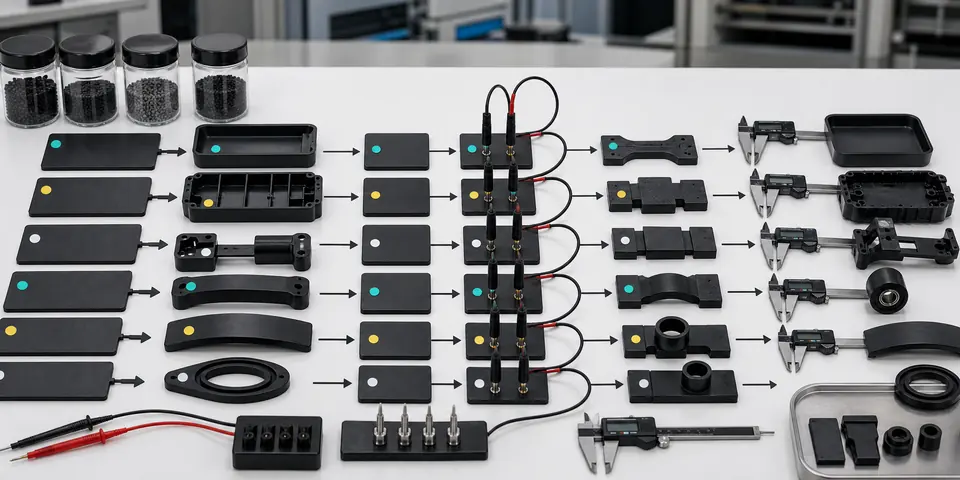
How to Choose Conductive Plastic Materials by Resin, Resistance and Application
Conductive plastic selection should start from the part function, not from a single resistance number or generic material name.
PP, PE, ABS, PA66, POM, TPU and TPR behave differently in flow, strength, wear, flexibility, surface quality and cost.
This guide connects resin choice, resistance range, filler route, processing method and final application risk into one material decision path.
DEYU helps buyers compare candidate routes and confirm the right compound through samples, testing and molded-part validation.
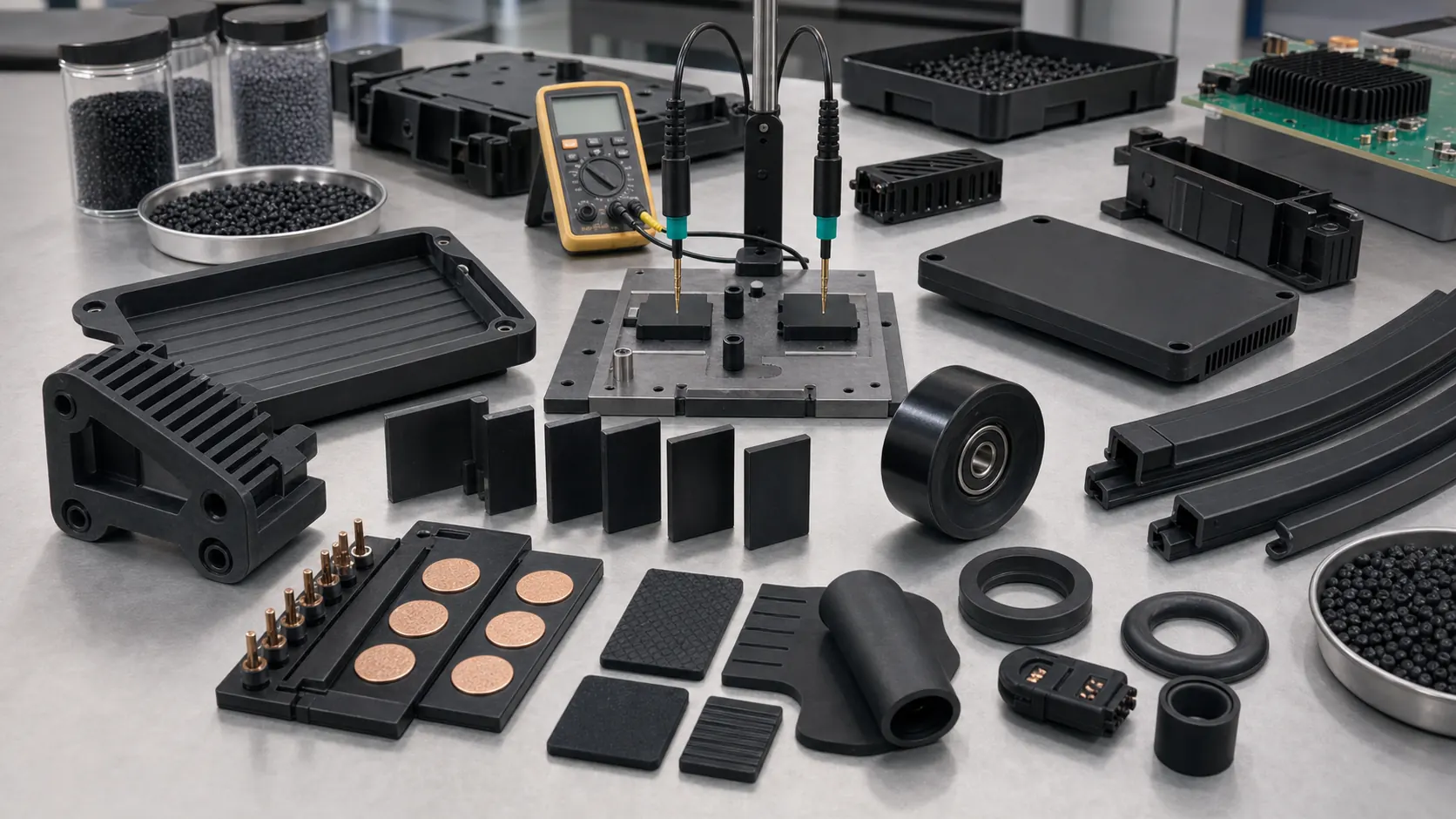
Buyer and engineer FAQ
Questions engineers often ask about this material route
Where can ABS / PA66 / PE / POM / PP / TPR / TPU with a conductive plastic requirement be used?
Typical fields include ESD trays, electronic housings, fixtures, EMI parts and antistatic logistics parts. For this article, DEYU would first confirm the working environment, wall thickness, expected lifetime and whether Conductive Plastics, Graphite Conductive ABS Pellets DGK-ABS DD3C, Carbon Fiber Reinforced PA66 Pellets DGK-PA66 CF15L-CF40L matches the part geometry or needs formulation adjustment.
What are the main performance indicators for the "conductive plastic" target on ABS / PA66 / PE / POM / PP / TPR / TPU?
Focus on surface resistance, volume resistance, dispersion uniformity, impact strength and molding stability. Buyers should ask for data on molded parts, not only pellet data, because gate position, filler orientation and thickness can change the final value.
What should engineers watch during injection molding or processing?
For ABS / PA66 / PE / POM / PP / TPR / TPU, a practical starting window is 210-245°C melt / 50-80°C mold. Avoid excessive filler loading, control weld lines and verify resistance on the molded part. Final parameters should follow part thickness, gate design and the actual machine.
What details help DEYU recommend Conductive Plastics, Graphite Conductive ABS Pellets DGK-ABS DD3C, Carbon Fiber Reinforced PA66 Pellets DGK-PA66 CF15L-CF40L more accurately?
Send the current resin or grade, drawing or photo, wall thickness, annual quantity, target standard, failure mode and required color. If a reference grade already passed one test but failed in production, include both data sets.
For a precise recommendation, share the part drawing, base resin, target performance, processing method and test standard with DEYU.
This page is for engineers and buyers who need to select conductive plastics by part function, resistance range and molded-part validation.
Conductive Plastics and Antistatic Plastics. Use the conductive and antistatic material platforms as the first split before choosing a specific resin and grade.
1. Background / Problem
Conductive plastic selection often starts with a target resistance number, but the real decision depends on the base resin, part geometry, strength requirement, processing route and service environment.
A material that works for a tray may not work for a bracket, sliding roller, flexible seal or high-conductive plate.
2. Technical Difficulty / Why It Happens
Resistance range, resin behavior and application function interact. PP and PE often focus on cost, flow and ESD logistics parts. ABS focuses on housings and appearance. PA66-CF focuses on strength and heat resistance. POM adds sliding and wear. TPU and TPR add flexibility and compression behavior.
3. DEYU Material Direction
DEYU usually starts by confirming whether the project needs antistatic, static dissipative or conductive behavior. Then the resin and conductive route are selected around molding, strength, appearance, wear, flame-retardant or elasticity requirements.
4. Reference Product Data
| Material direction | Data focus |
|---|---|
| Conductive plastics platform | PP / PE / ABS / PA / POM and engineering plastics with adjustable electrical behavior |
| Antistatic plastics platform | PP / PE / ABS / PS / PMMA / PC options for static dissipative or antistatic requirements |
| DGK-PP DD2-3A | Conductive 10^2-10^3 ohm for low-resistance PP parts |
| DGK-ABS DD3C | Graphite conductive ABS around 10^3-10^4 ohm |
| DGK-PA66 CF15L-CF40L | 15%-40% carbon fiber reinforced PA66 for high-strength conductive structural parts |
| DGK-POM DD4-5ML | Conductive 10^4-10^5 ohm with glossy surface and good toughness |
| DGK-TPU DD3-4ML / DGK-TPR DD6-9A | Flexible conductive directions for soft ESD parts and contact components |
5. Real Customer Application Case
A buyer first requested the lowest possible resistance for a logistics component. After part review, the target changed because the real failure was dust adhesion and handling damage, not current conduction. A lower-filler, easier-molding ESD direction became more practical.
6. Validation Data Table
| Item | Resistance-only selection | Resin + application selection | DEYU validation direction |
|---|---|---|---|
| Starting point | Lowest resistance | Function and resin | Function, resin and part test |
| Molding risk | High | Medium | Target controlled |
| Mechanical match | Unknown | Partly checked | Checked by part load |
| Cost control | Weak | Medium | Target balanced |
| Resistance stability | Plaque only | Plaque + part | Multiple positions on part |
| Internal pass rate | 72% | 84% | Target >90% |
This case is based on a real customer scenario from DEYU's internal project records.
7. Result Interpretation
The correct conductive plastic is the one that satisfies the application function with acceptable molding and mechanical risk. It is not always the grade with the lowest resistance value.
8. Suitable Applications
- ESD trays and liners
- Conductive housings and fixtures
- High-strength PA66-CF brackets
- Conductive POM sliding parts
- Flexible TPU and TPR ESD components
- Conductive PP plates and low-resistance parts
9. What Buyers Should Provide
Buyers should provide the required function, target resistance range, base resin preference, drawing, wall thickness, process, mechanical requirement, color or appearance requirement, use environment and current failure data.
Conclusion
Final material selection should be confirmed on the actual part: resistance, mechanics, processing, geometry and service conditions need to be evaluated together.