What Happens When Carbon Fiber Is Added to Plastic Products?
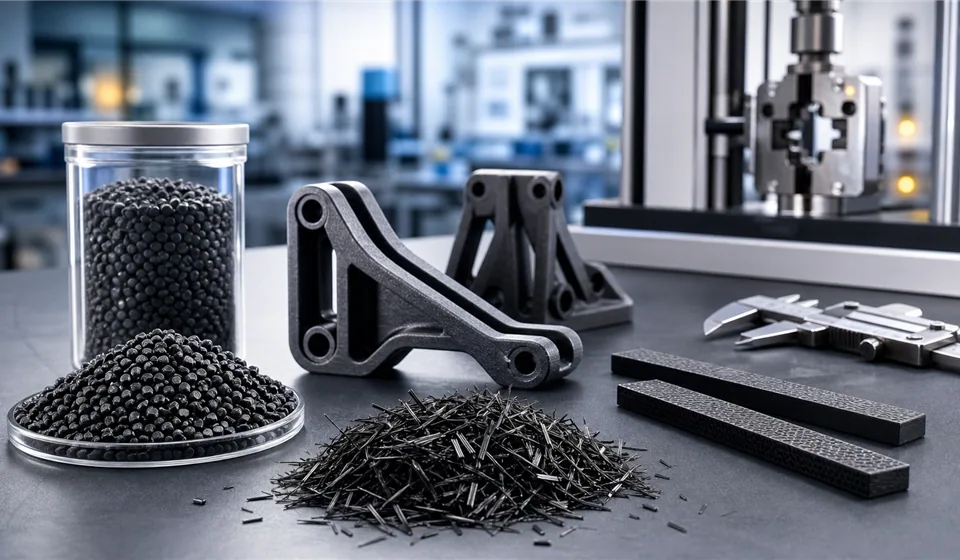
Adding carbon fiber to plastic can improve conductivity, stiffness, hardness, dimensional stability and heat resistance, but excessive carbon fiber may reduce impact strength, flowability and surface quality.
Buyer and engineer FAQ
Questions engineers often ask about this material route
Where can modified plastic with a reinforced plastic requirement be used?
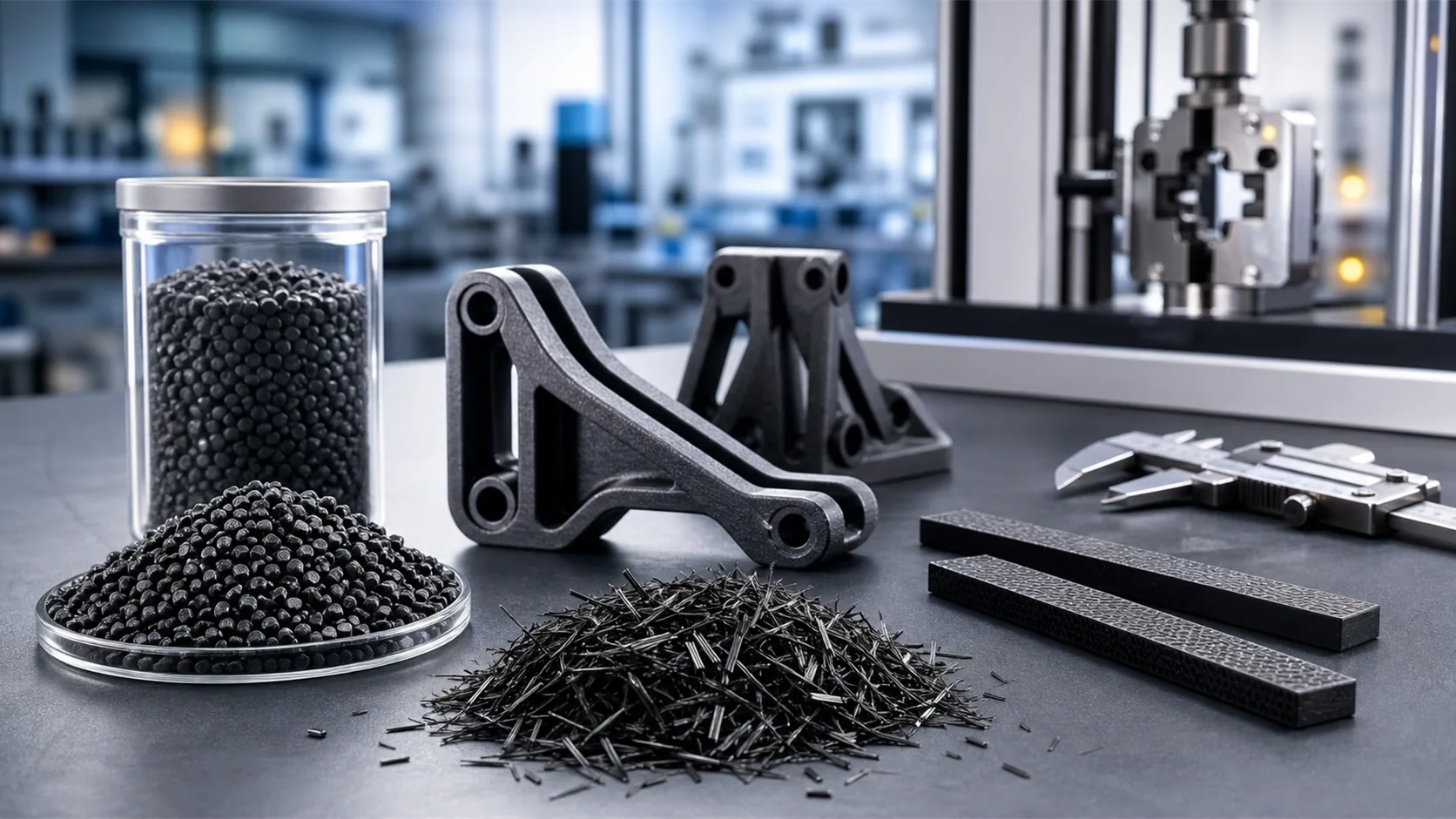
Typical fields include structural brackets, high-stiffness housings, supports, clips and metal-replacement parts. For this article, DEYU would first confirm the working environment, wall thickness, expected lifetime and whether DGK-ABS CF15L carbon fiber reinforced ABS, DGK-PA66 CF15L-CF40L customizable carbon fiber PA66 matches the part geometry or needs formulation adjustment.
What are the main performance indicators for the "reinforced plastic" target?
Focus on tensile strength, flexural modulus, impact balance, warpage, fiber orientation and screw holding. Buyers should ask for data on molded parts, not only pellet data, because gate position, filler orientation and thickness can change the final value.
What should engineers watch during injection molding or processing?
Control fiber breakage, gate direction and mold temperature; dry PA/PBT/PC blends before molding. Start from the base-resin processing window, then adjust by molded-part resistance, appearance and mechanical data.
What details help DEYU recommend DGK-ABS CF15L carbon fiber reinforced ABS, DGK-PA66 CF15L-CF40L customizable carbon fiber PA66 more accurately?
Send the current resin or grade, drawing or photo, wall thickness, annual quantity, target standard, failure mode and required color. If a reference grade already passed one test but failed in production, include both data sets.
For a precise recommendation, share the part drawing, base resin, target performance, processing method and test standard with DEYU.
Short Answer
When carbon fiber is added to plastic products, the most obvious effects are higher stiffness, higher hardness, improved dimensional stability, lower shrinkage, better heat deformation resistance and possible electrical conductivity. With the right formulation, carbon fiber reinforced plastics can also help reduce weight and replace selected metal or glass fiber reinforced parts.
However, carbon fiber is not “the more, the better.” As carbon fiber content increases, stiffness and conductivity may improve, but impact strength, elongation, flowability, surface quality and weld line strength may decrease. If the content is too high, the product may become brittle, difficult to mold, more prone to warpage and more expensive.
Yuyao Deyu DEYU plastics provides DGK-ABS CF15L carbon fiber reinforced ABS, DGK-PA66 CF15L-CF40L customizable carbon fiber PA66 and customized DGK carbon fiber reinforced compounds according to resin matrix, carbon fiber content, conductivity target, processing requirement and product application.
Carbon Fiber Is Not Just a Reinforcing Filler
In modified plastics, carbon fiber is often used when ordinary plastic or glass fiber reinforced plastic cannot meet the required stiffness, strength, conductivity, dimensional stability or lightweight target.
Many customers ask a simple question: “What will happen if carbon fiber is added to my product?”
The answer depends on carbon fiber content, base resin, fiber length, dispersion, surface treatment, processing method, mold design and application condition. Carbon fiber can significantly improve some properties, but it can also weaken others if not properly balanced.
In practical material selection, carbon fiber usually brings five major changes:
- the product becomes stiffer
- surface hardness and structural support improve
- dimensional stability becomes better
- electrical conductivity or anti-static performance may appear
- impact toughness and flowability may decrease if carbon fiber is excessive
Therefore, carbon fiber reinforced plastic should be treated as a formulation system, not as a simple additive. The correct question is not the highest carbon fiber content, but what content and resin base best match the product.
Main Effects of Adding Carbon Fiber
1. Stiffness Increases Significantly
The most direct effect of carbon fiber is stiffness improvement. Carbon fiber has high modulus, so after it is compounded into thermoplastic resin, the plastic part becomes less flexible and more resistant to bending deformation.
This is valuable for brackets, frames, structural supports, thin-wall housings, robotic components, precision positioning parts, metal replacement structures and parts that cannot deform under load.
However, higher stiffness also means the material becomes less flexible. If the part needs snap-fit movement, impact resistance, screw tightening or repeated assembly, the carbon fiber content must be carefully controlled.
2. Hardness and Surface Support Improve
Carbon fiber can improve the surface support of plastic parts. The material feels harder, more rigid and less easy to deform under pressure.
This is useful for parts that need better wear support, contact pressure resistance, less indentation, edge stability, dimensional retention and precise assembly positioning.
However, carbon fiber does not automatically mean better sliding wear in every condition. If carbon fiber is exposed on the surface, it may scratch the counter surface, especially when sliding against metal or softer plastic. For moving parts, carbon fiber may need to be combined with PTFE, MoS2, aramid fiber, silicone or other wear-resistant systems.
3. Electrical Conductivity or Anti-Static Performance May Improve
Carbon fiber can form conductive pathways inside the plastic matrix. When the carbon fiber content and dispersion reach a certain level, the material may show anti-static, static-dissipative or conductive behavior.
This is one of the key differences between carbon fiber and glass fiber. Typical applications include conductive housings, anti-static components, electronic device structures, industrial covers, sensor brackets and electrical equipment parts.
Conductivity does not increase linearly with carbon fiber content. There is usually a threshold. Below the threshold, resistance may still be high. Once a conductive network forms, resistance can drop significantly. After that, adding more carbon fiber may improve stability but also increases cost and brittleness.
4. Dimensional Stability and Shrinkage Control Improve
Carbon fiber can reduce molding shrinkage and improve dimensional stability. This is useful for precision parts and structural components that require stable assembly dimensions.
Benefits include lower shrinkage, better dimensional repeatability, less deformation under load, better long-term shape retention, better stability under heat and better control of precision assembly.
But carbon fiber also creates orientation effects. During injection molding, fibers align with the flow direction. This can create different shrinkage in different directions and may cause warpage if the part structure or gate design is not suitable.
5. Heat Deformation Resistance and Creep Resistance Improve
Carbon fiber reinforced plastics usually show better heat deformation resistance and lower creep than unfilled plastics. This is useful for automotive functional parts, industrial supports, electrical structural parts, power tool components, equipment brackets and parts under long-term load.
The heat resistance limit is still determined mainly by the base resin. Carbon fiber improves reinforcement, but it cannot make a low-temperature resin perform like a high-temperature resin. If the customer needs high heat resistance, the base resin must be selected first, then the carbon fiber content should be designed.
Carbon Fiber Content Gradient
The effect of carbon fiber changes gradually as content increases. The following table is a practical selection reference. Actual results depend on base resin, fiber type, dispersion, processing and part design.
| Carbon Fiber Content | Typical Effect | Main Advantages | Main Risks | Suitable Applications |
|---|---|---|---|---|
| 1-5% | Slight conductivity or functional adjustment | Small property improvement, low impact on flow | Conductivity may be unstable | Anti-static trial, light functional modification |
| 5-10% | Noticeable stiffness improvement, possible anti-static behavior | Better rigidity, moderate cost | Limited conductivity, moderate reinforcement | Housings, light brackets, anti-static parts |
| 10-15% | Clear stiffness and dimensional stability improvement | Balanced strength, flow and cost | Impact starts to decrease | Structural parts, conductive components, precision parts |
| 15-20% | Strong reinforcement and more stable conductivity | Higher modulus, better shrinkage control | Brittleness and flow risk increase | Industrial brackets, electrical parts, high-stiffness housings |
| 20-30% | High stiffness and strong functional performance | Good for high-rigidity and conductive applications | Higher cost, lower impact, warpage risk | Metal replacement trials, structural components, conductive parts |
| 30-40% | Very high stiffness and dimensional support | High modulus, strong deformation resistance | Brittle, difficult molding, surface and weld line risks | High-performance structural parts, selected engineering applications |
| Above 40% | Extreme reinforcement direction | Very high stiffness in selected systems | High brittleness, poor flow, high cost, processing difficulty | Special applications only after full validation |
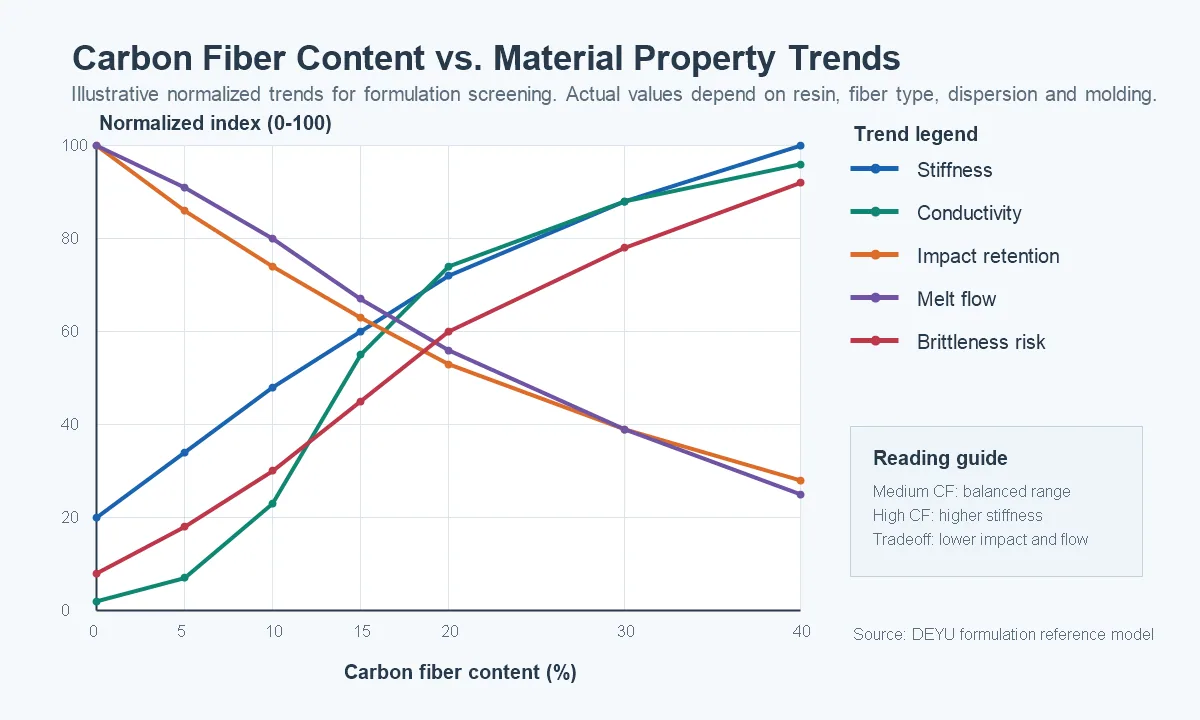
The chart above is an illustrative formulation model, not a universal data sheet. It shows the common engineering tradeoff: stiffness and conductivity usually increase as carbon fiber content rises, while impact retention and melt flow usually decrease. Brittleness risk tends to increase at higher loading.
For many products, 10-20% carbon fiber may already provide enough stiffness and dimensional stability. For some conductive applications, a well-dispersed medium carbon fiber content may perform better than a poorly dispersed high-content formula. For high-load structural parts, 20-30% or higher may be needed, but toughness and molding must be validated carefully.
Why Too Much Carbon Fiber Can Make Plastic Brittle
Carbon fiber improves stiffness, but it also reduces the ductility of the polymer matrix. When too much carbon fiber is added, the plastic may lose flexibility and impact absorption ability.
Common problems include:
- lower impact strength
- lower elongation
- weaker weld lines
- brittle screw bosses
- snap-fit cracking
- poor drop resistance
- surface roughness
- difficult injection molding
- strong fiber orientation
- higher warpage risk
For example, a high carbon fiber PA66 material may show excellent stiffness on a test bar, but if it is used in a part with screw holes or snap-fits, the part may crack during assembly. Therefore, carbon fiber reinforced plastic must balance stiffness and toughness. The target should not be the maximum carbon fiber content, but the best working content for the product.
DEYU plastics usually evaluates whether the customer’s part has screw bosses, mounting holes, clips, thin walls, weld lines or impact requirements before recommending carbon fiber content.
Selection Scenarios and Recommended Content Ranges
Anti-Static and Conductive Parts
For anti-static and conductive applications, the key is target resistance range, not maximum stiffness.
Recommended content direction:
- low anti-static trial: about 5-10%
- stable static dissipation: about 10-15%
- conductive structural parts: about 15-25%
- higher conductivity and stiffness: about 20-30%, depending on resin and part thickness
Suitable resin directions include PP for cost-sensitive anti-static parts, ABS or PC/ABS for housings, PA6 or PA66 for structural conductive parts, and PPS or PPA for high-temperature conductive parts.
High-Stiffness Structural Parts
For structural parts, stiffness, deformation resistance and dimensional stability are the main targets.
Recommended content direction:
- light structural reinforcement: about 10-15%
- strong stiffness improvement: about 15-25%
- high-load structural parts: about 25-35%
- special high-rigidity applications: above 35%, only after full validation
If the part has snap-fits, screw bosses or impact requirements, carbon fiber content should not be increased blindly. If deformation under load is the main issue, 15-20% carbon fiber may be considered depending on the resin.
Precision Dimensional Parts
For precision parts, the key target is dimensional stability, low shrinkage and low deformation.
Recommended content direction:
- precision dimensional improvement: about 10-15%
- high dimensional stability: about 15-25%
- special low-deformation structure: about 20-30%, depending on molding flow and wall thickness
Carbon fiber can reduce shrinkage but may increase anisotropic warpage. Gate position, wall thickness, flow direction and part shape must be evaluated.
Wear-Resistant Moving Parts
For moving parts, carbon fiber is not always the first or only answer. It can improve hardness and structural support, but it may also increase counter-surface wear if exposed.
For moving systems, carbon fiber is often combined with PTFE, MoS2, aramid fiber or silicone to balance rigidity, friction, wear and counter-surface protection.
Heat-Resistant Electrical and Automotive Parts
For heat-resistant applications, the base resin is more important than carbon fiber percentage alone.
Recommended content direction:
- basic high-heat reinforcement: about 10-15%
- high-stiffness heat-resistant parts: about 15-30%
- special high-temperature structural parts: 30% or above, depending on resin and molding
Carbon fiber improves stiffness and heat deformation performance, but the resin determines the real temperature limit.
Lightweight Metal Replacement
For selected metal replacement projects, the goal is usually not to completely copy metal performance. The goal is to reduce weight while meeting required stiffness, strength and safety margin.
Recommended content direction:
- lightweight functional replacement: about 15-25%
- strong structural replacement: about 25-35%
- special high-stiffness replacement: above 35%, only with strict validation
Metal replacement must consider screw fastening, fatigue, creep, impact, temperature and safety factor. A direct material swap without redesign may fail.
Base Resin Selection Guide
PA6 plus Carbon Fiber
PA6 carbon fiber reinforced materials are suitable for industrial structural parts, conductive components and cost-balanced reinforcement applications.
Advantages: good strength, reasonable processing performance, more controllable cost than high-end resins and broad industrial usability.
Key concerns: moisture absorption, dimensional change, impact balance and warpage control.
PA66 plus Carbon Fiber
PA66 carbon fiber reinforced materials are suitable for high-strength structural parts, automotive components, power tool parts and industrial brackets.
Advantages: higher strength and heat resistance than PA6, better structural performance, suitability for higher-load applications and metal replacement trials.
Key concerns: moisture absorption, brittleness at high fiber content, screw hole and snap-fit cracking risk, and processing stability.
PC / PC-ABS plus Carbon Fiber
PC and PC/ABS carbon fiber reinforced materials are suitable for housings, frames, conductive covers and parts requiring stiffness with some impact resistance.
Advantages: good appearance potential, good impact base, suitability for housings, and ability to design for conductivity or anti-static performance.
Key concerns: surface quality, flow marks, fiber exposure and impact reduction at higher content.
PPS / PPA / PEEK plus Carbon Fiber
These are high-performance carbon fiber reinforced systems for high-temperature, chemical-resistant and high-stiffness applications.
Advantages: high heat resistance, dimensional stability and strong structural support.
Key concerns: higher cost, higher processing temperature, strict molding control and the need for clear application justification.
PP / ABS plus Carbon Fiber
PP and ABS carbon fiber reinforced materials are suitable for cost-sensitive projects where stiffness, conductivity or lightweight performance must be improved.
Advantages: controllable cost, functional reinforcement, and suitability for housings and structural parts with moderate requirements.
Key concerns: interface compatibility, mechanical upper limit, heat resistance limitation and impact balance.
DEYU Carbon Fiber Content Customization Logic
DEYU does not recommend choosing carbon fiber content only by fixed grades. The development logic is based on product function and real working conditions.
Low Carbon Fiber Content: Functional Adjustment
Low carbon fiber content is suitable when the customer only needs slight conductivity, small stiffness improvement or early-stage trial. The key is keeping flowability and toughness while adding functional improvement.
Typical directions include anti-static trial, light stiffness improvement, cost-sensitive modification and thin-wall parts requiring flowability.
Medium Carbon Fiber Content: Balanced Performance
Medium carbon fiber content is often the most practical range. It can improve stiffness, dimensional stability and conductivity while keeping acceptable processing and toughness.
Typical directions include conductive housings, precision structural parts, industrial brackets, electrical components and medium-load reinforced parts.
High Carbon Fiber Content: High-Stiffness and Special Applications
High carbon fiber content is suitable for parts that truly need high modulus, strong deformation resistance and high conductivity.
Typical directions include metal replacement trials, high-stiffness brackets, high-temperature structural parts, high-performance conductive components and selected automotive or industrial applications.
This range requires strict validation of impact strength, flowability, weld line strength, surface quality, warpage and assembly reliability.
Application Case: Carbon Fiber Reinforced PA66 Structural Part
A customer used glass fiber reinforced PA66 for a structural bracket in industrial equipment. The original material had acceptable strength, but the bracket deformed under load. The customer wanted higher stiffness and better dimensional stability, but also needed screw hole assembly reliability.
DEYU recommended a carbon fiber reinforced PA66 direction and did not simply choose the highest carbon fiber content. The formulation was developed with a balanced carbon fiber level, toughness adjustment, fiber dispersion control and molding stability.
The development process focused on improving stiffness, reducing deformation, maintaining screw hole strength, controlling warpage and keeping injection molding stable. After trial molding, part deformation decreased and rigidity improved. Screw hole assembly remained acceptable after formulation adjustment.
Application Case: Conductive Carbon Fiber Precision Part
A customer needed a precision thermoplastic part with controlled conductivity. The original material provided dimensional stability, but it could not meet the electrical requirement. Some conductive filler solutions caused poor flowability and unstable surface appearance.
DEYU developed a carbon fiber reinforced solution focused on controlled surface resistance, dimensional stability, stable flowability, low warpage, acceptable surface appearance and balanced carbon fiber content.
Instead of using excessive carbon fiber, DEYU optimized carbon fiber dispersion and conductive network formation. After testing, the part achieved the target conductivity while maintaining the required dimensional control.
DEYU DGK Carbon Fiber Reinforced Material Platform
DEYU’s carbon fiber platform supports:
- custom carbon fiber content
- wide resin base coverage
- conductive and anti-static compounds
- high-stiffness structural compounds
- wear-resistant carbon fiber compounds
- heat-resistant carbon fiber compounds
- small-batch trials
- lab-level formulation adjustment
- production-scale delivery
Typical material directions include DGK-PA6 CF, DGK-PA66 CF, DGK-PC CF, DGK-ABS CF, DGK-PP CF, DGK-PPS CF, DGK-PPA CF, DGK-PEEK CF, DGK-PC/ABS CF, carbon fiber conductive compounds, carbon fiber wear-resistant compounds and carbon fiber flame-retardant compounds where required.
Information Customers Should Provide
To choose the correct carbon fiber content and resin base, DEYU recommends customers provide:
- product application
- current material
- target stiffness
- target conductivity or resistance range
- impact requirement
- working temperature
- load condition
- part wall thickness
- mold and gate information
- surface requirement
- whether wear resistance, flame retardancy or anti-static performance is required
- sample part, drawing or test standard
Based on this information, DEYU can determine whether the customer needs low, medium or high carbon fiber content, and which resin platform is most suitable.
FAQ
1. Does adding carbon fiber always make plastic stronger?
It usually improves stiffness and deformation resistance, but not every strength index improves. Impact strength, elongation and weld line strength may decrease if carbon fiber content is too high.
2. Can carbon fiber make plastic conductive?
Yes, if the fiber content and dispersion form a conductive network. The final resistance depends on resin, fiber type, loading, dispersion, wall thickness and molding direction.
3. What carbon fiber content is best?
There is no universal best percentage. Many applications work well in the 10-20% range, while high-stiffness or conductive structural parts may need higher content. The final choice must be validated by real part testing.
4. Why does carbon fiber plastic become brittle?
Carbon fiber restricts polymer deformation. Higher loading reduces matrix ductility and can create stress concentration, especially around screw holes, weld lines, snap-fits and thin-wall areas.
5. Can DEYU customize carbon fiber reinforced materials?
Yes. Yuyao Deyu DEYU plastics can customize carbon fiber reinforced thermoplastics by resin base, carbon fiber content, conductivity target, stiffness target, surface requirement and molding process.
Conclusion
Adding carbon fiber to plastic products can improve conductivity, stiffness, hardness, dimensional stability, heat deformation resistance and lightweight performance. But carbon fiber also changes toughness, flowability, surface quality, weld line strength, warpage and cost.
Low carbon fiber content is suitable for functional adjustment and anti-static trials. Medium carbon fiber content often provides the best balance of stiffness, conductivity, processability and cost. High carbon fiber content is suitable for high-stiffness, high-conductivity and selected metal replacement applications, but it must be carefully validated because brittleness and molding difficulty increase.
The best carbon fiber reinforced plastic solution is not the one with the highest percentage. It is the one that matches the product’s real load, temperature, conductivity, dimensional accuracy, impact requirement, processing method and cost target.