
Wear-Resistant POM vs PA66: Differences, Cost Logic and DEYU Aramid Solutions
Compare wear-resistant POM and wear-resistant PA66 for gears, bushings, sliders, rollers and moving mechanical parts. Learn when to choose POM aramid or PA66 aramid solutions from DEYU plastics.
Buyer and engineer FAQ
Questions engineers often ask about this material route
Where can PA66 / POM with a wear-resistant plastic requirement be used?
Typical fields include gears, rollers, bushings, sliding blocks, guide rails and low-noise moving parts. For this article, DEYU would first confirm the working environment, wall thickness, expected lifetime and whether DGK-POM FL100T aramid fiber reinforced POM, DGK-PA66 FL20L aramid reinforced PA66 matches the part geometry or needs formulation adjustment.
What are the main performance indicators for the "wear-resistant plastic" target on PA66 / POM?
Focus on friction coefficient, wear depth, PV value, noise, dimensional stability and mating material compatibility. Buyers should ask for data on molded parts, not only pellet data, because gate position, filler orientation and thickness can change the final value.
What should engineers watch during injection molding or processing?
For PA66 / POM, a practical starting window is 260-295°C melt / 75-100°C mold, dry before molding. Dry PA grades correctly, control glass or aramid fiber orientation and validate wear on the real mating surface. Final parameters should follow part thickness, gate design and the actual machine.
What details help DEYU recommend DGK-POM FL100T aramid fiber reinforced POM, DGK-PA66 FL20L aramid reinforced PA66 more accurately?
Send the current resin or grade, drawing or photo, wall thickness, annual quantity, target standard, failure mode and required color. If a reference grade already passed one test but failed in production, include both data sets.
For a precise recommendation, share the part drawing, base resin, target performance, processing method and test standard with DEYU.
Short Answer
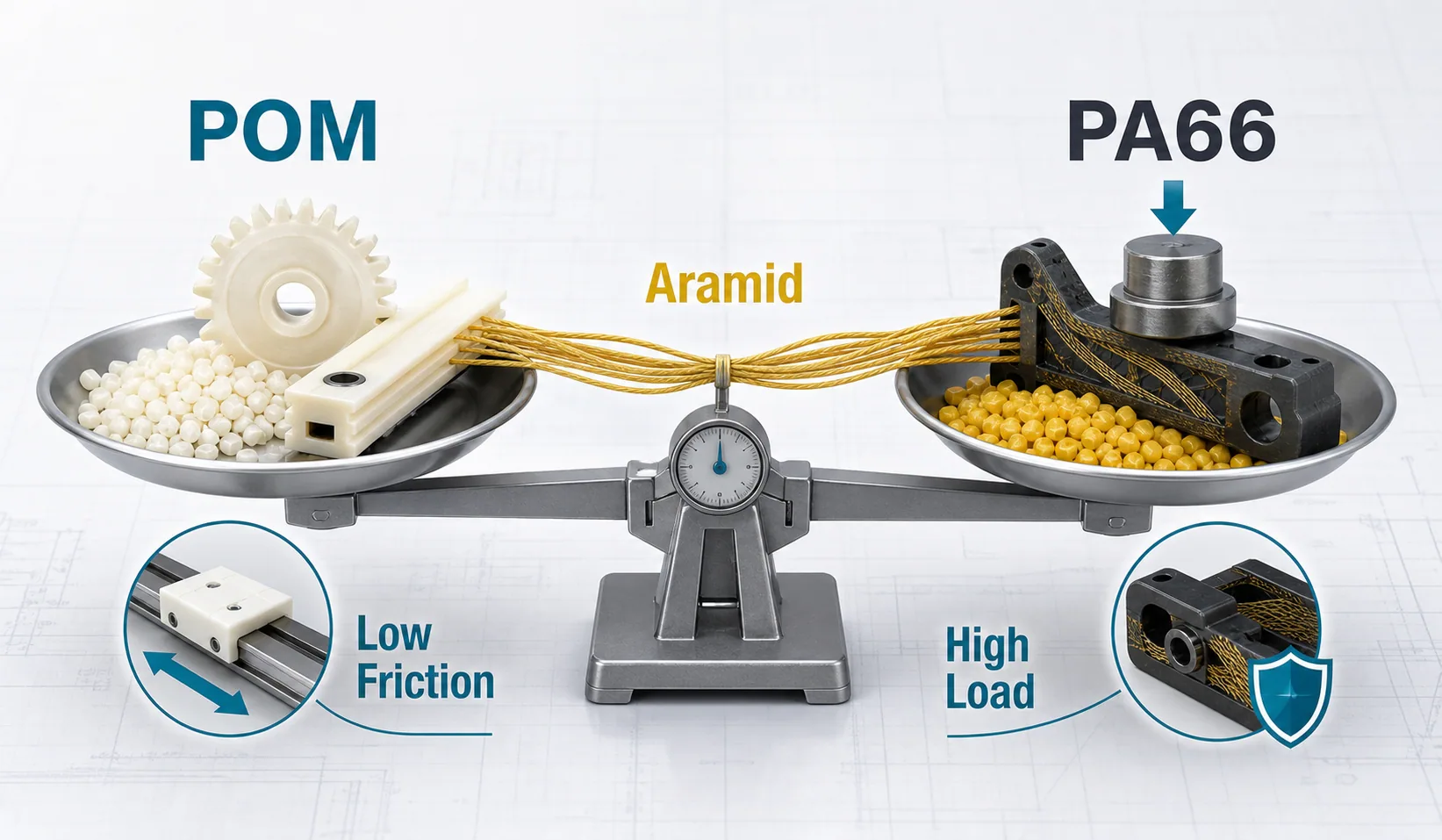
Wear-resistant POM is usually better for low friction, low moisture absorption, dimensional stability, precise sliding and low-noise gear applications. Wear-resistant PA66 is usually better for higher strength, higher impact toughness, higher load-bearing parts, heat resistance and complex structural parts. Yuyao Deyu DEYU plastics provides two aramid-reinforced wear-resistant routes: DGK-POM FL100T aramid fiber reinforced POM and DGK-PA66 FL20L aramid reinforced PA66 for different wear, load and cost targets.
Why Customers Compare Wear-Resistant POM and PA66
POM and PA66 are both common engineering plastics for wear-resistant moving parts. They are used in gears, bushings, sliders, guide blocks, rollers, sleeves, brackets and mechanical transmission components. If the requirement is only described as “wear resistant,” both may look suitable at first.
In real projects, their behavior is different. POM naturally has low friction, low moisture absorption, good dimensional stability and smooth sliding behavior. PA66 has stronger mechanical strength, better toughness, higher load-bearing potential and better structural reliability in many reinforced or modified systems.
The correct question is not which one is absolutely better. The better question is: does the part need low friction and dimensional precision, or does it need higher strength, impact toughness and structural reliability under load?
DEYU usually starts material selection by confirming five points:
- counter material: metal, plastic, rubber or coated surface
- movement type: sliding, rolling or gear engagement
- condition: dry, slightly lubricated or continuously lubricated
- priority: dimensional stability and low noise, or strength and life under load
- target cost and the material being replaced
Only after these points are clear can the direction be set: wear-resistant POM, wear-resistant PA66, aramid-reinforced POM, aramid-reinforced PA66, PTFE modification, MoS2 modification or a combined system.
1. Wear-Resistant POM: Low Friction and Dimensional Stability
POM, or polyoxymethylene, is a highly crystalline engineering plastic. It is valued for low friction, good rigidity, fatigue resistance, low water absorption and stable dimensions. In many medium-load applications with precise sliding or gear engagement, POM is often the first material to evaluate.
Its main advantages in wear-resistant parts include:
- naturally smooth sliding surface
- relatively low friction coefficient
- low moisture-related dimensional change compared with PA66
- good dimensional repeatability in small precision parts
- suitability for quiet gears, rollers, sliders and guide components
This makes POM attractive for small gears, precision sliders, low-noise rollers, conveyor components, guide blocks, office equipment parts, appliance transmission parts and light-to-medium load mechanical sliding parts.
POM also has limits. It is not always the best choice for high impact, high temperature, high structural load or assembly designs with screw bosses and snap-fits. Its processing temperature and residence time also need good control to avoid degradation or surface defects.
When standard POM does not provide enough wear life, aramid fiber, PTFE, silicone or other lubricating systems can be introduced. For customers who want to stay in the POM system while improving tooth-surface wear, slider life or dry friction behavior, DGK-POM FL100T is a practical direction.
2. Wear-Resistant PA66: Strength, Toughness and Load-Bearing Reliability
PA66, or nylon 66, has stronger mechanical performance than POM in many structural applications. It is often selected when the part must withstand higher load, impact, vibration, mounting stress or long-term operation in a more demanding assembly.
Its advantages include:
- higher strength and toughness potential
- better load-bearing ability after reinforcement or modification
- suitability for screw bosses, mounting holes, snap-fits and brackets
- better heat-resistance direction than many POM applications
- good formulation flexibility with aramid fiber, glass fiber, PTFE, MoS2 and toughening systems
PA66 is commonly evaluated for high-strength gears, loaded sliders, wear-resistant brackets, bushings, automotive functional parts, power tool components, industrial moving parts and parts with mounting holes or complex structures.
PA66 also has selection risks. It absorbs more moisture than POM, so dimensional change must be considered. In friction systems, ordinary glass fiber reinforced PA66 may improve stiffness but can damage the counter surface if glass fiber becomes exposed. Therefore, wear-resistant PA66 is not simply “stronger nylon.” The formulation must balance reinforcement, lubrication, toughness and counter-surface friendliness.
DGK-PA66 FL20L uses aramid reinforcement to improve wear resistance and shrinkage control while supporting strength and structural reliability for precision friction parts.
3. POM vs PA66 Selection Logic
| Requirement | POM Direction | PA66 Direction |
|---|---|---|
| Low friction and smooth sliding | Strong fit | Can be improved by formulation |
| Dimensional stability under humidity | Stronger | Needs moisture evaluation |
| Low-noise precision gear | Strong fit | Suitable when strength is also required |
| High load and structural strength | Needs validation | Strong fit |
| Screw bosses and mounting holes | Structure-dependent | Usually stronger |
| Heat-resistant loaded part | Limited by grade | Better direction |
| Counter-surface friendliness | Good with proper formulation | Avoid exposed glass fiber; aramid can help |
| Cost-sensitive precision part | Often practical | Depends on required grade |
For a small precise gear where noise, smooth movement and dimensional consistency are the key targets, POM is usually evaluated first. For a loaded slider, bracket or moving part with mounting holes and impact risk, PA66 is often more suitable.
4. Why Use Aramid Fiber in Wear-Resistant POM and PA66?
Aramid fiber is used in wear-resistant compounds because it can provide fiber reinforcement and surface support without behaving like glass fiber in many friction interfaces. It can help improve wear stability, reduce deformation, support the sliding surface and improve service life.
In POM systems, aramid reinforcement helps strengthen the wear surface while retaining POM’s low friction, low moisture absorption and dimensional stability. This is useful for precision gears, sliders, rollers and guide components where the customer wants better wear life without moving to nylon.
In PA66 systems, aramid reinforcement helps improve wear resistance and shrinkage control while keeping better structural toughness than a purely rigid high-glass-fiber approach. This is useful when the part must carry load, keep mounting-hole strength and reduce counter-surface damage.
Aramid is not a universal additive. Fiber content, fiber dispersion, lubricant balance, matrix toughness and molding stability all affect final performance. A high aramid loading without formulation balance can still cause surface quality issues, brittleness or processing instability.
5. Cost Logic: Do Not Compare Only Resin Names
Customers sometimes compare POM and PA66 by resin name or ask which one is cheaper. This is not enough. The real cost includes material price, wear life, defective rate, tooling compatibility, dimensional stability, maintenance cost and replacement frequency.
In one project direction, DEYU’s PA66 aramid solution was evaluated as a domestic replacement for an imported wear-resistant nylon. According to project calculation, the material cost could be reduced by about 43% while keeping the wear-life target within the customer’s acceptable performance window. This figure is project-specific and should not be treated as a universal guarantee.
For POM, the cost logic is different. DGK-POM FL100T is often evaluated when customers want to benchmark higher-grade wear-resistant POM applications while keeping the benefits of low moisture absorption and dimensional precision. The value is not only price; it is the ability to improve wear life without changing the material family.
6. Customer Case: Replacing Imported Wear-Resistant PA66
A customer used an imported wear-resistant nylon for a loaded moving component. The part required wear life, mounting-hole reliability, stable molding and acceptable counter-surface damage. The customer wanted to compare service life with the imported solution and reduce material cost.
DEYU judged that ordinary PA66 would not provide enough wear life, while a simple glass-fiber reinforced PA66 could increase stiffness but might increase metal guide wear. The project needed wear resistance under load and a counter-surface-friendly reinforcement route.
DEYU recommended an aramid-reinforced PA66 solution. The first formulation improved wear resistance, but mounting-hole toughness still needed adjustment. The second formulation improved aramid dispersion and PA66 matrix toughness. The third formulation optimized flowability and dimensional stability for continuous molding.
After small-batch validation, the customer reported that the DEYU solution was close to the imported material in the agreed wear-life window, while mounting-hole strength and molding stability met the project requirements. Based on the project calculation, material cost was about 43% lower than the imported comparison material.
7. Customer Case: Improving a POM Gear with Aramid
Another customer produced a small transmission gear using standard wear-resistant POM. The part required low noise, stable dimensions and long service life. Standard POM worked well at the beginning, but after long gear engagement, tooth wear increased, noise rose and tooth profile precision declined.
The customer did not want to switch to PA66 because moisture absorption and dimensional change could affect gear precision. DEYU therefore recommended a DGK-POM FL100T aramid POM direction.
The first trial improved tooth wear resistance. The second trial adjusted aramid dispersion and lubricant balance to make gear engagement smoother and slow down noise growth. The third trial optimized molding dimensional stability. The customer passed the first-stage validation and continued life testing.
This case shows why aramid POM is valuable: it helps improve wear life while keeping the dimensional stability and low-friction behavior that made the customer choose POM in the first place.
8. DEYU Existing Solution Directions
DGK-POM FL100T Aramid POM
Recommended for POM gears, rollers, sliders, guide blocks, bushings, conveyor components, low-noise transmission parts and precision wear-resistant structures. It is suitable when low friction, low moisture absorption, dimensional stability and improved wear life must be balanced.
DGK-PA66 FL20L Aramid PA66
Recommended for high-strength gears, loaded sliders, wear-resistant brackets, bushings, automotive functional parts, power tool parts, industrial moving components and structures with mounting holes, screw bosses or snap-fits. It is suitable when the customer needs stronger load-bearing ability, toughness and wear resistance than standard PA66.
FAQ
Is POM more wear-resistant than PA66?
Not universally. POM is often better for low-friction precision sliding and gear applications. PA66 can be better for high-load structural parts after suitable wear-resistant modification.
Is aramid better than glass fiber for wear parts?
For many friction applications, aramid can be more counter-surface-friendly than exposed glass fiber. Glass fiber improves stiffness, but it is not a lubricant and may increase counter-surface wear in some systems.
Can POM replace PA66?
Sometimes, especially when low friction and dimensional stability are more important than structural toughness. If the part has high load, impact, mounting holes or heat requirements, PA66 may still be better.
Can PA66 replace imported wear-resistant nylon?
It depends on the target material, wear life, load, counter surface and cost window. DEYU can develop PA66 aramid formulations for replacement evaluation, but final approval must come from customer testing.
Conclusion
Wear-resistant POM and wear-resistant PA66 should not be judged as simply better or worse. POM is stronger in low friction, low moisture absorption, precision movement and dimensional stability. PA66 is stronger in load-bearing, toughness, structural reliability and higher-demand mechanical parts.
DEYU plastics develops aramid wear-resistant solutions around both systems. DGK-POM FL100T helps customers improve POM wear life while keeping POM’s low-friction and dimensionally stable character. DGK-PA66 FL20L helps customers build stronger wear-resistant nylon parts and evaluate replacement of certain imported high-cost nylon solutions.
For wear-resistant POM, wear-resistant PA66, aramid POM compounds or PA66 aramid replacement projects, customers can contact Yuyao Deyu DEYU plastics with part application, counter material, load, speed, temperature, lubrication condition, structure, current problem and target life.