
How to Choose UV-Resistant ABS? 10 Application Scenarios and DEYU Plastic Solutions
UV-resistant ABS selection guide covering color stability, yellowing, outdoor exposure, impact retention, gloss, flame retardancy, painting and structural validation.
Buyer and engineer FAQ
Questions engineers often ask about this material route
Where can ABS with a UV-resistant plastic requirement be used?
Typical fields include outdoor clips, covers, housings, liners, sheets, equipment shells and exposed appearance parts. For this article, DEYU would first confirm the working environment, wall thickness, expected lifetime and whether DGK-ABS R165UV UV-resistant ABS matches the part geometry or needs formulation adjustment.
What are the main performance indicators for the "UV-resistant plastic" target on ABS?
Focus on color change, gloss retention, tensile retention, impact retention and weathering hours. Buyers should ask for data on molded parts, not only pellet data, because gate position, filler orientation and thickness can change the final value.
What should engineers watch during injection molding or processing?
For ABS, a practical starting window is 210-245°C melt / 50-80°C mold. Avoid overheating pigments or HALS systems, use stable black or color packages and validate outdoor aging. Final parameters should follow part thickness, gate design and the actual machine.
What details help DEYU recommend DGK-ABS R165UV UV-resistant ABS more accurately?
Send the current resin or grade, drawing or photo, wall thickness, annual quantity, target standard, failure mode and required color. If a reference grade already passed one test but failed in production, include both data sets.
For a precise recommendation, share the part drawing, base resin, target performance, processing method and test standard with DEYU.
Short Answer
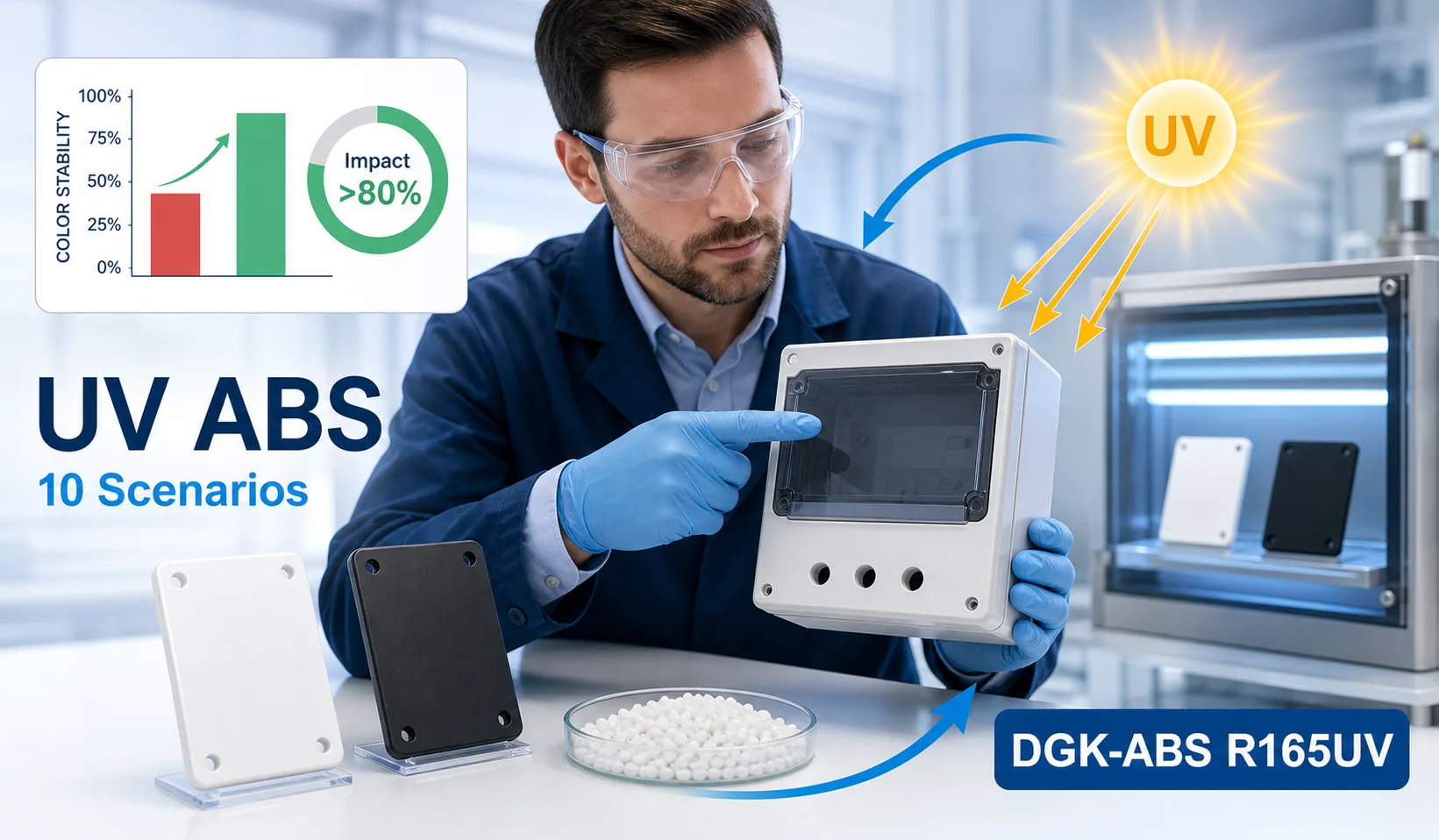
UV-resistant ABS should not be selected only by asking whether the material contains UV additives. A reliable selection should consider product color, outdoor exposure, UV aging time, impact retention, yellowing, surface gloss, snap-fit structure, screw boss strength, and whether the part also requires flame retardancy, painting, plating, anti-static performance, or heat resistance. Yuyao Deyu DEYU plastics provides DGK-ABS R165UV UV-resistant ABS and customized DGK-ABS UV weather-resistant modified ABS solutions based on real application conditions and part-level validation.
Introduction: Why Standard ABS Yellows, Fades, or Becomes Brittle
ABS is widely used in appliance housings, automotive interior parts, control panels, tool housings, equipment covers, and electronic enclosures because it offers good toughness, rigidity, dimensional stability, and processability.
However, standard ABS may show several problems after long-term exposure to ultraviolet light, heat, oxygen, and humidity:
- yellowing of white or light-colored parts
- fading or whitening of black parts
- surface gloss loss
- powdering or chalking
- brittle snap-fits
- cracked screw bosses
- reduced impact strength
- poor surface stability after painting, plating, or printing
Many customers simply ask: “Do you have UV-resistant ABS?” In actual material selection, this question is not enough. UV resistance is not a single property. It is a complete validation process based on application environment, appearance requirements, mechanical retention, processing conditions, and additional functional requirements.
DEYU plastics usually starts with three questions:
- Is the product used indoors, near windows, semi-outdoors, or fully outdoors?
- Is the customer more concerned about appearance retention or mechanical strength retention?
- Does the part also require flame retardancy, anti-static performance, heat resistance, painting, plating, or high-gloss surface quality?
Only after these conditions are confirmed can a suitable ABS UV modification solution be selected.
Technical Route: How UV-Resistant ABS Is Formulated
UV-resistant ABS is not made by simply adding one UV additive. It normally requires a balanced formulation system including base resin, UV absorber, hindered amine light stabilizer, antioxidant package, pigment system, and processing stabilizer.
1. ABS Base Resin Selection
ABS is not the most weather-resistant plastic for long-term outdoor exposure. If the part is exposed to strong sunlight, rain, high temperature, and long outdoor aging for years, ASA, PC/ABS, or ASA/ABS may also need to be evaluated.
For medium weathering conditions, such as indoor window-side parts, automotive interiors, small outdoor housings, tool shells, and equipment covers, modified ABS can still be a practical and cost-effective solution.
2. UV Absorber
UV absorbers help reduce the damage caused by ultraviolet light to the ABS polymer chain. They are commonly used to improve yellowing resistance, surface appearance, and color stability.
3. Hindered Amine Light Stabilizer
Hindered amine light stabilizers help slow down photo-oxidation. They are often used together with UV absorbers instead of being used alone.
4. Antioxidant System
ABS can also degrade during high-temperature processing and long-term heat exposure. A suitable antioxidant system helps improve processing stability and aging resistance.
5. Pigment and Color System
Black, white, gray, and natural ABS require different UV stabilization strategies. Black ABS can benefit from a properly dispersed carbon black system, while white or light-colored ABS requires careful control of titanium dioxide, color powder, UV stabilizers, and antioxidants.
6. Processing Stability
Injection temperature, residence time, shear, mold temperature, and part thickness can all affect the final UV aging performance. A good UV-resistant ABS material should also have a stable processing window.
10 Application Scenarios for UV-Resistant ABS Selection
Scenario 1: Indoor Appliance Housings Near Windows
Typical products include small appliance housings, smart device covers, socket panels, control panels, and display housings. These parts are not exposed to rain, but they may receive sunlight through glass for a long time. Standard ABS may yellow, lose gloss, or become dull.
Key validation: 300-500 hours UV aging, color difference Delta E, yellowing index for light colors, snap-fit assembly after aging, and notched impact retention.
DEYU suggestion: DGK-ABS UV medium weather-resistant grade is suitable for many indoor window-side appliance housings where appearance stability and cost balance are both important.
Scenario 2: Automotive Interior ABS Parts
Typical products include dashboard trim, air outlet parts, seat side covers, storage box parts, decorative covers, and interior structural parts. Automotive interior ABS must withstand light, heat, and thermal oxidation. The material may also need low odor, low VOC, stable dimensions, and good assembly strength.
Key validation: UV aging, thermal aging, impact retention, gloss retention, snap-fit testing, odor, and VOC evaluation.
DEYU suggestion: Automotive interior ABS requires a low-migration, low-odor, color-stable UV formulation. UV resistance should not be improved at the expense of surface quality or odor performance.
Scenario 3: Small Outdoor Control Box Housings
Typical products include outdoor control boxes, sensor housings, access control housings, communication module housings, monitoring equipment parts, and instrument covers. These products may face sunlight, rain, temperature changes, and dust. Standard ABS may fade, chalk, lose toughness, or crack around screw bosses.
Key validation: 500-1000 hours UV aging, humid heat aging, drop test, screw boss tightening test, and notched impact retention after aging.
DEYU suggestion: DGK-ABS UV enhanced weather-resistant solution can be used for small outdoor control boxes. If the customer requires long-term strong outdoor exposure, ASA or PC/ABS should also be evaluated.
Scenario 4: Charging Equipment and Electrical Enclosures
Typical products include charger housings, charging equipment components, distribution boxes, electrical covers, control boxes, and socket structures. These parts may require not only UV resistance, but also flame retardancy, insulation, heat resistance, and dimensional stability.
Key validation: flame retardancy before and after UV aging, impact retention after UV aging, thermal aging dimensional stability, screw boss cracking test, and final assembly test.
DEYU suggestion: UV-resistant flame-retardant ABS should not be made by simply mixing standard flame-retardant ABS with a UV masterbatch. The flame retardant system and light stabilization system must be compatible.
Scenario 5: White, Beige, and Light Gray ABS Appearance Parts
Typical products include white appliance housings, light gray control panels, beige decorative parts, office equipment shells, and medical equipment housings. Light-colored ABS is more difficult to stabilize because yellowing and color shift are easier to observe.
Key validation: Delta E before and after UV aging, yellowing index, different thickness plaques, batch-to-batch color stability, and processing temperature window.
DEYU suggestion: Light-colored UV-resistant ABS should use a dedicated light-color weathering formulation. Directly adding UV masterbatch to standard ABS may cause color drift, surface haze, or poor batch stability.
Scenario 6: Black and Dark Gray ABS Structural Parts
Typical products include tool housings, equipment covers, control boxes, brackets, outdoor structural parts, and instrument housings. Black ABS is generally easier to make UV-resistant, but poor carbon black dispersion may reduce impact strength or cause surface issues.
Key validation: 500-1000 hours UV aging, surface gloss retention, whitening or chalking observation, impact retention, and high-gloss surface inspection.
DEYU suggestion: Black UV-resistant ABS can use a carbon black shielding system combined with light stabilizers. This solution is suitable for control boxes, tool housings, and equipment covers.
Scenario 7: High-Gloss ABS and No-Paint Appearance Parts
Typical products include high-gloss panels, decorative covers, smart device housings, appliance glossy shells, and consumer electronic appearance parts. For high-gloss ABS, UV additives must not cause surface haze, migration, flow marks, gloss loss, or weld line defects.
Key validation: gloss before and after aging, surface haze observation, weld line strength, wipe test, and actual mold trial.
DEYU suggestion: High-gloss UV-resistant ABS must be tested with actual customer molds. Standard test bars alone are not enough.
Scenario 8: Painted, Plated, or Printed ABS Substrates
Typical products include painted housings, plated decorative parts, printed panels, film-covered parts, and logo components. For these applications, the whole surface treatment system must be tested, not only the ABS base material.
Key validation: cross-cut adhesion before and after aging, UV aging after painting, thermal shock, surface migration check, and plating peel risk.
DEYU suggestion: Customers should provide the actual painting, plating, or printing process. DEYU can adjust ABS flowability, toughness, and surface stability based on the post-treatment process.
Scenario 9: ABS Parts with Snap-Fits, Screw Bosses, and Thin-Wall Structures
Typical products include appliance housings, control boxes, snap-fit components, brackets, thin-wall covers, and assembled structural parts. Standard ABS may lose toughness after UV aging, causing snap-fit breakage or screw boss cracking.
Key validation: notched impact strength before and after aging, repeated snap-fit assembly, screw tightening test, drop test, and thin-wall molding stability.
DEYU suggestion: For structural UV-resistant ABS, impact retention must be treated as a key requirement. Increasing UV additives alone may not solve brittle failure.
Scenario 10: UV Resistance Combined with Flame Retardancy, Anti-Static, or Heat Resistance
Typical products include UV-resistant flame-retardant ABS housings, UV-resistant anti-static ABS parts, heat-resistant UV ABS, reinforced weather-resistant ABS, and outdoor electrical components.
Composite functional ABS is more complex than single-function UV ABS. Flame retardants may affect color and impact strength; anti-static additives may migrate; reinforcing fillers may affect appearance and flowability.
Key validation: flame retardancy after UV aging, surface resistance after UV aging, impact retention, color and surface change, and actual part assembly test.
DEYU suggestion: Composite ABS materials require systematic formulation design. Standard ABS, UV masterbatch, flame-retardant masterbatch, and anti-static masterbatch should not be mixed casually.
Customer Case: UV-Resistant ABS for an Outdoor Control Box
Project Background
A customer produced a small outdoor control box using standard black ABS. After outdoor use, some batches showed surface fading, gloss loss, and snap-fit breakage during maintenance.
The customer wanted to keep the ABS system because the mold, shrinkage, injection process, and cost structure were already stable.
Customer requirements:
- Color: black
- Application: outdoor control box
- Process: injection molding
- Main issues: surface fading, brittle snap-fits, screw boss cracking
- Validation target: improved UV aging appearance, better impact retention, stable assembly
Material Problem Analysis
DEYU found three main issues:
- The original ABS lacked a stable UV and photo-oxidation protection system.
- The black pigment system had insufficient dispersion, causing surface fading after aging.
- The initial impact strength was acceptable, but the aged toughness was not enough for snap-fits and screw bosses.
The problem was not only poor UV resistance. It was a combined issue of appearance retention and mechanical retention.
Formulation Adjustment Process
First trial: basic UV stabilization. A basic UV stabilization package was added to improve fading and gloss loss. Surface fading improved, but impact retention was still insufficient.
Second trial: combined light stabilization system. UV absorber, hindered amine light stabilizer, antioxidant system, and optimized black pigment dispersion were used. Surface fading was significantly reduced, but slight stress whitening remained during repeated snap-fit assembly.
Third trial: weathering and toughness balance. The ABS toughness system and processing stability were further adjusted. The customer’s part-level assembly test passed. Screw bosses showed no obvious cracking, and snap-fits did not break during repeated assembly.
Project Validation Data
The following data comes from an anonymous project and is provided as a reference. Actual results depend on color, thickness, mold design, aging conditions, and customer test standards.
| Test Item | Standard Black ABS | DEYU DGK-ABS UV Solution |
|---|---|---|
| Appearance after UV aging | Obvious fading and gloss loss | Reduced fading, no obvious chalking |
| Color difference Delta E | About 4.8-6.2 | About 1.5-2.3 |
| Notched impact retention | About 55%-65% | Above 80% |
| Snap-fit assembly | Whitening and local breakage | No breakage after repeated assembly |
| Screw boss tightening | Occasional cracking | No obvious cracking |
| Injection stability | Batch appearance fluctuation | Stable molding and improved surface consistency |
The customer finally used DEYU DGK-ABS UV weather-resistant modified ABS for production validation. The material showed stable molding, improved appearance, and better structural reliability.
DEYU Existing Solution
Yuyao Deyu DEYU plastics has developed DGK-ABS UV weather-resistant modified ABS solutions for different application requirements.
The solution can be adjusted for:
- black, white, light gray, and natural color
- standard, medium, and enhanced UV resistance
- high impact, high gloss, easy molding, painting, and plating
- UV resistance plus flame retardancy
- UV resistance plus heat resistance
- UV resistance plus anti-static performance
- UV resistance plus reinforcement
- part-level aging, color, impact, and assembly validation
Recommended Grade Direction
DGK-ABS UV Weather-Resistant Modified Series
Suitable for appliance housings, small outdoor control boxes, automotive interior parts, tool housings, light-colored appearance parts, high-gloss panels, painted substrates, and snap-fit structural parts.
For requirements such as 500-hour UV aging, 1000-hour UV aging, low yellowing in light colors, low fading in black parts, impact retention above 80%, or UV-resistant flame-retardant ABS, DEYU can provide customized formulation adjustment and small-batch trial production.
FAQ
1. Can ABS be made UV-resistant?
Yes. ABS can be modified with UV absorbers, hindered amine light stabilizers, antioxidants, pigment systems, and processing stabilizers. For long-term strong outdoor exposure, ASA, PC/ABS, or ASA/ABS should also be evaluated.
2. Is UV-resistant ABS only made by adding UV masterbatch?
No. UV-resistant ABS requires a balanced formulation. Simple addition of UV masterbatch may cause color instability, surface migration, lower impact strength, or poor batch consistency.
3. Why is white UV-resistant ABS more difficult than black ABS?
White and light-colored ABS are more sensitive to yellowing and color shift. Black ABS can benefit from a carbon black shielding system, while white ABS requires careful control of titanium dioxide, colorants, stabilizers, and antioxidants.
4. Does outdoor ABS always need to be replaced by ASA?
Not always. For semi-outdoor or medium weathering conditions, UV-resistant ABS may be suitable. For long-term strong sunlight and rain exposure, ASA or PC/ABS may be a better option.
5. What tests are recommended for UV-resistant ABS?
Common tests include UV aging, color difference Delta E, yellowing index, gloss retention, notched impact retention, tensile retention, snap-fit assembly, screw boss tightening, coating adhesion, and flame retardancy retention.
6. Can UV-resistant ABS also be flame-retardant?
Yes, but the formulation must be specifically designed. UV stabilizers and flame retardants may affect each other, so both UV aging and flame retardancy should be validated.
7. Can DEYU plastics customize UV-resistant ABS?
Yes. Yuyao Deyu DEYU plastics can provide DGK-ABS UV weather-resistant modified ABS solutions based on application, color, aging requirement, impact requirement, flame retardancy, and actual part structure.
Conclusion
Selecting UV-resistant ABS is not simply about choosing a sunlight-resistant plastic. It requires a scenario-based validation process.
Indoor window-side parts focus on yellowing and color difference. Automotive interior parts focus on heat, odor, and gloss retention. Outdoor control boxes focus on fading, chalking, and impact retention. Light-colored parts focus on Delta E and yellowing index. Structural parts focus on snap-fit and screw boss strength after aging. Composite functional parts must also validate flame retardancy, anti-static performance, heat resistance, or other required functions.
Yuyao Deyu DEYU plastics recommends that customers provide application details, color, exposure environment, aging requirements, part photos, and molding conditions before material selection. DEYU can then provide a suitable DGK-ABS UV weather-resistant modified ABS solution for trial and production validation.