
PP Natural Fiber Composites: Red Pine, Coconut Coir, Wheat Straw, Rice Husk, and Wheat Flour
PP natural fiber composites combine polypropylene with red pine fiber, coconut coir, wheat straw, rice husk, wheat flour and other plant fillers to create natural texture, higher stiffness and eco-style molded products.
Buyer and engineer FAQ
Questions engineers often ask about this material route
Where can PP with a plant-fiber modified plastic requirement be used?
Typical fields include consumer goods, household shells, packaging parts and lower-carbon appearance components. For this article, DEYU would first confirm the working environment, wall thickness, expected lifetime and whether Grain Fiber Composite PP, Wheat Straw PP Masterbatch matches the part geometry or needs formulation adjustment.
What are the main performance indicators for the "plant-fiber modified plastic" target on PP?
Focus on odor, moisture, stiffness, impact strength, color stability and fiber dispersion. Buyers should ask for data on molded parts, not only pellet data, because gate position, filler orientation and thickness can change the final value.
What should engineers watch during injection molding or processing?
For PP, a practical starting window is 190-230°C melt / 30-60°C mold. Dry the compound, avoid excessive melt temperature and protect natural fiber from burning. Final parameters should follow part thickness, gate design and the actual machine.
What details help DEYU recommend Grain Fiber Composite PP, Wheat Straw PP Masterbatch more accurately?
Send the current resin or grade, drawing or photo, wall thickness, annual quantity, target standard, failure mode and required color. If a reference grade already passed one test but failed in production, include both data sets.
For a precise recommendation, share the part drawing, base resin, target performance, processing method and test standard with DEYU.
Short Answer
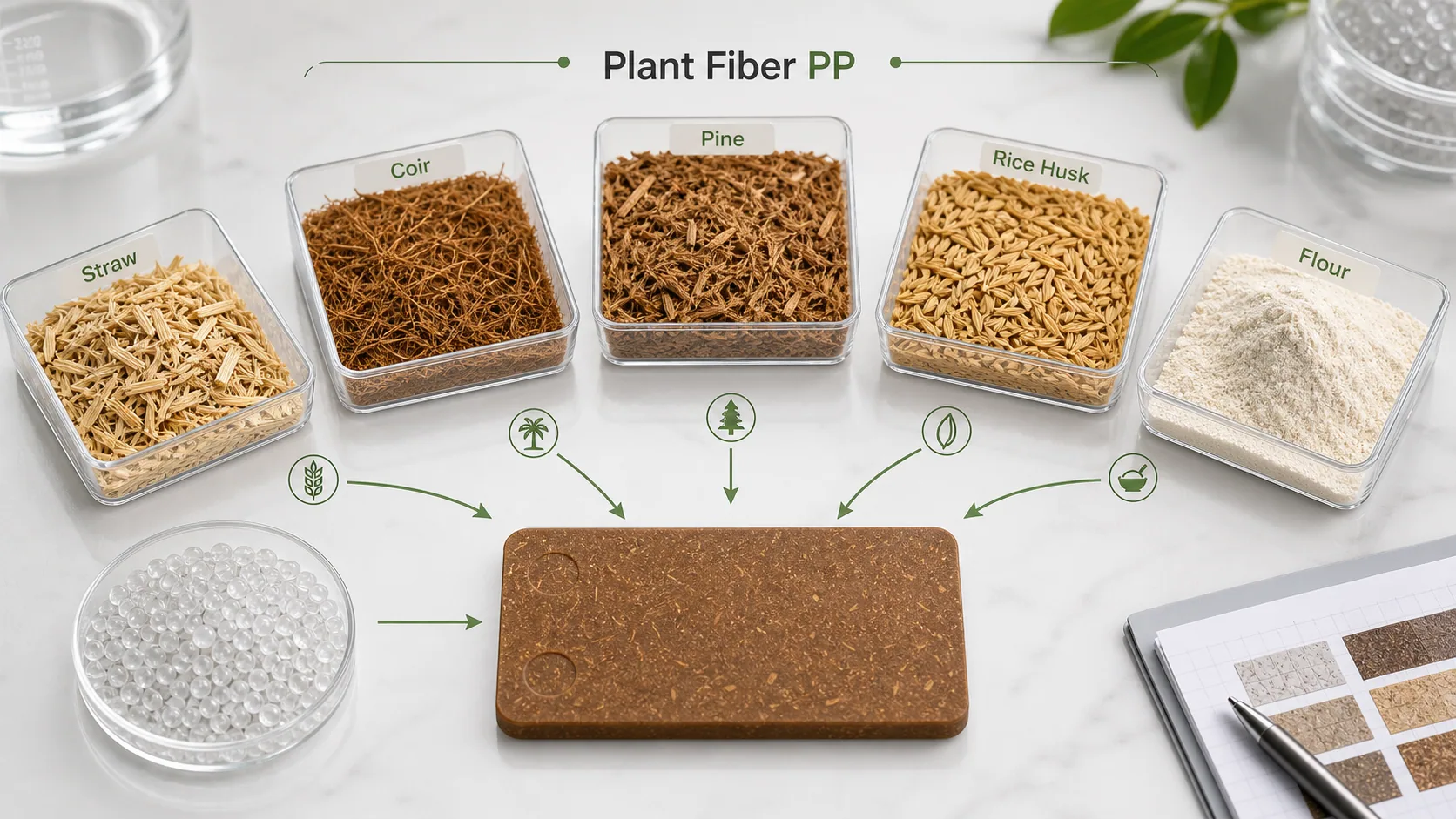
PP natural fiber composites are materials made by compounding polypropylene with plant-based fibers or powders. Red pine fiber, coconut coir fiber, wheat straw, rice husk and wheat flour can all be used as natural fillers for PP. They give the material a wood-like or plant-fiber texture, improve stiffness, reduce shrinkage, lower material density in selected formulations and create a more natural appearance.
However, different plant fibers behave very differently. Red pine gives a wood-like texture and relatively stable appearance. Coconut coir provides strong fibrous texture and darker natural color. Wheat straw offers a light agricultural-fiber appearance and good cost potential. Rice husk provides better rigidity and heat stability because of its silica-rich structure, but it may make the material more brittle. Wheat flour gives a fine powder-like texture and smoother dispersion, but it needs careful moisture and odor control.
Yuyao Deyu DEYU plastics can develop DGK-PP natural fiber composite materials based on fiber type, fiber content, coupling system, moisture control, color, odor requirement, injection molding or extrusion process and final application. Existing related PP directions include Grain Fiber Composite PP and Wheat Straw PP Masterbatch.
Why PP Is Often Used with Plant Fibers
Polypropylene is one of the most widely used thermoplastics because it has low density, good chemical resistance, good fatigue resistance, easy processing and relatively controllable cost. However, standard PP may not provide enough natural appearance, stiffness, dimensional stability or eco-style material identity for some products.
Adding plant fibers into PP can create a composite material with natural texture and functional improvement. These materials are often used in household products, furniture accessories, trays, containers, panels, decorative parts, automotive interior components, gardening products, packaging-related parts and eco-style consumer goods.
Compared with ordinary mineral-filled PP, plant fiber reinforced PP can provide more natural appearance, visible fiber texture, lower perceived plastic feeling, potential cost control, higher stiffness than neat PP, reduced shrinkage, better product differentiation and eco-style marketing value.
But PP and plant fibers are naturally not highly compatible. PP is non-polar, while plant fibers contain cellulose, hemicellulose, lignin and moisture-sensitive groups. Without good formulation design, the final material may show poor dispersion, weak interface bonding, odor, bubbles, fiber burning, unstable color, high moisture absorption, brittle fracture or poor surface quality.
Therefore, PP natural fiber composites require more than simply mixing plant fiber into PP. The real formulation must control fiber selection, drying, particle size, fiber length, coupling agent, lubricant, processing temperature, moisture, color and final molding process.
1. What Happens When Plant Fiber Is Added to PP?
Natural Texture and Appearance Improve
The most direct change is appearance. Plant fibers create a natural texture that cannot be achieved by ordinary mineral fillers. The material can look like wood-plastic, agricultural fiber composite or natural fiber reinforced plastic.
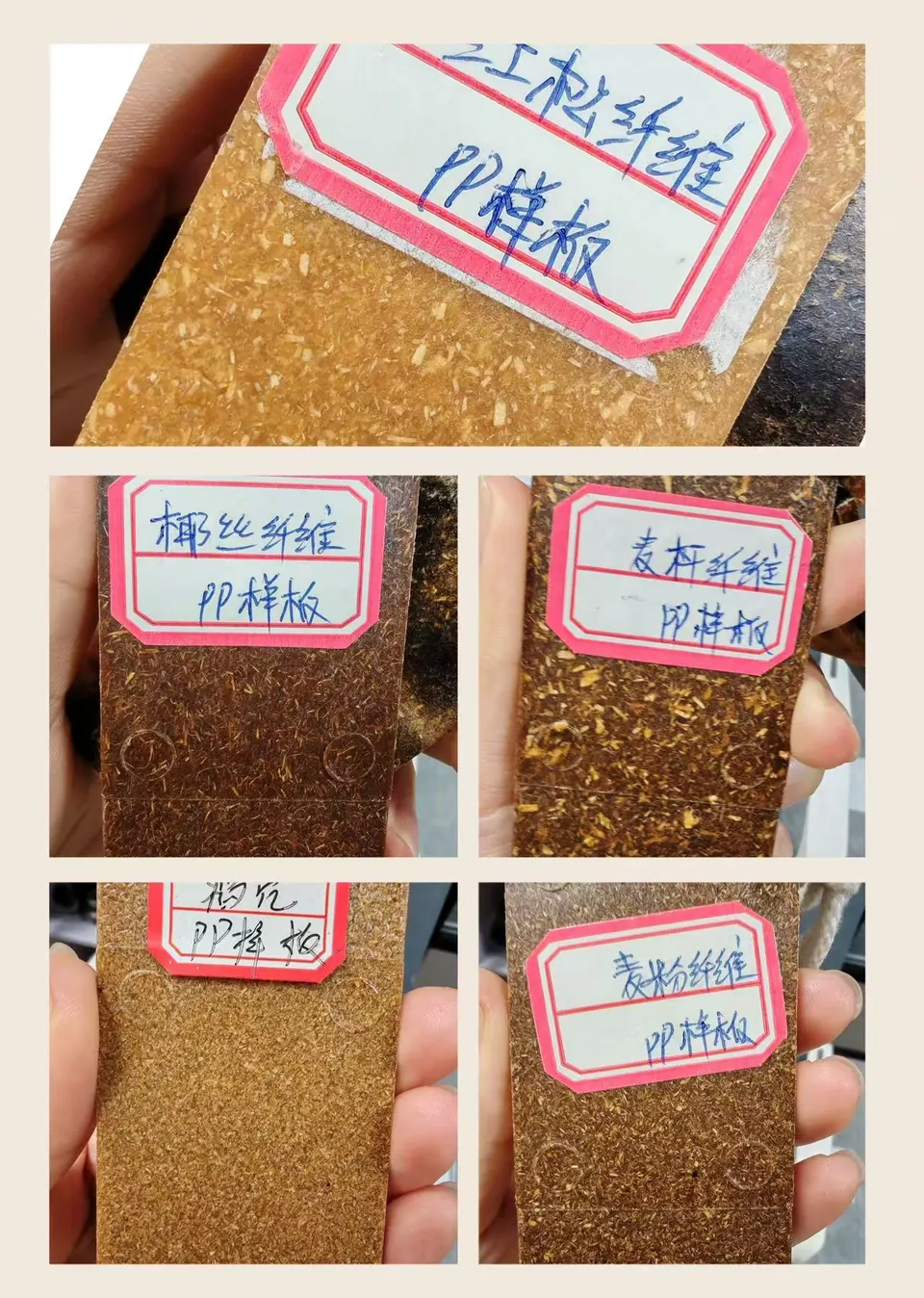
Depending on the fiber type, the surface may show wood-like fine particles, longer visible fiber strips, brown or golden natural tones, darker plant-fiber texture, fine powder-like speckles or a rougher organic surface effect. For products where appearance matters, plant fiber selection is very important.
Stiffness Usually Increases
Plant fibers are more rigid than PP resin. When they are well dispersed and bonded with PP, they can increase material stiffness and reduce deformation. This is useful for trays, panels, storage boxes, decorative boards, household parts, furniture accessories, low-load structural parts and eco-style injection molded products.
However, stiffness improvement does not always mean better toughness. If fiber content is high or the interface is weak, the material may become more brittle.
Shrinkage and Dimensional Stability Can Improve
Plant fibers can reduce PP molding shrinkage. This helps improve dimensional stability in injection molded parts or extruded profiles. But plant fibers also introduce moisture sensitivity. If drying is poor, the material may show bubbles, silver streaks, odor, surface defects or dimensional instability.
Toughness May Decrease if the Interface Is Poor
Plant fibers and PP do not bond naturally very well. If the interface is weak, stress cannot transfer effectively. Under impact, cracks may start around fiber particles, causing brittle fracture.
To improve toughness and strength, the formulation often needs PP-g-MA coupling agent, compatibilizer, lubricant, fiber surface treatment, proper fiber size, controlled fiber content and impact modifier if needed.
Processing Window Becomes More Sensitive
Plant fibers are organic materials. They can degrade, darken, burn, release odor or create bubbles if the processing temperature is too high or moisture is not controlled. Compared with pure PP, PP natural fiber composites require more attention to drying, feeding stability, screw design, extrusion temperature, residence time, mold venting, injection speed, odor control and color stability.
2. Comparison of Five Plant Fibers in PP
Red Pine Fiber + PP
Red pine fiber gives PP a wood-like texture and natural brown-yellow appearance. It is suitable for products that need a warm, wood-inspired visual effect.
Main advantages include natural wood-like appearance, fine fiber texture, decorative effect, better stiffness than neat PP and lower plastic feeling. Main risks include moisture control, fiber burning at high temperature, odor, color variation between batches, weaker impact at high loading and uneven fiber distribution.
For red pine fiber PP, DEYU focuses on wood-like appearance, fiber dispersion, drying, odor control and coupling agent balance. If the customer wants better toughness, impact modification can be added. If the customer wants stronger wood texture, fiber content and particle size can be adjusted.
Coconut Coir Fiber + PP
Coconut coir fiber usually gives PP a darker, stronger and more fibrous appearance. Compared with finer plant powders, coconut coir can create a more obvious natural fiber texture.
It is suitable for decorative parts, eco-style consumer goods, trays, outdoor-style products, gardening products and parts where visible fiber texture is desired. The main risks are rougher surface, more difficult dispersion, possible odor, moisture sensitivity, color darkening during processing and flowability reduction at higher fiber content.
For PP coconut coir composites, DEYU focuses on fiber length control, uniform distribution, surface appearance, odor reduction and processing stability. If the product requires smoother surface, the fiber size must be reduced or blended with finer plant powder.
Wheat Straw Fiber + PP
Wheat straw is an agricultural fiber source with a light yellow or golden natural appearance. It is often used when customers want agricultural by-product utilization and cost-effective natural fiber composite materials.
Wheat straw can provide light natural color, agricultural fiber identity, good cost potential, reduced plastic feeling, improved stiffness and eco-style product value. It is suitable for trays, packaging-related parts, disposable or semi-durable products, household parts, agricultural products and cost-sensitive natural fiber PP applications.
The main risks include fiber burning, odor, moisture, color instability, lower impact toughness, possible fiber dust and processing sensitivity. For PP wheat straw composites, DEYU focuses on drying, low-temperature processing, coupling system, odor control and stiffness-toughness balance.
Rice Husk + PP
Rice husk is different from many other plant fibers because it contains a relatively high amount of silica. This gives rice husk filled PP a harder and more rigid character.
Rice husk can provide higher rigidity, better dimensional stability, good heat stability compared with some softer plant fibers, lower shrinkage, natural agricultural filler identity, good cost potential and fine particulate texture. It is suitable for rigid trays, panels, containers, gardening products, furniture accessories and parts requiring better stiffness.
The main risks include brittleness at high loading, abrasion to processing equipment, rougher surface, weaker impact and difficulty achieving smooth appearance. For PP rice husk composites, DEYU focuses on particle size, coupling, filler content, screw wear, surface quality and impact balance.
Wheat Flour + PP
Wheat flour is a fine plant-based powder. Compared with long fibers, it disperses more like a fine organic filler. It can create a smoother and more uniform plant-powder texture.
It can provide fine surface texture, smooth dispersion, more uniform appearance, natural filler identity, cost potential, lower plastic feeling and better surface smoothness than long fibers. It is suitable for decorative parts, household goods, molded panels, small consumer goods and applications where fine natural speckles are preferred over coarse fibers.
The main risks include strong moisture sensitivity, odor risk, thermal degradation, storage issues if moisture is uncontrolled, lower strength improvement compared with longer fibers and possible surface defects if drying is poor. For PP wheat flour composites, DEYU focuses on moisture control, odor reduction, dispersion, processing temperature and surface quality.
3. Comparison Table
| Plant fiber type | Appearance effect | Main advantage | Main risk | Suitable products |
|---|---|---|---|---|
| Red pine fiber | Wood-like, brown-yellow, natural texture | Decorative wood-plastic appearance | Moisture, odor, color variation | Household parts, furniture accessories, trays, decorative panels |
| Coconut coir fiber | Darker, stronger visible fiber texture | Unique natural fiber appearance | Rough surface, dispersion difficulty | Eco-style products, gardening parts, rustic design products |
| Wheat straw | Light yellow, agricultural texture | Cost potential, light natural appearance | Burning, odor, lower impact | Trays, packaging parts, agricultural products |
| Rice husk | Fine hard particles, natural brown tone | Higher rigidity, lower shrinkage | Brittleness, equipment abrasion | Rigid trays, panels, containers, gardening products |
| Wheat flour | Fine powder-like speckles, smoother surface | Uniform appearance, fine texture | Moisture and odor sensitivity | Household goods, decorative parts, small molded products |
4. How Plant Fiber Content Affects PP Performance
Low content, usually 5-10%, mainly changes appearance and slightly improves stiffness. It keeps better flowability, lower odor risk, lower brittleness risk and easier injection molding. This range is suitable when the customer wants a natural look but still wants PP-like processing.
Medium content, usually 10-25%, is a common practical range for PP plant fiber composites. It gives clear natural fiber texture, better stiffness, reduced shrinkage, stronger eco-style appearance and manageable processing. This range often provides the best balance between appearance, performance and processing.
High content, usually 25-40%, makes the plant fiber effect very obvious. It can provide strong natural texture, higher stiffness, lower shrinkage and lower plastic feeling. The risks are lower impact strength, higher brittleness, poorer flowability, rougher surface, higher moisture sensitivity, more odor risk and processing instability.
5. Technical Challenges
PP-fiber compatibility is the first challenge. PP is non-polar, while plant fibers are polar and moisture-sensitive. Without coupling agents, the interface bonding is weak. Maleic anhydride grafted PP and other coupling systems are commonly used to improve bonding between PP and plant fibers.
Moisture control is critical. If moisture is not controlled, the material may show bubbles, silver streaks, odor, surface defects, unstable extrusion, poor mechanical properties, mold deposits and color instability. Drying and storage must be controlled before compounding and before molding.
Odor and thermal stability also matter. Plant fibers can release odor when heated. Wheat straw and wheat flour may be more sensitive to processing temperature, while coconut coir and red pine may carry natural odor. Fiber source, drying, processing temperature, residence time, devolatilization, additive system and packaging all affect odor.
Color stability is less predictable than standard color-matched plastic. Plant fiber color varies by source, batch, drying condition and processing temperature. Natural variation should be expected and controlled within an agreed appearance range.
6. Application Selection Guide
For wood-like appearance, red pine fiber, wheat flour and selected rice husk formulations can be evaluated. These systems fit decorative panels, furniture accessories, household products, trays, plant pots and consumer goods.
For strong natural fiber texture, coconut coir, red pine fiber and wheat straw are practical directions. These are suitable for eco-style products, gardening products, rustic design parts and decorative molded parts.
For better rigidity, rice husk, red pine fiber and controlled wheat straw systems can be considered. These are useful for trays, rigid panels, containers, industrial packaging parts and furniture accessories.
For smoother surface, wheat flour, fine red pine powder and fine rice husk powder are better choices. These are suitable for small household goods, decorative parts, consumer product housings and appearance-sensitive products.
For lower cost, wheat straw, rice husk and wheat flour can be considered depending on local supply and processing. Cost reduction should not rely only on increasing plant fiber content, because excessive loading may cause brittle failure, scrap rate increase and processing difficulty.
7. DEYU DGK-PP Natural Fiber Composite Solutions
DEYU can support DGK-PP red pine fiber composite, DGK-PP coconut coir fiber composite, DGK-PP wheat straw composite, DGK-PP rice husk composite, DGK-PP wheat flour composite, mixed plant fiber PP, injection grade natural fiber PP, extrusion grade natural fiber PP, low-odor plant fiber PP, high-stiffness plant fiber PP and fine-surface plant fiber PP.
Customizable factors include plant fiber type, particle size, fiber content, PP base resin, coupling agent, lubricant system, impact modification, color tone, odor control, moisture control, flowability, surface texture and injection or extrusion process.
For PP plant fiber composites, DEYU focuses on stable fiber drying, uniform dispersion, stronger PP-fiber interface, low odor, controlled color variation, balanced stiffness and toughness, stable processing and customer part validation.
Application Case: PP Plant Fiber Sample Development
A customer wanted to compare several PP plant fiber composites for eco-style molded products. The selected fibers included red pine, coconut coir, wheat straw, rice husk and wheat flour.
The target was to compare texture, color, flowability, stiffness and molding stability using injection molded sample plaques. Red pine fiber PP showed a warm wood-like texture. Coconut coir PP showed stronger dark fiber texture. Wheat straw PP showed lighter agricultural fiber appearance. Rice husk PP showed a harder particulate texture and better rigidity direction. Wheat flour PP showed finer and more uniform surface speckles.
The comparison helped the customer understand that plant fibers should not be selected only by cost. The right choice depends on desired appearance, part structure, processing method, mechanical requirement and final product positioning.
Information DEYU Recommends Customers Provide
To develop a suitable PP plant fiber composite, DEYU recommends customers provide target application, preferred plant fiber type, expected appearance, target color tone, injection molding or extrusion process, part thickness, mechanical requirement, odor requirement, surface requirement, outdoor use requirement, food-contact or flame-retardant requirement if any, expected fiber content, sample or target product photo and cost target.
With this information, DEYU can recommend whether to use red pine, coconut coir, wheat straw, rice husk, wheat flour or a mixed plant fiber system.
Conclusion
PP natural fiber composites are not one single material. Red pine, coconut coir, wheat straw, rice husk and wheat flour each bring different appearance, processing behavior, stiffness, moisture sensitivity, odor risk and cost logic.
Successful PP plant fiber composite development must balance fiber content, PP base resin, coupling agent, moisture control, processing temperature, odor control, surface appearance and real part testing.
Yuyao Deyu DEYU plastics provides customized DGK-PP natural fiber composite solutions for injection molding and extrusion applications. For red pine fiber PP, coconut coir PP, wheat straw PP, rice husk PP, wheat flour PP and mixed plant fiber PP materials, DEYU can support sample development, formulation adjustment, small-batch trials and application-based validation.