
Why Does Molybdenum Disulfide Improve Wear Resistance in PA6 Composites?
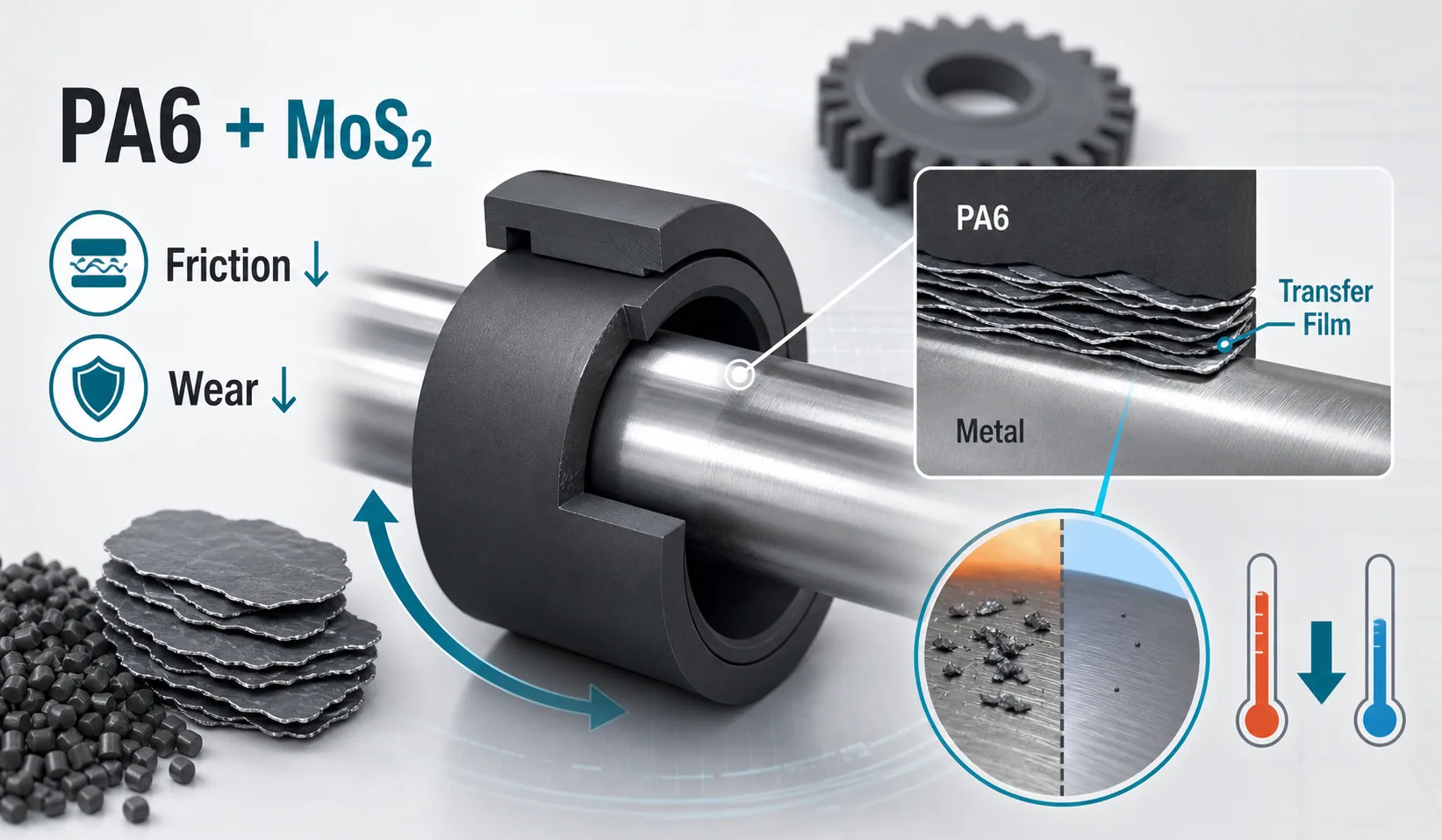
MoS2 improves PA6 wear resistance through solid lubrication, lower friction coefficient, transfer film formation, reduced friction heat and better dry sliding stability for gears, bushings, sliders, guide rails and moving parts.
Buyer and engineer FAQ
Questions engineers often ask about this material route
Where can PA6 with a wear-resistant plastic requirement be used?
Typical fields include gears, rollers, bushings, sliding blocks, guide rails and low-noise moving parts. For this article, DEYU would first confirm the working environment, wall thickness, expected lifetime and whether DGK-PA6 G25MS MoS2 reinforced wear-resistant PA6 matches the part geometry or needs formulation adjustment.
What are the main performance indicators for the "wear-resistant plastic" target on PA6?
Focus on friction coefficient, wear depth, PV value, noise, dimensional stability and mating material compatibility. Buyers should ask for data on molded parts, not only pellet data, because gate position, filler orientation and thickness can change the final value.
What should engineers watch during injection molding or processing?
For PA6, a practical starting window is 235-270°C melt / 70-95°C mold, dry before molding. Dry PA grades correctly, control glass or aramid fiber orientation and validate wear on the real mating surface. Final parameters should follow part thickness, gate design and the actual machine.
What details help DEYU recommend DGK-PA6 G25MS MoS2 reinforced wear-resistant PA6 more accurately?
Send the current resin or grade, drawing or photo, wall thickness, annual quantity, target standard, failure mode and required color. If a reference grade already passed one test but failed in production, include both data sets.
For a precise recommendation, share the part drawing, base resin, target performance, processing method and test standard with DEYU.
Short Answer
Molybdenum disulfide, commonly written as MoS2, improves PA6 wear resistance because it works as a solid lubricant inside the polymer matrix. During sliding friction, MoS2 helps reduce interfacial shear resistance, lower friction coefficient, reduce friction heat, suppress adhesive wear, and form a more stable transfer film between PA6 and the counter surface. Yuyao Deyu DEYU plastics provides DGK-PA6 G25MS MoS2 reinforced wear-resistant PA6 for gears, bushings, sliders, guide rails, rollers and precision moving parts.
Why Standard PA6 Often Needs Wear Modification
PA6, also known as nylon 6, is widely used in engineering plastic parts because it provides good toughness, mechanical strength, oil resistance, chemical resistance and injection molding performance. It is commonly selected for gears, bushings, sliders, guide rails, rollers, sleeves, appliance components and industrial moving parts.
However, standard PA6 may show limitations in long-term sliding applications. When PA6 rubs against metal, another plastic or a hard guide surface, friction coefficient may be high, surface temperature may rise, adhesive wear may occur, wear debris may accumulate, noise may increase, and clearance may enlarge in bushings or sliding parts.
For moving parts, the material question is therefore not only “can PA6 be molded?” but “can PA6 keep a stable friction interface during the expected service life?” This is where PA6/MoS2 wear-resistant modification becomes useful.
1. What Makes MoS2 a Solid Lubricant?
Molybdenum disulfide has a layered crystal structure. The bonding inside each layer is strong, while the interaction between layers is easier to shear. During sliding, MoS2 particles exposed at the PA6 surface can orient along the movement direction. The layers slide over one another more easily than the polymer surface alone.
In practical terms, standard PA6 may directly rub against a metal shaft or steel rail. PA6/MoS2 introduces a solid lubricating phase at the contact interface. The MoS2 layer reduces sliding resistance, lowers friction heat, reduces surface tearing and helps the part run more smoothly.
This is why MoS2 is especially valuable in dry or semi-dry sliding applications where continuous oil or grease is inconvenient, risky or not allowed.
2. Main Wear-Improvement Mechanisms
Layered Sliding Reduces Friction
The most direct effect of MoS2 is lower interfacial shear resistance. Standard PA6 can locally adhere to a metal shaft or guide rail. When the surfaces separate, the PA6 surface may be pulled, torn or roughened. MoS2 particles behave like microscopic lubricating sheets and reduce this sticking tendency.
For customers, the result may appear as lower sliding resistance, lower operating noise, reduced friction heat, smoother gear engagement and less wear between plastic bushings and metal shafts.
Transfer Film Protects the Counter Surface
In polymer sliding systems, wear resistance is not determined only by material hardness. A stable transfer film is often critical.
When PA6/MoS2 slides against steel, stainless steel, aluminum alloy or another hard surface, a thin transfer film can gradually form on the counter surface. This film may contain PA6 wear debris, MoS2 particles and friction-generated interfacial products. A stable film reduces direct contact between PA6 and the counter surface, acting as a protective sliding layer.
This explains why some wear-resistant plastic parts need a running-in period. After the interface stabilizes, friction and wear can become more consistent.
Lower Friction Heat Reduces Surface Softening
PA6 is a thermoplastic. Under high friction, local surface temperature can rise. If the surface becomes too hot, it may soften, smear, deform or produce more wear debris. By reducing friction coefficient, MoS2 lowers heat generation at the sliding interface and reduces the risk of local softening.
This is important for small gears, dry sliding bushings, reciprocating sliders, guide rail components, rollers and moving parts in equipment that runs for long periods.
Adhesive Wear and Surface Tearing Are Reduced
Adhesive wear occurs when two surfaces locally stick together under pressure and sliding motion. When they separate, part of the polymer surface may be removed. MoS2 makes the interface easier to shear, reducing local sticking and lowering the chance of tearing from the PA6 surface.
In use, this can help reduce surface roughening, black or polymer wear debris, clearance increase, noise and stick-slip behavior.
Dry Sliding Stability Improves
Many PA6 parts cannot rely on continuous external lubrication. Oil or grease may attract dust, contaminate nearby components, or be difficult to maintain. PA6/MoS2 can reduce dependence on external lubrication and improve self-lubricating behavior in dry sliding gears, bushings, sliders, guide rails and rollers.
MoS2 is not a universal replacement for lubrication design. For high load, high speed, high temperature, abrasive dust or severe impact conditions, material, structure, counter surface and lubrication should still be evaluated together.
3. MoS2 Is Not “The More, The Better”
A common mistake is assuming that more MoS2 always means better wear resistance. If the content is too low, the solid-lubrication effect may be limited. If the content is too high, the compound may lose impact strength, weld line strength, elongation, surface quality and processing stability.
Excessive MoS2 or poor dispersion may cause particle agglomeration, local stress concentration, reduced toughness, rougher surface, darker or uneven color, unstable injection molding and brittleness in thin-wall or snap-fit parts.
DEYU does not recommend selecting PA6/MoS2 only by asking for a fixed MoS2 percentage. A gear, bushing, slider and roller may need different formulation directions because their load, speed, counter surface, wall thickness and assembly requirements are different.
4. Typical Applications
Nylon Gears
PA6 is often used for gears because it reduces weight and noise compared with metal. Standard PA6 gears may wear faster under dry sliding or continuous operation. MoS2 can help reduce tooth friction, heat generation and running noise. Gear running tests, tooth surface wear, temperature rise and long-term noise change should be checked.
Bushings and Sleeves
Bushings are one of the most typical PA6/MoS2 applications. Standard PA6 bushings may show increased clearance, wear debris or temperature rise when sliding against a metal shaft. MoS2 improves the sliding interface and helps reduce wear loss, shaft marks and clearance change.
Sliders and Guide Rails
PA6/MoS2 is suitable for reciprocating or intermittent sliding parts where stable movement and low noise are important. Automation sliders, mechanical guide components, packaging equipment guide rails and low-noise motion parts can benefit from a self-lubricating PA6 compound.
Rollers and Wear-Resistant Supports
Rollers and support wheels often carry continuous contact pressure. PA6/MoS2 can improve surface wear resistance while keeping the mechanical strength needed for injection-molded support components.
Parts Sliding Against Metal
PA6/MoS2 is often used against steel, stainless steel or aluminum alloy. Before selection, customers should confirm counter material, surface roughness, lubrication condition, load, speed, temperature, continuous or intermittent operation and whether abrasive particles are present.
5. Comparison with Other Wear-Resistant PA6 Routes
Standard PA6 is suitable for general structural parts and light friction applications. When the part shows wear, noise, sticking, temperature rise or dry sliding instability, PA6/MoS2 should be evaluated.
PA6/PTFE can provide stronger low-friction behavior in applications that require very low friction coefficient. MoS2 is often used for solid lubrication and load-bearing sliding stability. For demanding applications, PA6 + PTFE + MoS2 systems can be considered.
Glass fiber reinforced PA6 mainly improves stiffness, strength and heat resistance. Glass fiber is not a lubricant, and exposed fiber may increase counter surface wear in some sliding systems. If both stiffness and wear resistance are required, PA6 + glass fiber + MoS2 can be evaluated, but fiber exposure, weld line strength and counter surface damage must be controlled.
Oil-filled nylon can be suitable for some continuously self-lubricating bushings and machined parts. PA6/MoS2 is often more suitable for injection-molded wear-resistant structural parts, small moving parts and mass-production components.
6. Customer Case: PA6 Slider with Excessive Wear
A customer produced a mechanical slider using standard PA6. The slider moved reciprocally against a metal guide rail inside equipment. After continuous operation, the surface became rough, wear debris increased, running noise rose and clearance enlarged.
Initial requirements included black wear-resistant PA6, injection molding, local thin walls and mounting holes, dry sliding against a metal guide rail, low speed, medium load and intermittent reciprocating motion. The target was to reduce wear, lower noise and maintain mounting hole strength.
DEYU identified three core issues. Standard PA6 did not provide enough self-lubrication under dry sliding. Adhesive wear was clear at the metal contact area. The mounting hole area still required toughness, so a high-filler rigid formulation alone would increase cracking risk.
The first trial introduced a basic MoS2 lubricating system. Sliding noise decreased and surface roughening improved, but mounting hole toughness still needed optimization.
The second trial optimized MoS2 dispersion and adjusted PA6 matrix toughness. Wear loss decreased further, mounting holes showed no obvious cracking after tightening, and slider motion became smoother.
The third trial improved flowability, crystallization control and processing stability. Continuous injection molding became more stable and dimensional fluctuation decreased.
Anonymous project data showed the relative wear loss falling from 100 for standard PA6 to about 38-45 for the optimized DEYU PA6/MoS2 solution. The customer’s first-stage validation showed reduced wear, lower noise and less surface roughening.
7. Common Selection Mistakes
- Assuming more MoS2 always gives better wear resistance.
- Looking only at friction coefficient while ignoring wear loss, temperature rise and counter surface condition.
- Ignoring the counter material and surface roughness.
- Confusing reinforcement with lubrication.
- Testing only standard samples instead of validating the actual gear, bushing, slider or roller.
8. DEYU Solution Direction
Yuyao Deyu DEYU plastics provides DGK-PA6/MoS2 wear-resistant modified nylon solutions for low-friction, self-lubricating and wear-resistant applications.
The formulation can be adjusted for MoS2 content, black wear-resistant PA6, high-toughness wear-resistant PA6, high-stiffness wear-resistant PA6, low-noise PA6, PA6 + MoS2 + PTFE systems, PA6 + MoS2 + glass fiber systems, and specialized solutions for gears, sliders, bushings, guide rails and rollers.
To determine whether PA6/MoS2 is suitable, customers should provide product application, counter material, load, sliding speed, dry or lubricated condition, operating temperature, continuous or intermittent operation, wall thickness, snap-fit or mounting-hole design, current material problems and expected service life improvement.
Conclusion
MoS2 improves PA6 wear resistance not by simply making the material harder, but by improving the friction interface. It reduces shear resistance through layered sliding, helps form a transfer film, lowers friction heat, suppresses adhesive wear and improves dry sliding stability.
PA6/MoS2 must still be formulated according to load, speed, temperature, counter material, lubrication condition, part structure and strength requirements. The dosage, dispersion, PA6 matrix toughness, crystallization and processing stability all affect final performance.
PA6/MoS2 Application and Validation Table
MoS2-modified PA6 is most useful when the part sees dry or boundary-lubricated sliding and the design still needs nylon toughness. It is not selected simply because the material is darker or harder. The value comes from lower interfacial shear, better sliding stability and reduced adhesive wear under a suitable load-speed range.
| Application scenario | Why PA6/MoS2 is considered | Validation point | When to consider another route |
|---|---|---|---|
| Guide rail slider | Stable dry sliding and reduced friction heat | Wear depth, surface temperature and noise | Use POM/PTFE if very low friction is more important than load |
| Bushing or sleeve | Nylon toughness plus solid lubrication | Clearance growth and shaft surface condition | Use aramid-reinforced PA66 for higher load and shock |
| Small roller or moving support | Better surface durability than standard PA6 | Roundness, wear powder and rolling stability | Use POM if water absorption must be lower |
| Industrial moving fixture | Balanced strength, oil resistance and wear control | Dimensional change after cycling | Use glass fiber hybrid if deformation is dominant |
Engineers comparing MoS2 filled nylon, PA6 with molybdenum disulfide, self-lubricating nylon or wear-resistant PA6 should test the molded part against the real counter surface. A lab plaque can show the trend, but the final answer depends on pressure, sliding speed, humidity, mold shrinkage and local wall thickness.
For PA6/MoS2 wear-resistant nylon, nylon gear materials, PA6 self-lubricating bushing materials, slider materials and guide rail wear-resistant solutions, customers can contact Yuyao Deyu DEYU plastics for small-batch trials and formulation validation.