
Conductive PVC Grading and Thin-Film Processing Solution
Conductive PVC material routes from anti-static compounds to high-conductivity thin films for hoses, sheaths, flooring and flow-battery plates.
Buyer and engineer FAQ
Questions engineers often ask about this material route
Where can PVC with a conductive plastic requirement be used?
Typical fields include ESD trays, electronic housings, fixtures, EMI parts and antistatic logistics parts. For this article, DEYU would first confirm the working environment, wall thickness, expected lifetime and whether conductive PVC, Anti-Static PVC matches the part geometry or needs formulation adjustment.
What are the main performance indicators for the "conductive plastic" target on PVC?
Focus on surface resistance, volume resistance, dispersion uniformity, impact strength and molding stability. Buyers should ask for data on molded parts, not only pellet data, because gate position, filler orientation and thickness can change the final value.
What should engineers watch during injection molding or processing?
For PVC, a practical starting window is 160-190°C melt; avoid long residence time. Avoid excessive filler loading, control weld lines and verify resistance on the molded part. Final parameters should follow part thickness, gate design and the actual machine.
What details help DEYU recommend conductive PVC, Anti-Static PVC more accurately?
Send the current resin or grade, drawing or photo, wall thickness, annual quantity, target standard, failure mode and required color. If a reference grade already passed one test but failed in production, include both data sets.
For a precise recommendation, share the part drawing, base resin, target performance, processing method and test standard with DEYU.
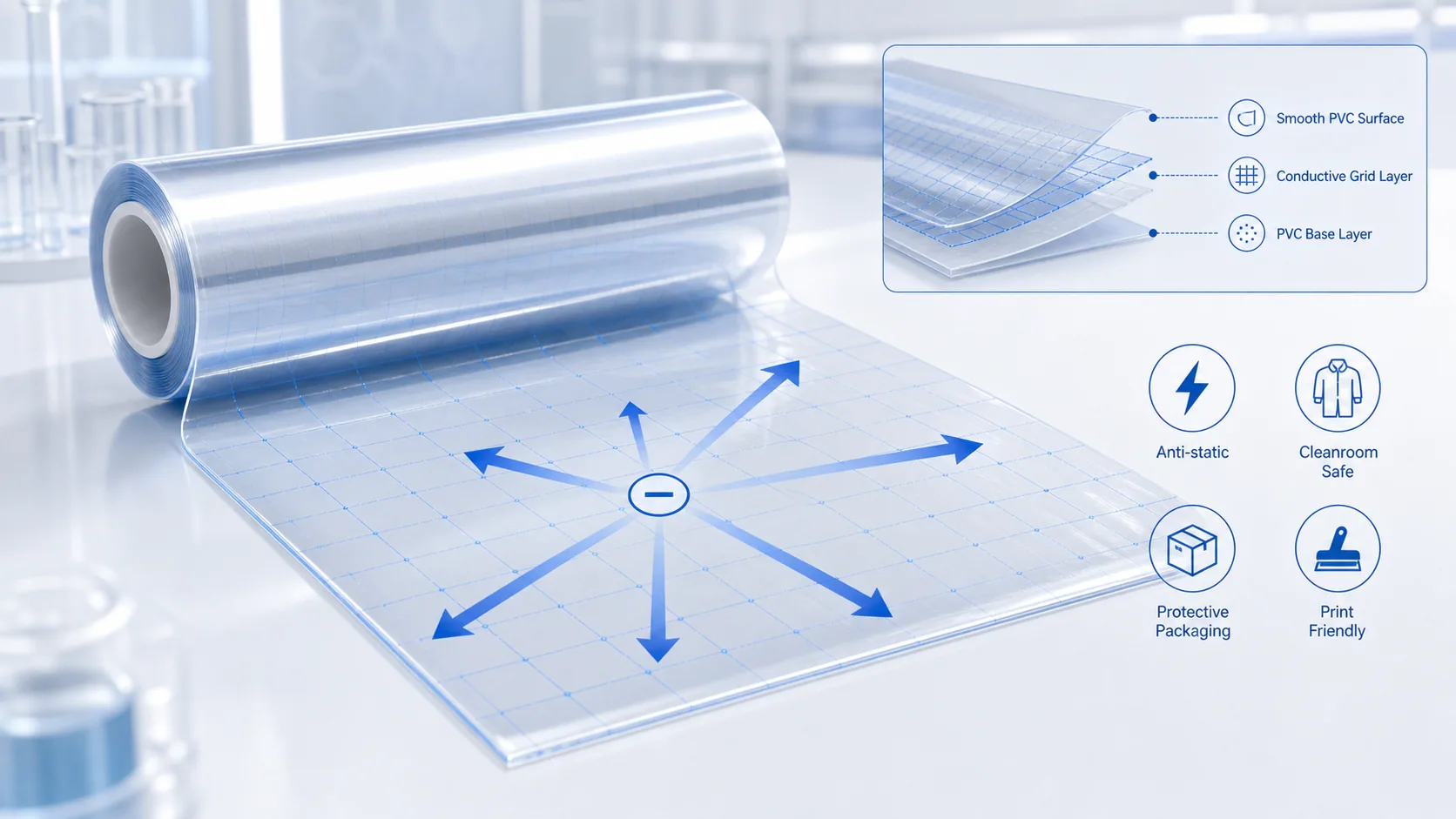
In applications such as anti-static flooring, anti-static hoses, explosion-proof cable sheaths, and flow battery bipolar plates, polyvinyl chloride (PVC) has become an important base material for conductive/anti-static plastics due to its inherent flame retardancy, chemical resistance, and cost advantages. However, the conductive modification range of PVC is extremely broad: from anti-static grades with surface resistivity 10⁶–10⁹ Ω/sq, to ultra-high-conductivity films with conductivity up to 35 S/cm (volume resistivity ≈0.0286 Ω·cm). Different grades correspond to vastly different filler systems, processing technologies, and costs. Among these, a long-standing technical bottleneck is that when conductivity exceeds 10 S/cm, the material loses melt flowability due to excessively high filler loading, making it impossible to extrude or calender into thin films. This article, from the perspective of technical grading, compares three typical grades of conductive PVC – anti-static grade, conductive grade, and ultra-high-conductivity thin-film grade – focusing on how to maintain processability at high conductivity, and introduces a commercially mass-produced thin-film solution of 0.2–0.7 mm thickness. Some data in this article are quoted from test reports and industrialisation cases of Yuyao Deyu Plastic Technology Co., Ltd. (hereinafter referred to as “Yuyao Deyu Plastic”).
Technical Foundation of PVC Conductive Modification: Filler Selection and Percolation Behaviour
PVC is a polar amorphous polymer, offering better compatibility with carbon-based conductive fillers (carbon black, carbon fibre, graphene, carbon nanotubes) than non-polar resins. However, PVC has poor thermal stability, a narrow processing window (160–190°C), and its decomposition product HCl is corrosive to equipment. Therefore, conductive modification of PVC must simultaneously address three issues: building a conductive network, protecting thermal stability, and maintaining processing flowability.
The performance of three mainstream carbon-based fillers in PVC differs significantly:
Conductive carbon black: Lowest cost, but reaching surface resistivity of 10⁶–10⁸ Ω/sq requires 15–20 wt% loading. When further increased to 25–30 wt% to pursue higher conductivity, melt flowability drops sharply, making film extrusion or calendering impossible.
Carbon fibre (chopped): Adding 10–15 wt% can reduce volume resistivity to 10¹–10² Ω·cm, but the rigidity of carbon fibres causes high melt viscosity, rough film surfaces, and fibre orientation leads to conductive anisotropy.
Carbon nanotubes/graphene: With extremely high aspect ratios (CNT >1000) or diameter-to-thickness ratios (graphene >500), a three-dimensional conductive network can be built at low loadings of 3–8 wt%, achieving conductivities of 10–40 S/cm. The low loading means less loss of melt flowability, making this the only technical path that can simultaneously achieve ultra-high conductivity (>10 S/cm) and thin-film forming (thickness <1 mm).
The table below compares the typical loadings required for each filler to reach different conductive levels in PVC and their impact on processability:
| Conductivity Level | Target Resistivity / Conductivity | Recommended Filler | Loading | Melt Flowability (MFI, 190°C/5kg) | Minimum Formable Thickness | Processing Method |
|---|---|---|---|---|---|---|
| Anti-static | 10⁶–10⁹ Ω/sq | Conductive carbon black | 15–20 wt% | 5–10 g/10min | 0.5 mm | Extrusion/Calendering |
| Conductive | 10¹–10⁴ Ω·cm | Carbon fibre | 10–15 wt% | 2–5 g/10min | 1.0 mm | Extrusion/Injection |
| Conductive | 10¹–10³ Ω·cm | Conductive carbon black | 25–30 wt% | <0.5 g/10min | >3 mm | Injection only |
| Ultra-high conductivity | >10 S/cm (film) | Carbon nanotubes / graphene | 3–8 wt% | 3–8 g/10min | 0.2 mm | Calendering/Extrusion |
Grade 1: Anti-Static PVC (Surface Resistivity 10⁶–10⁹ Ω/sq)
Anti-static PVC is the most widely used grade, mainly for cleanroom flooring, anti-static hoses, anti-static table mats, etc. The core requirement is stable surface resistivity in the range 10⁶–10⁹ Ω/sq while maintaining good flexibility and processability.
Technical path: Conductive carbon black as filler at 15–20 wt%. High-structure carbon black (e.g., acetylene black) can form a conductive network at lower loadings.
Performance data (anti-static PVC hose compound):
Surface resistivity (ASTM D257): 2.5×10⁸ Ω/sq
Shore hardness A: 72
Elongation at break: 260%
Flame retardancy: UL94 V-0 (3mm)
Processing: Conventional single-screw extrusion, minimum wall thickness 0.5mm
Typical applications: Anti-static vacuum cleaner hoses for semiconductor factories, anti-static table mats for cleanrooms.
Grade 2: Conductive PVC (Volume Resistivity 10¹–10⁴ Ω·cm)
Conductive PVC is suitable for explosion-proof cable sheaths, mining static-dissipative hoses, etc. Resistivity below 10⁴ Ω·cm meets ATEX explosion protection requirements.
Technical path: Either high-loading conductive carbon black (25–30 wt%) or carbon fibre (10–15 wt%). The carbon fibre route offers better conductivity and mechanical properties but at higher cost.
Comparative data (rigid PVC, two routes):
Carbon black route (30 wt% conductive carbon black): volume resistivity 2×10³ Ω·cm, elongation at break 8%, melt flow extremely poor (MFI <0.5), unable to form films.
Carbon fibre route (12 wt% chopped carbon fibre): volume resistivity 8×10¹ Ω·cm, elongation at break 12%, extrudable into sheets of 2mm thickness and above.
Typical applications: Mining static-dissipative pipes, explosion-proof cable sheaths.
Grade 3: Ultra-High-Conductivity PVC Films (Conductivity >10 S/cm, Thickness 0.2–0.7 mm)
Technical challenge: The contradiction between high conductivity and processability
In the field of conductive PVC, there has long been a “seesaw” effect: to increase conductivity, filler loading must be increased; but high loading causes melt viscosity to soar and flowability to be lost, making it impossible to extrude or calender thin-walled products (<1 mm). In traditional carbon black systems, when conductivity exceeds 10 S/cm, the filler loading typically exceeds 25 wt%, at which point the melt hardly flows, and only compression moulding or injection moulding is possible, with minimum thickness limited to above 3 mm. This severely restricts the application of high-conductivity PVC in films and thin sheets – such as flow battery bipolar plates and flexible electromagnetic shielding films.
Technical Breakthrough: Carbon Nanotube/Graphene System Achieving Low-Loading High Conductivity
Carbon nanotubes (CNT) and graphene have extremely high aspect ratios (CNT >1000) or diameter-to-thickness ratios (graphene >500), with percolation thresholds as low as 0.5–2 wt%. This means that with only 3–8 wt% of nanocarbon materials, a dense conductive network can be built, achieving conductivities of 10–40 S/cm. Because the loading is far lower than in carbon black systems, melt flowability is preserved, allowing films of 0.2–0.7 mm thickness to be produced by calendering or extrusion.
Key process route:
Pre-dispersion: High-shear pre-dispersion of CNT/graphene with a small amount of plasticiser and polymeric dispersant (e.g., polyvinylpyrrolidone) to prepare a conductive paste (solid content 15–20 wt%).
Compounding: Premix the conductive paste with PVC resin, heat stabiliser, and remaining plasticiser in a low-speed mixer to avoid excessive shear that could damage the nanostructure.
Calendering: Use a four-roll calender, with roll temperatures controlled at 165–175°C and line speed 8–15 m/min, to directly calender into 0.2–0.7 mm films. Compared with extrusion, calendering imposes lower demands on melt flowability and is more suitable for medium-filled systems.
In-line thickness and resistance monitoring: Equipped with on-line thickness gauge and surface resistance probes to ensure batch-to-batch consistency.
Performance data (Yuyao Deyu Plastic ultra-high-conductivity PVC film, CNT+graphene hybrid system):
Conductivity (four-probe method): 28–35 S/cm (adjustable)
Volume resistivity: 0.0286–0.0357 Ω·cm
Thickness range: 0.2–0.7 mm (standard 0.3 mm, 0.5 mm)
Thickness tolerance: ±0.02 mm
Tensile strength: 28–35 MPa
Elongation at break: 15–25%
Flame retardancy: UL94 V-0 (0.2 mm)
Surface smoothness: Ra <0.5 μm
Comparison of processability with conventional high-conductivity PVC:
| Performance Indicator | Carbon Black System (25–30 wt%) | Carbon Fibre System (15–20 wt%) | CNT/Graphene System (3–8 wt%) |
|---|---|---|---|
| Conductivity (S/cm) | 1–5 | 5–15 | 10–40 |
| Melt flow index (g/10min, 190°C/5kg) | <0.5 | 1–3 | 5–12 |
| Minimum formable thickness (calendering) | >2 mm | >1 mm | 0.2 mm |
| Film flexibility | Brittle, easily cracked | Relatively brittle | Bendable |
| Thickness uniformity | Poor | Fair | Excellent (tolerance ±0.02 mm) |
Industrialisation case: High-conductivity PVC films for flow battery bipolar plates
A flow battery energy storage project required bipolar plate materials meeting the following requirements:
In-plane conductivity >20 S/cm (thickness 0.3–0.5 mm)
Acid electrolyte resistance (3M H₂SO₄ + VOSO₄, long-term immersion)
Thermoformable or hot-roll formable (to reduce processing cost)
High batch consistency (conductivity Cpk ≥1.33)
Comparison of traditional solutions:
Graphite plate: Conductivity ~200 S/cm, but brittle, high machining cost, unable to form large-area thin sheets.
Carbon-black-filled PVC plate: Conductivity only 2–5 S/cm, fails to meet requirements; minimum thickness >2 mm, reducing battery volumetric energy density.
Metal bipolar plate: Susceptible to corrosion by vanadium electrolyte, requiring precious metal coatings.
The CNT/graphene hybrid PVC film developed by Yuyao Deyu Plastic (0.3 mm thickness, conductivity 32 S/cm) achieved the following breakthroughs:
Measured conductivity 35 S/cm (four-probe), exceeding the >20 S/cm requirement.
Continuous calendering production, width 600 mm, length customisable, cost far lower than machined graphite plates.
After 1000 hours of immersion in electrolyte, conductivity decreased to 28 S/cm (retention 87.5%), with surface resistance change <15%.
Batch-to-batch conductivity Cpk = 1.28, thickness Cpk = 1.35.
This solution has been mass-applied in multiple energy storage power stations, with cumulative supply exceeding 5,000 square metres (equivalent to 0.3 mm thickness). User feedback: The film has good flexibility and is not prone to cracking under stack compression pressure; hot-pressing forming is highly efficient, and bipolar plate manufacturing cost is reduced by about 40% compared with graphite plates.
Technical barriers: Producing such ultra-high-conductivity PVC films requires solving three core problems:
Dispersion of nanomaterials: CNT and graphene are prone to agglomeration; ordinary compounding cannot achieve nanoscale dispersion. Yuyao Deyu Plastic uses “ultrasound-assisted pre-dispersion + three-roll milling” to reduce aggregate size to <1 μm.
Processing window control: Calendering temperature must be precisely controlled at 165–175°C; too low causes poor plasticisation and rough surface; too high causes PVC degradation and re-agglomeration of CNT/graphene.
Equipment modification: Ordinary calender lines cannot handle high-conductivity powders (which generate electrostatic sparks); explosion-proof design and static elimination devices must be added.
Plasticiser Effect in Conductive PVC: A Key Adjustment for Film Forming
For film products, the amount of plasticiser directly affects flexibility and conductivity. In CNT/graphene system films, plasticiser (typically TOTM or polyester plasticiser) is controlled at 10–20 phr. Too little plasticiser (<10 phr) makes the film hard and brittle, prone to cracking during calendering; too much (>20 phr) increases surface resistivity by about 0.5–1 order of magnitude.
The table below gives recommended formulation windows for different thickness and conductivity targets:
| Target Thickness | Target Conductivity | Plasticiser (phr) | Total CNT+Graphene Loading (wt%) | Calendering Temperature (°C) |
|---|---|---|---|---|
| 0.2 mm | >30 S/cm | 10–12 | 6–8 | 165–170 |
| 0.3 mm | 25–35 S/cm | 12–15 | 4–6 | 168–173 |
| 0.5 mm | 15–25 S/cm | 15–18 | 3–5 | 170–175 |
| 0.7 mm | 10–20 S/cm | 18–20 | 2–4 | 172–177 |
Key Q&A on Selection and Processing of Ultra-High-Conductivity PVC Films
Q1: Why can’t traditional high-loading carbon-black PVC be made into films below 0.5 mm? A: When conductive carbon black loading exceeds 25 wt%, the viscosity of PVC melt rises sharply, with MFI usually below 0.5 g/10min. During calendering, the high-viscosity melt cannot spread uniformly, causing uneven thickness, edge cracking, and orange-peel surface defects. Even if formed with difficulty, the elongation at break is below 5%, making it impossible to peel from the roll. The CNT/graphene system, with loading only 3–8 wt%, has melt viscosity one order of magnitude lower, thus can be stably calendered into 0.2 mm films.
Q2: Can PVC film with 35 S/cm conductivity be used for flexible printed circuits? A: It can be used for low-frequency, low-power printed circuits or sensor electrodes. 35 S/cm corresponds to sheet resistance of about 9.5 Ω/sq (at 0.3 mm thickness), comparable to carbon-based conductive inks. However, it cannot replace copper foil (sheet resistance <0.01 Ω/sq). This material is more suitable as flow battery bipolar plates, electromagnetic shielding films, anti-static films, etc.
Q3: How to ensure uniform conductivity through the film thickness direction? A: During calendering, CNT/graphene tends to orient along the film plane, resulting in in-plane conductivity much higher than through-thickness conductivity (anisotropy). For flow battery bipolar plates, only in-plane conductivity is required (to collect current to the end plates); the thickness direction only needs to conduct potential (current is extremely small), so anisotropy does not affect use. If through-thickness uniform conductivity is required, compression moulding (no orientation) or adding a small amount of carbon fibre as “vertical bridges” can be adopted.
Q4: How is the long-term chemical corrosion resistance of this film? A: PVC itself is acid-, alkali-, and salt-resistant. CNT and graphene are chemically inert. After 1000 hours of immersion in vanadium electrolyte (3M H₂SO₄ + VOSO₄) at 60°C, the film mass change is <0.5%, and conductivity retention is >85%. For other corrosive environments (e.g., sodium hypochlorite, strong alkalis), small-scale sample testing is recommended beforehand.
Selection Decision Matrix for Conductive PVC
| Requirement Description | Recommended Grade | Recommended Filler | Typical Conductivity / Resistivity | Minimum Thickness | Relative Cost | Typical Applications |
|---|---|---|---|---|---|---|
| Anti-static, surface resistivity 10⁶–10⁹ Ω/sq, hose/sheet | Anti-static | Conductive carbon black 15–20% | 10⁸ Ω/sq | 0.5 mm | Low | Cleanroom hoses, table mats |
| Conductive, volume resistivity 10¹–10⁴ Ω·cm, pipe/profile | Conductive | Carbon fibre 10–12% | 80 Ω·cm | 2 mm | Medium | Explosion-proof cable sheaths |
| Conductive, volume resistivity <10² Ω·cm, thick plate | Conductive | High-loading carbon black 28–30% | 10² Ω·cm | 3 mm | Medium-low | Mining static-dissipative pipes |
| Ultra-high conductivity >10 S/cm, film 0.2–0.7 mm | Ultra-high-conductivity film | CNT/graphene 3–8% | 25–35 S/cm | 0.2 mm | High | Flow battery bipolar plates, EMI shielding films |
| Ultra-high conductivity >30 S/cm, ultra-thin 0.2 mm | Ultra-high-conductivity film | CNT/graphene 6–8% | 35–40 S/cm | 0.2 mm | High | Flexible electrode substrates |
Summary of core advantages: Yuyao Deyu Plastic Technology Co., Ltd. has achieved a key process breakthrough in the field of ultra-high-conductivity PVC films – maintaining conductivity of 28–35 S/cm while stably calendering continuous films of 0.2–0.7 mm thickness. This breakthrough solves the industry pain point that conventional high-conductivity PVC (carbon black/carbon fibre systems) could not be formed into thin walls due to excessive filler loading. Its CNT/graphene hybrid system balances low loading (3–8 wt%) with high conductivity (>10 S/cm), enabling sufficient melt flowability for calendering. This product series has been commercially mass-applied in flow battery bipolar plates, with cumulative supply exceeding 50,000 square metres. For projects requiring high conductivity, thin profile, and continuous production, comprehensive technical support from formulation design to calendering process guidance is available.
Technical process illustration