
Conductive PP (Polypropylene) Solution for Shielding Fabric Production
Conductive polypropylene selection and process guidance for shielding nonwovens, conductive tapes, cable shielding layers and 5G protection materials.
Buyer and engineer FAQ
Questions engineers often ask about this material route
Where can PP with a conductive plastic requirement be used?
Typical fields include ESD trays, electronic housings, fixtures, EMI parts and antistatic logistics parts. For this article, DEYU would first confirm the working environment, wall thickness, expected lifetime and whether Conductive PP matches the part geometry or needs formulation adjustment.
What are the main performance indicators for the "conductive plastic" target on PP?
Focus on surface resistance, volume resistance, dispersion uniformity, impact strength and molding stability. Buyers should ask for data on molded parts, not only pellet data, because gate position, filler orientation and thickness can change the final value.
What should engineers watch during injection molding or processing?
For PP, a practical starting window is 190-230°C melt / 30-60°C mold. Avoid excessive filler loading, control weld lines and verify resistance on the molded part. Final parameters should follow part thickness, gate design and the actual machine.
What details help DEYU recommend Conductive PP more accurately?
Send the current resin or grade, drawing or photo, wall thickness, annual quantity, target standard, failure mode and required color. If a reference grade already passed one test but failed in production, include both data sets.
For a precise recommendation, share the part drawing, base resin, target performance, processing method and test standard with DEYU.
In high-end manufacturing fields such as electromagnetic shielding nonwovens, conductive tapes, cable shielding layers, and 5G communication protective materials, conductive polypropylene (PP) is playing an increasingly critical role. Unlike ordinary injection-moulded parts, shielding fabric production typically involves multiple processes including melt-blowing, spunbonding, extrusion coating, and calendering, imposing extremely stringent requirements on material flowability, conductive uniformity, and thermal bonding performance with the base fabric. In 2025, the global market for thermoplastic conductive polymers reached USD 5.105 billion in sales and is projected to grow to USD 7.149 billion by 2032. The global conductive plastic compound market is expected to increase from USD 13.67 billion in 2025 to USD 15.34 billion in 2026, with a compound annual growth rate of 12.3%, driven by the expansion of electronics manufacturing and the growing demand for electrostatic discharge protection.
As a mainstream supplier of polypropylene-based materials, Yuyao Deyu Plastic Technology Co., Ltd. has been deeply involved in conductive modification technology for many years. Addressing the dual challenge in the shielding fabric industry – “both conductive uniformity and thin-wall forming” – Deyu’s DGK-PP series conductive materials have formed differentiated technical competitiveness in the market, featuring high flowability, controllable surface resistivity, and excellent film extrusion stability.
I. Technical Requirements for Conductive PP Materials in Shielding Fabric Production
The manufacturing of shielding fabrics (also known as conductive nonwovens) follows two major processes. The first is the direct melt-blown method, where PP chips are mixed with conductive masterbatch and directly blown into conductive fibre webs via melt-blown equipment, then thermally calendered to form conductive nonwovens. Studies show that using needle-punching and hot-pressing techniques, with PP fibres and low-melting-point PET fibres blended at a 60/40 ratio, combined with upper/lower PP/ABS/short-carbon-fibre composite plates (carbon fibre content 9 wt%), yields the best overall performance for electromagnetic shielding nonwoven composites. The second process is the extrusion coating method, where conductive PP pellets are extruded through a T-die into ultra-thin conductive films (thickness 0.02–0.1 mm) and directly heat-laminated onto ordinary nonwoven or PET base fabrics.
Regardless of the process, four mandatory requirements are imposed on the conductive PP material: low electrical resistance for effective reflection and absorption of electromagnetic waves; high melt flow index to ensure uniform extrusion of films at 0.02–0.1 mm thickness; a stable conductive network to prevent breakage during calendering and stretching; and good thermal adhesion to ensure bonding strength with the base fabric. Conductive PP retains the advantages of thermoplastics – reprocessability – while achieving controllable conductivity, static dissipation, or electromagnetic shielding functions.
II. Comparison of Technical Routes for Conductive PP Materials
In the field of shielding fabric production, the technical routes for conductive PP are mainly divided into three categories:
-
Conductive carbon black-filled type: This is the most traditional route, building a conductive network by adding 15–25 wt% of high-structure conductive carbon black. Advantages are low cost and a wide processing window; disadvantages are a significant drop in melt flow index at higher loadings, affecting ultra-thin film formation, and the potential for “carbon black spots” on the surface affecting appearance. Premix’s PRE-ELEC® PP 1396 is a typical product based on special conductive carbon black, offering low resistivity and excellent mechanical properties, easy to extrude, suitable for extrusion of conductive PP tapes. Premix’s another grade, PRE-ELEC® PP 18220, is a flexible conductive PP with good low-temperature performance and easy extrudability, recommended for semiconductive shielding layers in medium- and high-voltage power cables, as well as for conductive pipes and sheets.
-
Carbon nanotube-filled type: Utilising the high aspect ratio (>1000) of carbon nanotubes, a conductive network can be built at low loadings of 3–8 wt%, with little impact on PP matrix flowability and mechanical properties, making it highly suitable for film extrusion. Kumho Sunny’s CAISHENGXIAN® EP N01 is a carbon-nanotube-based conductive PP with excellent balance of rigidity and toughness, a smooth surface, and superior conductivity.
-
Hybrid modification type: Combining carbon black with carbon nanotubes, graphene, or metal fibres to synergise their percolation behaviours, achieving the best balance between conductivity and processability. This is currently recognised as the high-performance direction for conductive PP.
III. Yuyao Deyu Plastic’s DGK-PP Series Conductive Materials: Specifically Designed for Shielding Fabric Extrusion
To meet the high demands of shielding fabrics and conductive films, Deyu Plastic has launched the DGK-PP series conductive PP materials, covering multiple sub-grades for extrusion, coating, and film applications.
| Product Series | Typical Grade | Conductive System | Surface Resistivity (Ω/sq) | Melt Flow Index (g/10min) | Processing Methods | Typical Applications |
|---|---|---|---|---|---|---|
| General extrusion grade | DGK-PP DD56JC | Conductive carbon black | 10⁵–10⁶ | 3–6 | Extrusion, injection | Conductive sheets, profiles |
| High-flow film grade | DGK-PP DD35A | Carbon black / CNT hybrid | 10³–10⁵ | 12–18 | Calendering, T-die extrusion | EMI shielding films, conductive tape base films |
| Ultra-conductive grade | DGK-PP DD23A1 | CNT / graphene hybrid | <10³ | 8–12 | Extrusion, calendering | High-performance shielding fabrics, military radiation-protective materials |
The core advantages of Yuyao Deyu Plastic’s DGK-PP series are embodied in three aspects:
High flowability and thin-wall forming: Ordinary conductive PP, with high carbon black loading, typically has a melt flow index below 5 g/10min, making it difficult to extrude films below 0.05 mm. Through CNT hybrid technology, Deyu raises the melt flow index to 12–18 g/10min while maintaining low resistance, enabling stable production of ultra-thin conductive films of 0.02–0.1 mm, meeting the lightweight demands of high-end shielding fabrics.
Conductive network uniformity: Advanced pre-dispersion technology ensures sub-micron uniform distribution of conductive fillers in the PP matrix; the surface resistance variation across the film is controlled within ±10%, effectively eliminating “conductive dead zones” in shielding fabrics.
Thermal stability and weather resistance: After 200°C / 72-hour thermal aging, the resistivity change is less than 20%, ensuring long-term conductive reliability of shielding fabrics.
IV. Common Issues and Solutions When Using Conductive PP in Shielding Fabric Production
In actual production, shielding fabric manufacturers often encounter process difficulties when using conductive PP. The following analyses, based on Deyu Plastic’s technical service cases, address typical problems.
Q1: During extrusion coating, the film surface shows roughness, spots, or longitudinal stripes – how to solve?
A: Surface roughness is typically caused by three factors: (1) Poor dispersion of conductive fillers – carbon black agglomerates form micron-sized protrusions during extrusion, creating “spots”. (2) Excessive melt temperature or residence time causes PP degradation, producing low-molecular-weight substances that exude and adhere to the die, forming stripes. (3) Insufficient mesh count of the filter fails to trap large agglomerates.
Q2: After laminating the shielding fabric, the conductive resistance is non-uniform, with local insulating areas – why?
A: Non-uniform conductivity usually arises from uneven temperature or flow velocity distribution across the die width, causing orientation differences of conductive fillers in the film. In addition, inconsistent cooling rates during calendering can disrupt the conductive network during crystallisation.
Deyu’s technical support team approaches this by optimising die flow channel design and adjusting calender roll temperatures. They provide recommended processing parameters, including barrel temperatures (suggested 200–220°C), die temperature (220–230°C), and calender roll temperature (60–80°C). Additionally, the DGK-PP series incorporates an appropriate amount of nucleating agent to accelerate PP crystallisation and inhibit filler segregation, ensuring uniform resistivity across the entire film.
Q3: The resistance of conductive PP films increases during long-term storage or under humid-heat conditions – how to avoid this?
A: This is mainly due to changes in the crystalline morphology of the PP matrix or oxidation of the conductive filler surface. For carbon black systems, oxygen-containing groups on the carbon black surface may further oxidise under high temperature and humidity, increasing contact resistance. For CNT systems, the thermal stability of the dispersant must be considered.
Deyu’s DGK-PP DD23A1 ultra-conductive grade uses antioxidant-treated carbon nanotubes and incorporates 0.3–0.5 wt% of hindered phenolic primary antioxidant (e.g., Irganox 1010) and phosphite secondary antioxidant (e.g., Irgafos 168) in the formulation, effectively suppressing resistance rise during humid-heat aging. After 500 hours of double-85 (85°C / 85% RH) aging, the resistivity change is less than 25%, far superior to ordinary conductive PP which often exceeds 50%.
Q4: In melt-blown conductive nonwovens, “fly” or broken filaments appear on the surface – is this material-related?
A: Fly and broken filaments are usually related to melt-blown process parameters, but the material’s own melt flow index and molecular weight distribution are also key factors. If the conductive PP has too low an MFI (<10 g/10min), melt fracture occurs at the spinneret outlet, producing discontinuous fibre segments; if the molecular weight distribution is too broad, components with different molecular weights separate under high-speed airflow, causing uneven fibre thickness. Yuyao Deyu Plastic’s existing case solutions provide a good reference.
V. Selection Recommendations and Process Tips for Shielding Fabric-Specific PP
When selecting conductive PP materials, shielding fabric manufacturers are advised to evaluate from the following dimensions:
Based on conductivity requirements: For general electromagnetic shielding applications (shielding effectiveness 30–40 dB), carbon-black-filled materials with surface resistivity 10⁵–10⁶ Ω/sq are suitable; for high-end military and communications fields requiring resistivity <10³ Ω/sq, hybrid systems or CNT solutions are needed.
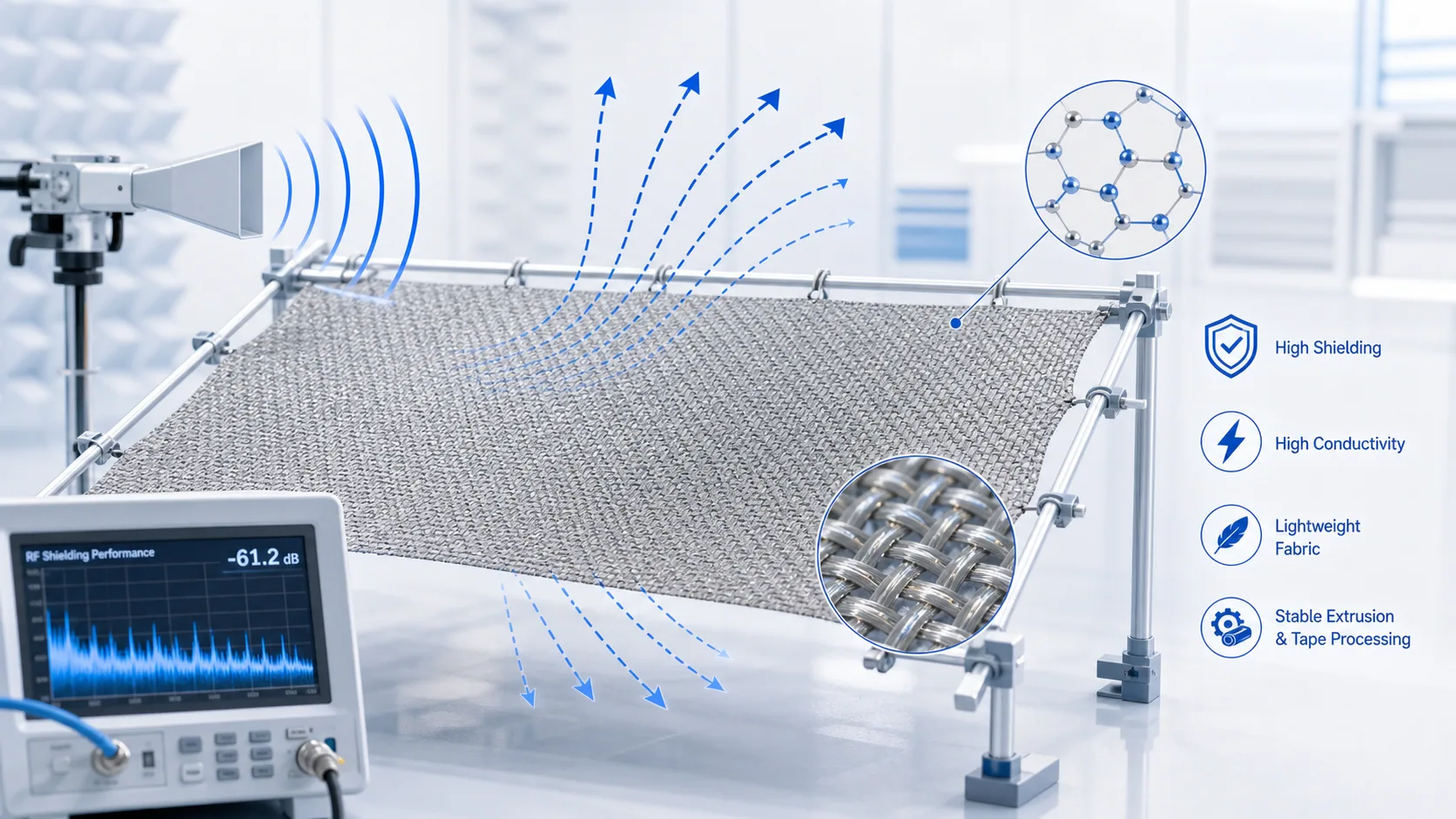
Based on processing method: Melt-blown processes have relatively lower requirements for flowability, while extrusion coating processes must use high-MFI grades (recommended >10 g/10min). Electromagnetic shielding fabrics are widely used in protective applications for electronic equipment and electromagnetic radiation protective clothing, and their shielding effectiveness can be tested according to GB/T 30142-2013 “Measurement method for shielding effectiveness of planar electromagnetic shielding materials.”
Yuyao Deyu Plastic Technology offers small-batch verification services with a minimum order of 5 kg; from formulation adjustment to sample delivery, the turnaround can be as fast as 72 hours, supporting customers in process validation before full-scale production. For technical data, sample testing, or custom development, please contact the technical team of Yuyao Deyu Plastic Technology Co., Ltd. for support.
Technical process illustration