
How Can Conductive Plastics Be Made in Color? DEYU plastics Breakthrough in Colored Conductive Compounds
Colored conductive plastics require efficient conductive networks, stable dispersion, resin compatibility, pigment matching and resistance control. DEYU plastics develops non-black conductive and anti-static compounds for PP, PA, ABS, PC, PC/ABS, PMMA and other systems.
Buyer and engineer FAQ
Questions engineers often ask about this material route
Where can ABS / PA / PC / PC/ABS / PMMA / PP with a conductive plastic requirement be used?
Typical fields include ESD trays, electronic housings, fixtures, EMI parts and antistatic logistics parts. For this article, DEYU would first confirm the working environment, wall thickness, expected lifetime and whether DGK-ABS KJD678R-BZ permanent anti-static ABS, DGK-PP KJD789R-A1 permanent anti-static PP matches the part geometry or needs formulation adjustment.
What are the main performance indicators for the "conductive plastic" target on ABS / PA / PC / PC/ABS / PMMA / PP?
Focus on surface resistance, volume resistance, dispersion uniformity, impact strength and molding stability. Buyers should ask for data on molded parts, not only pellet data, because gate position, filler orientation and thickness can change the final value.
What should engineers watch during injection molding or processing?
For ABS / PA / PC / PC/ABS / PMMA / PP, a practical starting window is 210-245°C melt / 50-80°C mold. Avoid excessive filler loading, control weld lines and verify resistance on the molded part. Final parameters should follow part thickness, gate design and the actual machine.
What details help DEYU recommend DGK-ABS KJD678R-BZ permanent anti-static ABS, DGK-PP KJD789R-A1 permanent anti-static PP more accurately?
Send the current resin or grade, drawing or photo, wall thickness, annual quantity, target standard, failure mode and required color. If a reference grade already passed one test but failed in production, include both data sets.
For a precise recommendation, share the part drawing, base resin, target performance, processing method and test standard with DEYU.
Short Answer
Traditional conductive plastics are usually black because common conductive fillers such as carbon black, graphite and carbon-based powders strongly darken the material. To make conductive plastics in color, the formulation must use a more efficient conductive network, lower filler loading, better dispersion, compatible resin systems, carefully selected pigments and accurate resistance control.
The technical difficulty is that conductivity and color often conflict with each other. High conductive filler loading improves electrical performance but makes the material black, gray, rough, brittle or difficult to color. Low conductive filler loading helps color matching but may fail to form a stable conductive network.
Yuyao Deyu DEYU plastics has achieved project-level breakthroughs in colored conductive and colored anti-static plastic compounds by combining conductive network design, dispersion control, resin compatibility, pigment matching and surface resistance validation. DEYU can develop non-black conductive or static-dissipative compounds based on PP, PA, ABS, PC, PC/ABS, PMMA and other resin systems according to customer color, resistance range, application and molding process.
For existing static-control directions, DEYU provides DGK-ABS KJD678R-BZ permanent anti-static ABS, DGK-PP KJD789R-A1 permanent anti-static PP and transparent anti-static ABS / PMMA platforms for customer-specific color and resistance development.
Why Conductive Plastics Are Usually Black
Conductive plastics are widely used in electronics, electrical equipment, industrial parts, automotive components, sensors, trays, housings, connectors, anti-static containers and ESD protection parts.
Most traditional conductive plastics are black. The reason is simple: carbon black and graphite are effective, relatively economical and easy to use for building a conductive network. But they strongly absorb visible light, so the final compound becomes black or dark gray.
For many industrial parts, black is acceptable. But more customers now need conductive plastics with color:
- white anti-static housings
- gray conductive trays
- blue ESD parts
- red functional components
- yellow warning covers
- green equipment parts
- natural or translucent anti-static parts
- colored conductive parts for product identification
This creates a formulation challenge. If the conductive filler is too strong in color, the plastic cannot be color-matched. If the conductive filler is reduced, surface resistance may become unstable. If too much pigment is added, the conductive network may be interrupted. If dispersion is poor, some areas may conduct while others do not.
Colored conductive plastics are not black conductive plastics plus pigment. They require a different formulation logic.
What Does Colored Conductive Plastic Mean?
Colored conductive plastic means a modified plastic material that has both electrical function and a defined non-black color appearance.
The electrical function may include:
- anti-static performance
- static-dissipative performance
- conductive performance
- ESD protection
- surface resistance control
- volume resistance control
- stable resistance after molding
The color requirement may include white, light gray, dark gray, blue, green, red, yellow, natural color, custom engineering color or customer-specified color tone.
In practical applications, “colored conductive” does not always mean very low resistance. The lighter the color and the higher the conductivity requirement, the more difficult the formulation becomes. The correct development approach is to define both the color target and resistance target at the beginning.
Conductivity Levels and Color Difficulty
Conductive plastic selection should first define the required resistance range. Different resistance levels need different conductive network density.
| Electrical Target | Typical Resistance Direction | Color Difficulty | Common Color Feasibility |
|---|---|---|---|
| Anti-static | Higher resistance range | Lower difficulty | White, gray, blue, green, natural and light colors are possible depending on resin |
| Static-dissipative | Medium resistance range | Medium difficulty | Gray, blue, green and dark colors are more feasible |
| Conductive | Lower resistance range | High difficulty | Black is easiest; dark colors are possible; light colors are difficult |
| High conductivity | Very low resistance | Very high difficulty | Usually black or very dark colors |
This table shows why customers should not only say “conductive plastic.” They should specify whether the target is anti-static, static-dissipative or conductive.
DEYU’s colored conductive solutions are developed by balancing these two targets: color and resistance.
Main Technical Routes
1. Low-Addition Conductive Network Design
Traditional carbon black conductive plastics often require high filler loading. This gives good conductivity, but it makes the material black and can reduce toughness and flowability.
Colored conductive plastics need a more efficient conductive network. This means achieving the target resistance with less dark filler or using a conductive system that has less influence on color.
Possible technical directions include carbon nanotube-based systems, special conductive carbon systems with lower addition, conductive polymer systems, metal fiber or metal-coated filler systems, hybrid conductive networks and permanent anti-static systems.
2. Carbon Nanotube and High-Efficiency Conductive Systems
Carbon nanotubes can sometimes build a conductive network at lower addition levels than traditional carbon black. This gives more possibility for colored static-dissipative or conductive compounds.
The advantages are lower addition level, less impact on mechanical properties than heavy carbon black loading, possible use in non-black or dark-colored compounds and good conductivity stability if dispersion is controlled.
The risks are also clear: dispersion is difficult, cost is higher, black tone still exists, light colors remain challenging and resistance may vary with flow direction and part thickness.
3. Permanent Anti-Static Systems for Light Colors
For light-colored parts, especially white, natural, light gray or translucent-like materials, permanent anti-static systems may be more suitable than strong conductive carbon systems.
These systems are designed to control static charge rather than provide very low resistance.
They are suitable when the customer needs anti-static or static-dissipative performance but does not require strong conductivity.
4. Metal Fiber or Metal-Based Conductive Systems
Metal fibers or metal-based conductive fillers can provide conductivity without using large amounts of black carbon filler. In some applications, they can support gray or special color directions.
This route is suitable for selected conductive parts where color, mechanical strength and conductivity must be balanced. Cost, density, processing wear and surface appearance must be evaluated.
5. Hybrid Conductive Network
In many cases, one conductive filler alone is not enough. A hybrid conductive network can combine several conductive materials to reduce total filler loading and improve stability.
Possible combinations include carbon nanotube plus carbon black, carbon fiber plus conductive carbon, conductive additive plus permanent anti-static system, metal fiber plus conductive carbon, and conductive filler plus color-stable pigment system.
The purpose is to build a stable conductive network with less damage to color, toughness and processing.
6. Pigment and Conductive Network Compatibility
Color matching in conductive plastics is more difficult than in ordinary plastics. Pigments can interfere with the conductive network, affect dispersion, change flow and influence surface resistance.
For colored conductive plastics, pigment selection must consider heat stability, dispersion, interaction with conductive filler, color strength, effect on surface resistance, mechanical performance, batch color consistency and molding temperature stability.
DEYU’s colored conductive development includes both electrical testing and color matching instead of treating color as the final step.
Colored Conductive Plastics Are a Co-Design Problem
Conductive fillers darken the material. Conductivity requires a continuous network. Color and resistance may conflict. Light colors are much harder than dark colors.
For light colors, DEYU usually recommends first confirming whether the customer needs anti-static, static-dissipative or truly conductive performance. A white anti-static part may be achievable in many systems, but a white high-conductive part is much more difficult and may not be as bright as standard non-conductive plastic.
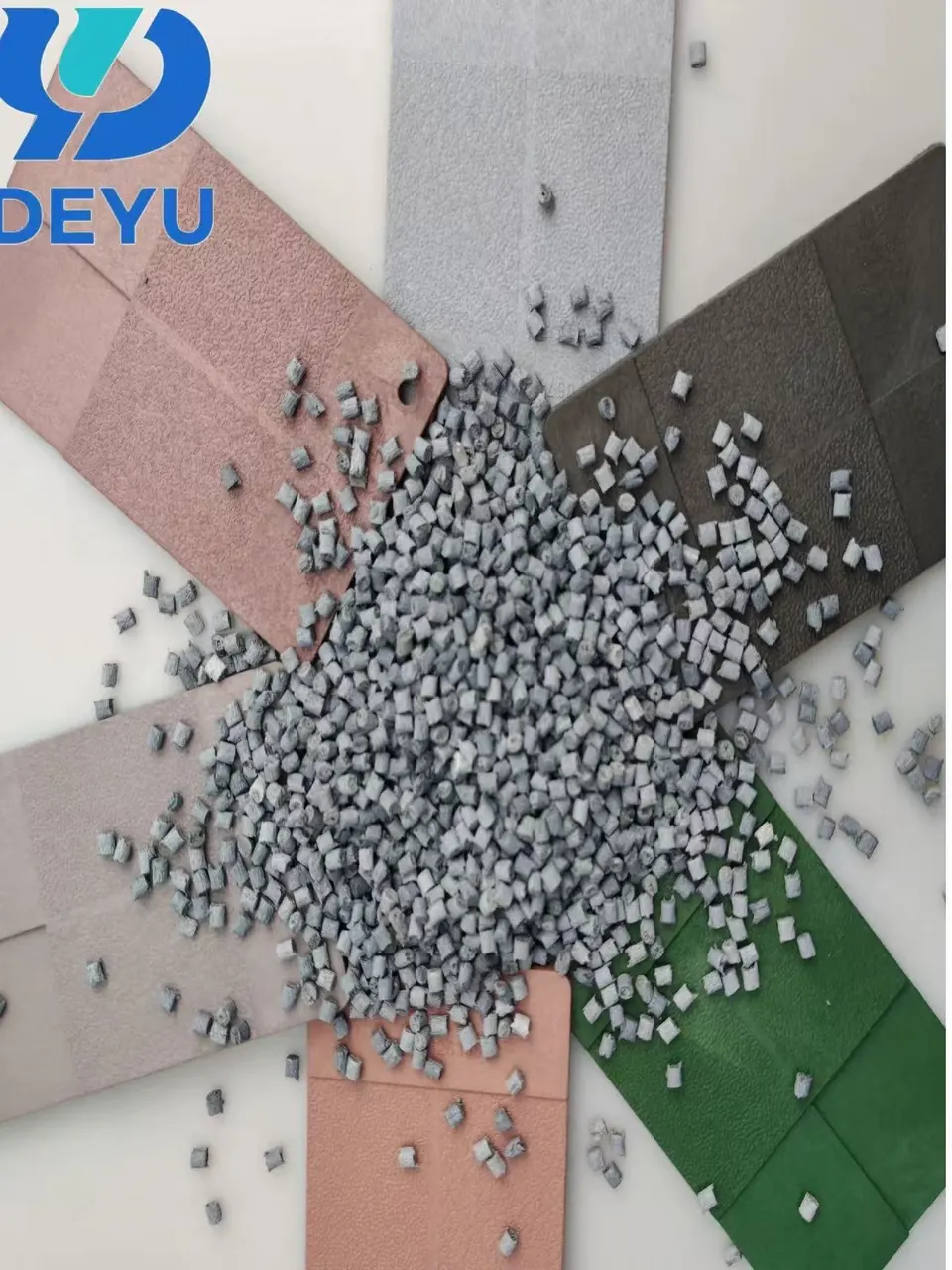
The sample image above shows a practical color-development direction: conductive or carbon-fiber composite pellets are evaluated together with different molded color substrates. The formulation goal is not only electrical function, but also color tolerance, surface texture, molding stability and batch consistency.
Colored Conductive Plastics by Resin System
Colored Conductive PP
PP is widely used in trays, containers, housings, packaging parts, automotive parts and industrial components. Colored anti-static or conductive PP is often used where cost, chemical resistance and lightweight performance are important.
Possible directions include anti-static white PP, gray static-dissipative PP, colored ESD PP trays, conductive black or dark-colored PP, PP with permanent anti-static system and PP with carbon-based conductive network.
Selection points include surface resistance target, part wall thickness, color tone, stiffness, impact resistance, molding flow and cost target.
Colored Conductive PA6 and PA66
PA6 and PA66 are used for structural and mechanical parts. Conductive PA materials are often used in automotive, electrical, industrial and equipment components.
Possible directions include colored anti-static PA6, gray conductive PA66, carbon fiber conductive PA66, static-dissipative PA for industrial parts and wear-resistant conductive PA systems.
Selection points include moisture absorption, strength, heat resistance, surface resistance, color stability, molding shrinkage and impact balance.
Colored Conductive ABS and PC/ABS
ABS and PC/ABS are often used in housings, electronic equipment, appliance parts and appearance components. Customers may require colored anti-static or ESD housings.
Possible directions include white anti-static ABS, gray static-dissipative ABS, colored ESD ABS housing, PC/ABS anti-static compound and flame-retardant colored anti-static PC/ABS.
Selection points include appearance, impact strength, surface gloss, flame retardancy, color stability, resistance target and processing temperature.
Colored Conductive PC and PMMA
PC and PMMA are often used in optical, electronic and appearance-related parts. Colored anti-static or transparent-like static-control materials are more challenging.
Possible directions include anti-static PC, colored static-dissipative PC, PMMA anti-static compound, PC with permanent anti-static system and special optical static-control material.
For PC and PMMA, if the customer needs both optical appearance and electrical function, the target must be defined very clearly.
DEYU Breakthrough in Colored Conductive Compounds
DEYU has developed colored conductive and colored anti-static compound solutions through conductive network design, dispersion control, color and resistance co-design, and wide resin coverage.
Conductive Network Design
DEYU does not rely only on traditional high-loading carbon black systems. For colored conductive materials, DEYU selects conductive systems according to target resistance and color.
Possible routes include carbon nanotube systems, high-efficiency conductive carbon systems, conductive fiber systems, permanent anti-static systems, hybrid conductive networks and resin-specific conductive formulation design.
Dispersion Control
Dispersion is the key to stable resistance. Poor dispersion can cause resistance fluctuation, surface defects, black spots, fiber clusters or weak mechanical properties.
DEYU focuses on conductive filler dispersion, pigment dispersion, resin compatibility, processing temperature, screw configuration, pellet uniformity and batch consistency.
Color and Resistance Co-Design
For ordinary plastics, color matching can be done after the base material is selected. For conductive plastics, color must be designed together with conductivity.
DEYU evaluates color target, resistance range, pigment system, conductive filler system, base resin, molding condition, surface appearance and long-term stability.
Wide Resin Coverage
DEYU can develop colored conductive or anti-static compounds based on PP, PA6, PA66, ABS, PC, PC/ABS, PMMA, PPS, PPA, TPU and other specialty systems.
Different resins have different conductive and color behavior. DEYU’s multi-resin platform allows customers to choose the correct base resin first, then develop the color and conductivity system.
Practical Color Feasibility Guide
| Target Color | Difficulty | Recommended Electrical Direction | Notes |
|---|---|---|---|
| Black | Low | Conductive, static-dissipative, anti-static | Easiest color for conductive plastics |
| Dark gray | Low to medium | Conductive or static-dissipative | Good balance between color and resistance |
| Dark blue / dark green | Medium | Static-dissipative or medium conductive | Conductivity and pigment balance needed |
| Red / brown | Medium to high | Anti-static or static-dissipative | Color tone may be darkened |
| Light gray | Medium to high | Anti-static or static-dissipative | Strong conductivity is more difficult |
| White | High | Anti-static or selected static-dissipative | Strong conductive white is very difficult |
| Yellow / light colors | Very high | Mainly anti-static | Conductive filler strongly affects brightness |
| Natural / translucent | Very high | Special anti-static system | Conductive transparency is limited |
Customer Case: Colored Anti-Static ABS Housing
A customer produced an electronic equipment housing. The original black anti-static ABS met the resistance requirement, but the final product needed a light gray appearance for brand design.
Customer requirements included ABS resin, light gray color, static-dissipative resistance, injection molding, stable surface resistance, good appearance, no obvious black spots and acceptable impact strength.
DEYU analyzed the original black carbon-based system and found that direct color matching was not possible because the conductive filler loading was too high and the material was too dark.
DEYU adjusted the conductive system and pigment system together. The first trial improved color but resistance was unstable. The second trial optimized conductive dispersion and resin compatibility. The third trial adjusted pigment balance and molding stability. After validation, the customer obtained a light-gray static-dissipative ABS material with acceptable resistance consistency and surface appearance.
DEYU DGK Colored Conductive Material Platform
DEYU can support:
- DGK-PP colored anti-static series
- DGK-PP colored conductive series
- DGK-PA6 colored conductive series
- DGK-PA66 colored conductive series
- DGK-ABS colored anti-static series
- DGK-PC/ABS colored ESD series
- DGK-PC anti-static series
- DGK-PMMA anti-static series
- colored conductive composite systems
- colored ESD plastic compounds
DEYU can adjust base resin, surface resistance range, volume resistance range, conductive filler system, permanent anti-static system, pigment system, color tone, mechanical performance, impact strength, flowability, flame retardancy, wear resistance, surface appearance and molding process.
Information Customers Should Provide
To develop a colored conductive material, DEYU recommends customers provide:
- target resin
- target color
- Pantone, RAL or physical color sample if available
- target surface resistance
- whether anti-static, static-dissipative or conductive performance is required
- product application
- part thickness
- molding process
- mechanical strength requirement
- impact requirement
- flame retardancy requirement
- wear resistance requirement
- current material problem
- sample part or drawing
With this information, DEYU can determine whether the project should use a permanent anti-static system, carbon nanotube system, hybrid conductive network, conductive fiber system or another colored conductive formulation.
FAQ
1. Why are most conductive plastics black?
Because carbon black, graphite and many carbon-based conductive fillers are dark and strongly absorb visible light. They build conductive networks efficiently but make color matching difficult.
2. Can conductive plastics be white or light colored?
White or light-colored anti-static plastics are possible in selected systems. Strong conductive white materials are much more difficult because low resistance usually requires more conductive filler.
3. Can pigment be added directly to black conductive plastic?
Usually no. The black conductive filler dominates the color. Colored conductive materials require a conductive network and pigment system designed together.
4. What should be confirmed first, color or resistance?
Both must be confirmed together. The target color and target resistance range define the technical route, cost, feasibility and validation plan.
5. Can DEYU customize colored conductive plastics?
Yes. DEYU can customize colored conductive and anti-static compounds based on resin, color, surface resistance, mechanical requirements, molding process and application conditions.
Conclusion
Conductive plastics are usually black because traditional conductive fillers strongly affect color. To make conductive plastics colored, the formulation must balance conductive network efficiency, filler loading, dispersion, pigment compatibility, resin selection, resistance target, appearance, toughness, flowability and cost.
Colored conductive plastics are not achieved by simply adding pigment to black conductive plastic. They require co-design of color and electrical performance.
Yuyao Deyu DEYU plastics has achieved project-level breakthroughs in colored conductive and colored anti-static plastic compounds. Through conductive network design, dispersion control, wide resin platform coverage and color-resistance co-development, DEYU can help customers develop non-black conductive or static-dissipative materials for PP, PA, ABS, PC, PC/ABS, PMMA and other resin systems.