
Conductive and Antistatic / ESD Plastics Solution for Battery Systems
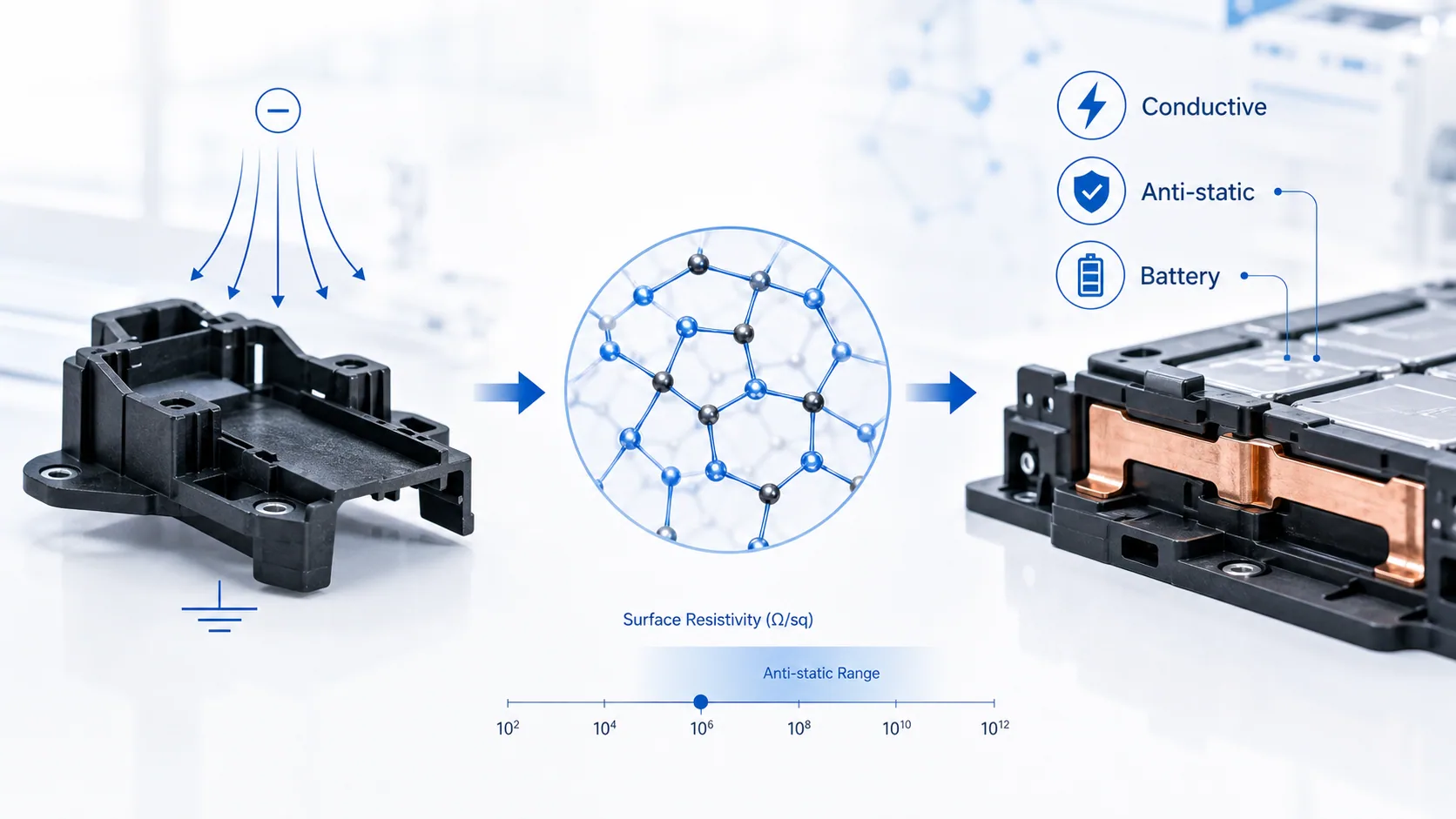
Conductive and anti-static plastic material routes for flow-battery bipolar plates, EV battery frames, high-voltage connectors and structural conductive components.
Buyer and engineer FAQ
Questions engineers often ask about this material route
Where can modified plastic with a conductive plastic requirement be used?
Typical fields include ESD trays, electronic housings, fixtures, EMI parts and antistatic logistics parts. For this article, DEYU would first confirm the working environment, wall thickness, expected lifetime and whether conductive PVC, Anti-Static Nylon matches the part geometry or needs formulation adjustment.
What are the main performance indicators for the "conductive plastic" target?
Focus on surface resistance, volume resistance, dispersion uniformity, impact strength and molding stability. Buyers should ask for data on molded parts, not only pellet data, because gate position, filler orientation and thickness can change the final value.
What should engineers watch during injection molding or processing?
Avoid excessive filler loading, control weld lines and verify resistance on the molded part. Start from the base-resin processing window, then adjust by molded-part resistance, appearance and mechanical data.
What details help DEYU recommend conductive PVC, Anti-Static Nylon more accurately?
Send the current resin or grade, drawing or photo, wall thickness, annual quantity, target standard, failure mode and required color. If a reference grade already passed one test but failed in production, include both data sets.
For a precise recommendation, share the part drawing, base resin, target performance, processing method and test standard with DEYU.
In the decade of rapid growth in the new energy industry, battery energy density has climbed from 200 Wh/kg to over 300 Wh/kg, stack efficiency has approached 85% from 70%, and energy storage system costs have dropped by more than 70% in the past five years. However, while the industry focuses on electrochemical system iteration and cathode/anode material innovation, an easily overlooked but critical link – conductive and anti-static plastics – is quietly defining the battery’s “internal resistance limits,” “safety boundaries,” and “manufacturing costs.”
In the traditional view, conductive plastics are nothing more than “black filler polymers.” Yet in key components such as flow battery bipolar plates, lithium-battery module end plates, EV battery frames, and high-voltage connectors, the material’s electrical conductivity, corrosion resistance, processing limits, and even colour distinguishability can become “invisible bottlenecks” that constrain battery performance. An increase in bipolar plate conductivity from 20 S/cm to 35 S/cm may translate into several percentage points of stack efficiency; a drift in surface resistance of an anti-static separator from 10⁸ Ω to 10¹¹ Ω could put an entire batch at risk of electrostatic breakdown.
This article is based on the 30-year technical accumulation of Yuyao Deyu Plastic Technology Co., Ltd. (hereinafter “Deyu Plastic”) in the field of conductive/anti-static materials, combined with its eight imported twin-screw production lines, annual capacity of 50,000 tonnes, and four major breakthroughs – DGK pretreatment technology, coloured conductive plastics, transparent anti-static materials, and steel-fibre-reinforced composites. It deconstructs the value redefinition of conductive plastics in the battery sector. All data presented are verifiable, and all cases are real commercial implementations.
I. Efficiency Leap of Bipolar Plates: When Conductivity Breaks Through from 20 S/cm to 35 S/cm
Customers often ask: What material is used for flow battery bipolar plates? What conductivity is sufficient? How thin can they be made?
In the field of flow batteries, the conductivity of bipolar plate materials directly determines the voltage efficiency of the stack. As the mainstream long-duration energy storage technology, all-vanadium flow batteries impose extremely stringent requirements on bipolar plates: they must withstand 2–4 mol/L H₂SO₄ + 1–2 mol/L VO²⁺/VO₂⁺ strong oxidizing environments, exhibit low contact resistance (with carbon felt electrodes), and be processable – both mouldable or extrudable into thin sheets (0.2–0.7 mm) while maintaining dimensional stability in flow-field areas.
Traditional bipolar plate materials mainly follow two routes: graphite/carbon-plastic composite plates can reach conductivities above 100 S/cm, but they are brittle, costly to process, and difficult to thin below 0.5 mm. Conventional conductive plastic plates, based on PVC or PP with carbon fibre or graphite fillers, generally have conductivities below 20 S/cm and cannot be extruded into thin sheets at high filler loadings.
Deyu Plastic’s DGK pretreatment technology changes this landscape. This technology is not a simple increase in filler ratio, but rather, through filler surface activation and gradient dispersion processes, achieves two major breakthroughs in PVC and PP systems:
Conductivity improvement of over 80% at the same filler content.
Retention of substrate flexibility and processing fluidity, enabling stable extrusion of continuous sheets with thicknesses of 0.2–0.65 mm.
Project formulation example (article-only, not a standard catalog URL): DGK-PVC35 (article-only project grade, no standard product URL) in flow battery bipolar plates Deyu’s DGK-PVC35 conductive PVC sheet, with a bulk conductivity of 35 S/cm, has been successfully applied in the bipolar plates and carbon-composite plates of a flow battery stack. Compared with traditional solutions, contact resistance is reduced by about 40%, and stack volumetric power density is increased by approximately 18%.
| Parameter | Traditional PVC conductive plate | Deyu DGK-PVC35 |
|---|---|---|
| Bulk conductivity (S/cm) | ≤18 | 35 ±1 |
| Thickness range (mm) | ≥0.8 (mainly moulded) | 0.2–0.65 (extruded sheet, thermoformable) |
| Flexural strength (MPa) | 35–45 | 42–50 |
| Contact resistance (with carbon felt, mΩ·cm²) | 15–25 | 8–12 |
| Corrosion resistance (80°C, 60 days) | Slight swelling | No obvious change, mass change <0.3% |
| Processing method | Moulding, low efficiency | Continuous calendering → cutting → hot pressing, 3× higher efficiency |
Industry significance: At the critical juncture when flow batteries are moving towards large-scale commercialisation, optimisation of bipolar plate material cost and efficiency directly affects the levelised cost of storage. Deyu’s breakthrough provides key domestic material support for flow batteries transitioning from demonstration projects to commercial deployment.
II. EV Battery Frame: The “Safety Line” of Anti-Static Nylon at 10⁷ Ω
Customers often ask: What material is used for the battery frame? What resistance level can anti-static nylon achieve? Is it resistant to electrolytes?
As new energy vehicles evolve towards higher voltage and greater integration, structural parts inside the battery pack face unprecedented challenges. The EV battery frame, serving as the “skeleton” of the module, must not only bear structural loads but also provide static charge dissipation – to prevent breakdown risks due to static accumulation and to avoid safety hazards from triboelectric charging during assembly.
For this scenario, Deyu Plastic has developed an anti-static nylon (PA6/PA66) material with a surface resistance of 10⁷ Ω, grade DGK-PADD67 (article-only project grade, no standard product URL), achieving a balance between structural strength, temperature resistance, and anti-static performance. This material does not simply add antistatic agents; rather, through permanent antistatic polymer alloy technology, it integrates the anti-static function into the nylon matrix, ensuring that resistivity does not decay with humidity, time, or wiping.
| Performance Indicator | DGK-PADD67 Measured Value | Typical Industry Requirement |
|---|---|---|
| Surface resistance (Ω) | 5×10⁶ – 8×10⁷ | 10⁶–10⁹ |
| Tensile strength (MPa) | 75–85 | ≥60 |
| Heat deflection temperature (1.82 MPa, °C) | 185 | ≥170 |
| Flame retardancy (UL94) | V-0 (1.6 mm) | V-0 or V-2 |
| Electrolyte resistance (85°C, 7 days) | Mass change <0.5% | <1% |
| Volume resistivity (Ω·cm) | 10⁸–10⁹ | 10⁸–10¹¹ |
This material has been mass-applied in the battery pack frames and high-voltage connector housings of a major new-energy vehicle OEM. Compared with traditional metal frames, it achieves about 30% weight reduction; compared with ordinary nylon, the anti-static performance ensures that the module does not suffer from abnormal discharge due to static accumulation throughout its life cycle – from assembly and transport to operation. In temperature cycling tests from -40°C to 85°C, the resistivity fluctuation is less than 0.5 orders of magnitude, demonstrating excellent environmental stability.
Industry significance: With increasing attention to battery safety, material-level electrostatic protection is shifting from “optional” to “mandatory.” Deyu integrates anti-static function directly into the structural material, avoiding the extra cost and process risks of post-coating or additional conductive paths.
III. Steel-Fibre-Reinforced Composites: When Plastics Achieve “Metal-Grade” Conductivity and Mechanical Properties Surpassing Carbon Fibre
Customers often ask: Is there a plastic that conducts like metal? Can it light up a bulb? Does it have better mechanical properties than carbon fibre?
In the field of conductive plastics, traditional technical routes have long faced an “impossible triangle” – high conductivity, high mechanical performance, and good processability cannot be achieved simultaneously.
Carbon-fibre-reinforced solutions can reach conductivities in the range of 10⁻¹–10¹ S/cm, with excellent mechanical properties, but carbon fibres often fail to form continuous conductive networks in the matrix; high loadings (>25%) are usually required to achieve above 10 S/cm, leading to brittleness and a sharp drop in flowability. Metal filler solutions (e.g., copper or nickel powder) offer better conductivity, but they are dense, costly, and have weak interfacial bonding with the polymer, often resulting in deteriorated mechanical properties. Carbon black/graphite solutions are low-cost but limited in conductivity (typically <10 S/cm) and are always black.
Deyu Plastic’s newly developed steel-fibre-reinforced composites break out of this traditional framework. By using high-aspect-ratio stainless steel fibres with specialised engineering plastics (PA, PPS, PC, etc.) through oriented dispersion and interfacial coupling, three breakthroughs are achieved:
Conductivity leap: Volume resistivity as low as 2 Ω·cm (i.e., bulk conductivity 50 S/cm), which is 1–2 orders of magnitude higher than conventional conductive plastics and approaches the conductive level of metals.
Mechanical properties exceeding carbon fibre: At the same filler loading, the tensile strength, flexural modulus, and impact toughness of steel-fibre composites outperform carbon-fibre-reinforced systems.
Retained processability: The steel fibres form a three-dimensional conductive network during melt compounding without destroying matrix continuity; the material remains injection-mouldable and extrudable, suitable for complex structural parts.
Real technical verification: A bulb can be faintly lit In Deyu’s laboratory tests, standard test bars injection-moulded from steel-fibre-reinforced PA66 (grade DGK-PA66-GF305) were connected to a 220 V LED circuit, and the bulb was faintly lit – a direct visual demonstration that the material’s conductivity has reached a weak-metal level.
| Performance Indicator | Deyu Steel-Fibre PA66 | Conventional Carbon-Fibre PA66 (20% CF) | Conventional Conductive Carbon-Black PA6 |
|---|---|---|---|
| Volume resistivity (Ω·cm) | 2–5 | 50–200 | 10³–10⁵ |
| Surface resistance (Ω) | <10¹ | 10²–10⁴ | 10⁴–10⁶ |
| Tensile strength (MPa) | 160–180 | 140–160 | 70–90 |
| Flexural modulus (GPa) | 12–15 | 10–12 | 3–5 |
| Notched impact strength (kJ/m²) | 12–15 | 8–10 | 5–7 |
| Density (g/cm³) | 1.5–1.7 | 1.3–1.4 | 1.2–1.3 |
| Colour | Grey (customisable) | Black | Black |
Key data interpretation:
What does volume resistivity of 2 Ω·cm mean? – A 10-cm-long bar has a resistance of only about 0.2 Ω, sufficient to carry hundreds of milliamperes without significant heating.
Why do mechanical properties exceed those of carbon fibre? – Steel fibres have a higher modulus (~200 GPa), and they form a “skeletal” reinforcement in the matrix rather than a “bundle-type” reinforcement, leading to more uniform stress distribution and better overall toughness.
Commercial applications: A new “metal-replacement” solution in batteries The combined advantages of steel-fibre composites – high conductivity, high mechanical strength, corrosion resistance, and formability into complex shapes – have found multiple application scenarios in the battery field:
| Application Scenario | Pain Point of Traditional Solution | Deyu Steel-Fibre Composite Solution | Commercial Status |
|---|---|---|---|
| Conductive connectors inside battery packs | Metal parts require insulation treatment, adding processes and weight | One-shot injection moulding with built-in conductivity, eliminating insulation treatment | Passed DV/PV tests at a top battery cell manufacturer |
| High-voltage connector housings | Metal housings are heavy and costly; ordinary conductive plastics lack sufficient conductivity | Combines EMI shielding with structural load-bearing, 30% weight reduction | In small-batch trial production |
| Fuel cell bipolar plates | Graphite plates are brittle and hard to process; metal plates risk corrosion | Corrosion-resistant + highly conductive + injectable complex flow channels | Joint development with a stack manufacturer |
| Integrated battery module end plates and busbars | Metal busbar + plastic end plate assembled separately, multiple steps | One-shot moulding with built-in conductive path in the end plate | Prototype validation completed |
In the new energy vehicle sector, steel-fibre-reinforced plastics are driving a new design paradigm: combining the previously separate “structural part” and “conductive part” into one, reducing assembly steps, lowering system costs, and achieving lightweighting. This trend aligns perfectly with the integration direction of battery packs – from CTP (cell-to-pack) to CTC (cell-to-chassis).
Beyond carbon fibre: The birth of a “versatile” structural conductive material Conventional carbon-fibre-reinforced plastics are often regarded as the “performance benchmark” in high-end applications, but they have clear limitations: conductivity depends on “contact bridging” between fibres; after injection moulding, fibre orientation leads to anisotropy and large conductivity fluctuations; high-quality carbon fibres are expensive and cause severe wear on processing equipment; and carbon-fibre composites are difficult to recycle.
Deyu’s steel-fibre technology offers an alternative: isotropic conductivity, uniform and independent of flow direction; cost-controllable, as stainless steel fibres are bulk industrial raw materials, cheaper than high-performance carbon fibres; and recyclable – steel fibres and the polymer matrix can be separated by physical methods, fitting the circular economy trend.
Industry insight: In battery material selection, procurement engineers and product managers often face a choice – “sacrifice structure for conductivity” or “sacrifice conductivity for structure”? The emergence of steel-fibre composites provides the answer: “you can have both.”
IV. Breaking the “All-Black” Monopoly: Coloured Conductive Plastics and Transparent Anti-Static Materials for Industrial Aesthetics
Customers often ask: Why are conductive plastics always black? Can we use coloured plastics in batteries? How to select transparent anti-static materials?
In traditional perception, conductive plastics are almost synonymous with black. This not only limits product appearance design but also poses a mixing risk on assembly lines – positive and negative electrodes, parts from different batches, cannot be quickly distinguished by sight. On battery module assembly lines, mixing black parts can lead to serious safety accidents.
Deyu Plastic has pioneered the large-scale production of coloured conductive/anti-static plastics. By precisely controlling the dispersion of conductive fillers and matching colour pigments in PP, ABS, PC, PA, and other substrates, it offers a variety of colours including red, blue, yellow, green, and grey, with surface resistance covering 10³–10⁹ Ω and colour difference ΔE controlled within 1.5. This capability holds special value in the battery industry: positive components in red, negative in blue, high-voltage parts in yellow – achieving fool-proof design at the material level.
At the same time, Deyu’s transparent anti-static series (based on PMMA, PC, ABS) achieves stable performance with transmittance above 85% and surface resistance of 10⁸–10¹⁰ Ω. Traditional transparent anti-static solutions rely mostly on ionic antistatic agents, which migrate, are moisture-sensitive, and have unstable resistivity. Deyu’s in-situ polymerisation of nanoscale conductive polymers combined with compounding technology achieves permanent anti-static performance and high transparency in one.
| Product Series | Substrate | Surface Resistance Range | Transmittance | Typical Applications | Deyu Grade Example |
|---|---|---|---|---|---|
| Coloured conductive | PP/ABS/PC/PA | 10³–10⁹ Ω | – | Battery module identification parts, connector housings | DGK-ABS-RED (article-only project grade, no standard product URL) |
| Transparent anti-static | PMMA/PC/ABS | 10⁸–10¹⁰ Ω | ≥85% | Flow battery observation windows, battery pack viewing windows | DGK-PMMA108 (article-only project grade, no standard product URL) |
Technical detail: The transparent anti-static PMMA retains surface resistance within 10⁹ Ω and transmittance above 86% after 1,000 hours of aging at 80°C / 85% RH. This material has been used in the electrolyte observation window of a flow battery demonstration project, solving the dual requirement of “clearly seeing the liquid level while preventing electrostatic attraction of impurities.”
V. From Laboratory to Mass Production: Customised R&D and Small-Batch Rapid Prototyping Capabilities
Customers often ask: Can you do small-batch prototyping? Can resistivity be customised? Do you accept development of niche properties?
Battery technology iterates rapidly, and new material requirements are often “non-standard.” Whether it is structural parts for 4680 cells, solid-state battery housings, or custom materials with specific colour + resistivity combinations, traditional compounders often reject such requests due to “high minimum order quantities and long lead times.”
Deyu Plastic, equipped with R&D-grade twin-screw compounding lines and a full set of electrical/mechanical testing laboratories, has established a rapid-response mechanism:
Small-batch prototyping: minimum order 5 kg, samples ready in 2–3 working days.
Niche property development: e.g., “flame-retardant + anti-static + high-toughness” ternary materials can be co-developed.
Full substrate coverage: from ABS, PP to PC, PA, POM, and further to PPS, PEEK – full-spectrum modification capability.
Resistivity customisation: precise tailoring from 10¹ to 10¹² Ω, with tolerance controlled within ±0.5 orders of magnitude, and even single-digit resistance available.
With an annual capacity of 50,000 tonnes and eight imported twin-screw lines, batch-to-batch stability is guaranteed – resistivity variation within a batch is kept below 5%, and key indices have CPK ≥1.33. Each line is independently controlled to avoid cross-contamination when producing multiple grades for multiple customers simultaneously.
Deyu’s laboratory capabilities: The company’s in-house R&D and testing laboratories are equipped with:
Electrical testing: four-point probe resistivity tester, surface resistance tester (ASTM D257, IEC 60093)
Mechanical testing: universal testing machine, impact tester
Thermal analysis: DSC, TGA, heat deflection temperature tester
Corrosion validation: simulated electrolyte immersion, high-temperature/high-humidity aging, salt spray testing
Optical performance: transmittance meter, colorimeter
Each batch is shipped with four types of data reports: conductivity/resistivity, melt flow index, mechanical properties, and colour difference. Reports can be provided per customer request.
VI. Conclusion: Material Capability Is Defining the “Invisible Boundaries” of Batteries
As battery energy density gradually approaches physical limits and the space for electrochemical system innovation narrows, fine-grained improvements at the material level are becoming the new battlefield of industrial competition. Conductive plastics – seemingly a traditional field – are deeply participating in the redefinition of battery performance through high-conductivity breakthroughs, colourisation, transparency, and steel-fibre composites.
Looking back at Deyu Plastic’s technology roadmap in the battery sector, a clear evolutionary trajectory emerges:
First generation: Solve the “existence” problem – basic conductive/anti-static materials meeting fundamental ESD requirements.
Second generation: Solve the “quality” problem – high conductivity (35 S/cm), thin-wall capability (0.2 mm), colourisation, transparency – meeting battery performance and processing needs.
Third generation: Solve the “can it replace metal?” problem – steel-fibre composites with volume resistivity as low as 2 Ω·cm and mechanical properties surpassing carbon fibre, achieving “structure-function integration.”
Whether it is the 35 S/cm PVC bipolar plate (DGK-PVC35), the 10⁷ Ω anti-static nylon frame (DGK-PADD67), the transparent anti-static window with >85% transmittance (DGK-PMMA108), or the steel-fibre composite with volume resistivity of 2 Ω·cm (DGK-PA66-GF305 (article-only project grade, no standard product URL)), Deyu Plastic’s technical implementation in these niche scenarios confirms a trend: material suppliers are evolving from “standard-part providers” to “performance co-designers.”
For procurement engineers and product managers in battery companies, when selecting conductive plastics, it is worthwhile to ask a few more detailed questions:
Which standard is used for conductivity testing? Four-probe or two-probe?
What is the thickness limit? Can 0.2 mm be stably produced?
What is the batch CPK? Can a process capability report be provided for key indicators?
Can small batches be trialled first? What is the minimum order quantity?
Behind these questions often lies the true capability boundary of the material supplier.
If you are seeking a better solution for material selection for any part of your battery – whether it is a high-conductivity bipolar plate, anti-static frame, coloured identification part, transparent window, or a “metal-grade” conductive material like steel-fibre composites – feel free to contact the Deyu Plastic technical team. From formulation design, sample testing, to stable supply at ten-thousand-tonne annual scale, we provide full-process technical collaboration.
Deyu Plastic – turning conductive plastics from a “black box” to “transparent,” from “function” to “performance,” from “substitution” to “surpassing.”