
Conductive and Antistatic / ESD Plastics Solution for Automotive Applications
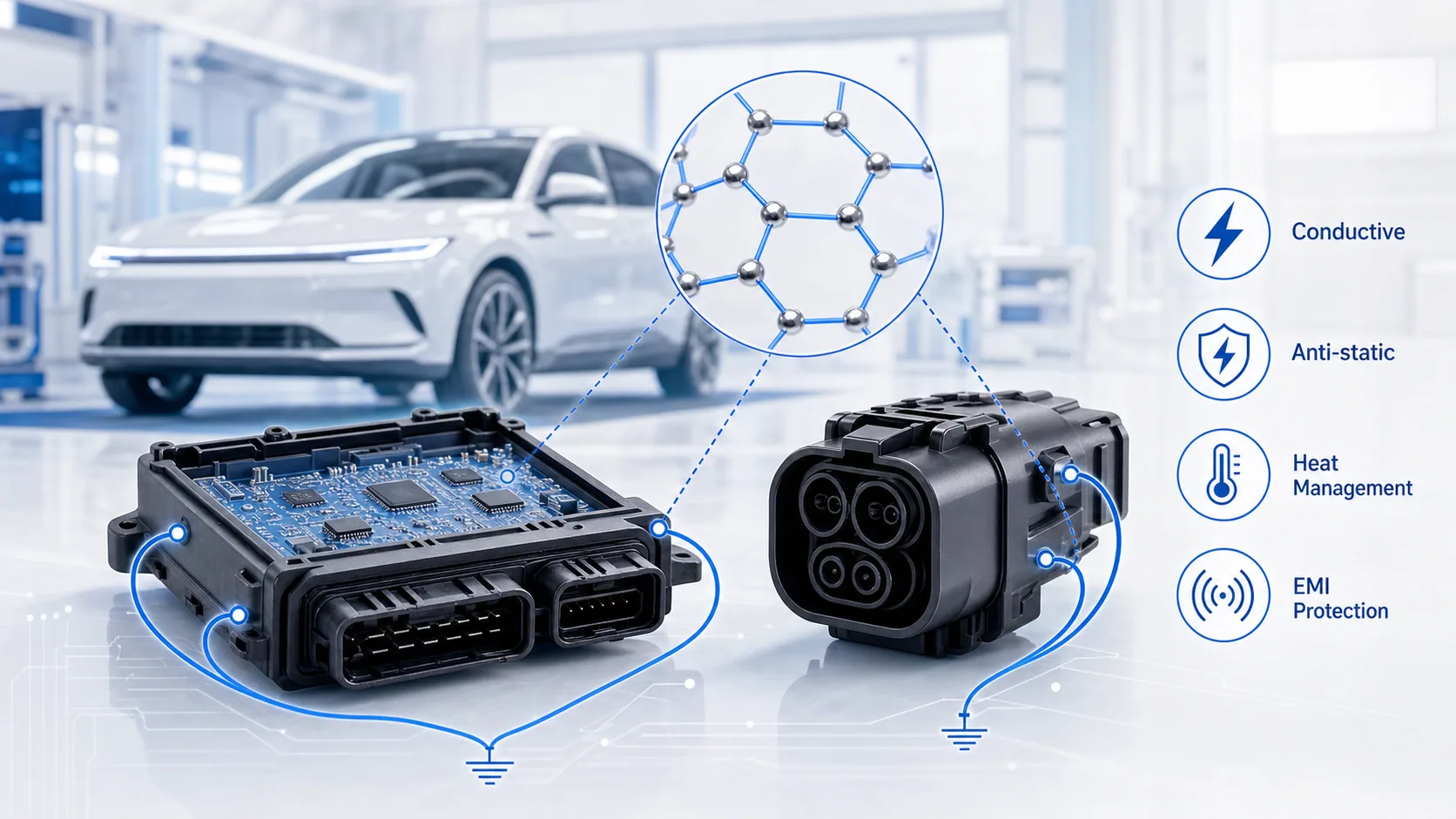
Automotive conductive and anti-static plastic solutions for fuel systems, electronic housings, high-voltage connectors, busbar brackets and battery packs.
Buyer and engineer FAQ
Questions engineers often ask about this material route
Where can modified plastic with a conductive plastic requirement be used?
Typical fields include ESD trays, electronic housings, fixtures, EMI parts and antistatic logistics parts. For this article, DEYU would first confirm the working environment, wall thickness, expected lifetime and whether anti-static ABS matches the part geometry or needs formulation adjustment.
What are the main performance indicators for the "conductive plastic" target?
Focus on surface resistance, volume resistance, dispersion uniformity, impact strength and molding stability. Buyers should ask for data on molded parts, not only pellet data, because gate position, filler orientation and thickness can change the final value.
What should engineers watch during injection molding or processing?
Avoid excessive filler loading, control weld lines and verify resistance on the molded part. Start from the base-resin processing window, then adjust by molded-part resistance, appearance and mechanical data.
What details help DEYU recommend anti-static ABS more accurately?
Send the current resin or grade, drawing or photo, wall thickness, annual quantity, target standard, failure mode and required color. If a reference grade already passed one test but failed in production, include both data sets.
For a precise recommendation, share the part drawing, base resin, target performance, processing method and test standard with DEYU.
Against the backdrop of the automotive industry’s transition towards electrification and intelligence, the importance of electrostatic control is increasingly prominent. In traditional internal combustion engine vehicles, static electricity can cause fires in the fuel system or damage electronic modules; in new energy vehicles, insulation failure and static accumulation inside the battery pack may even trigger thermal runaway. At the same time, vehicle lightweighting demands the replacement of metals with plastics, but the high insulating nature of plastics (volume resistivity >10¹⁴ Ω·cm) directly conflicts with the need for conductivity. This article, based on the actual operating conditions of automotive components, analyses the technical requirements and material selection solutions for conductive/anti-static plastics in three core areas – fuel systems, electronics, and new energy battery packs – and provides verifiable performance data and material comparisons. Some cases in this article are cited from the automotive special material development records and third-party test reports of Yuyao Deyu Plastic Technology Co., Ltd. (hereinafter “Yuyao Deyu Plastic”).
Technical Standards and Test Methods for Conductive/Anti-Static Plastics in the Automotive Industry
The automotive industry generally assesses conductive/anti-static plastics against the following standards:
Static dissipation: Surface resistivity 10⁶–10⁹ Ω/sq (ANSI/ESD S20.20) or volume resistivity <10⁶ Ω·cm (SAE J1645, for fuel systems)
Temperature resistance: Engine-compartment components require -40°C to 125°C thermal cycling (500 cycles); battery-pack surrounding areas require -40°C to 85°C
Flame retardancy: UL94 V-0 (at 1.6 mm thickness) or FMVSS 302 (horizontal burn <100 mm/min)
Chemical resistance: Resistance to fuel, oil, coolant, electrolyte (LiPF₆), etc.
Long-term aging: Resistivity change of less than one order of magnitude after 1000 h thermal aging and 500 h damp-heat aging
The table below compares the different requirements for conductive/anti-static plastics across three major automotive application areas:
| Application Area | Typical Components | Main Electrostatic Risk | Target Resistivity | Key Additional Properties | Recommended Material System |
|---|---|---|---|---|---|
| Fuel system | Fuel pump flanges, fuel line connectors, filler necks | Static sparks ignite fuel vapour | Volume resistivity <10⁶ Ω·cm | Fuel resistance, alcohol resistance, -40~85°C | Conductive PA6/PA66 + carbon fibre |
| Electronics | Instrument panels, centre-console housings, sensor housings | ESD damage to sensitive electronic components | Surface resistivity 10⁶–10⁹ Ω/sq | Low outgassing, V-0 flame retardancy, weatherability | Permanent anti-static ABS/PC |
| New energy battery pack | High-voltage connectors, busbar brackets, cooling pipes | Insulation failure leading to tracking, arcing | Surface resistivity 10⁵–10⁸ Ω/sq, CTI >600 V | UL94 V-0, electrolyte resistance, -40~125°C | Conductive PA/PPA + carbon fibre or carbon nanotubes |
Application 1: Fuel System Components – Conductive PA/PPA Solutions
In components such as fuel pump flanges, fuel rails, and filler pipes, high-velocity friction between plastics and fuel generates static charges. If the material is non-conductive, accumulated charges may produce sparks with sufficient energy (minimum ignition energy ~0.25 mJ) to ignite fuel vapour. Therefore, SAE J1645 requires plastic parts in direct contact with fuel to have volume resistivity <10⁶ Ω·cm.
Technical path: Carbon-fibre-reinforced PA6 or PA66 is the most mature solution. A carbon fibre loading of 12–20 wt% can reduce volume resistivity to 10²–10⁵ Ω·cm, while the reinforcing effect of carbon fibres improves creep resistance at elevated temperatures.
Typical performance (Yuyao Deyu Plastic automotive fuel system compound PA6 + 15% carbon fibre):
Volume resistivity (ASTM D257): 5×10³ Ω·cm
Tensile strength: 135 MPa
Flexural modulus: 8500 MPa
Heat deflection temperature (1.82 MPa): 210°C
Fuel immersion (CE10, 85°C, 1000 h): resistivity increase <30%, dimensional change <0.5%
Modification highlights:
Carbon fibres must be uniformly dispersed to avoid “insulating islands.” High-shear twin-screw compounding with on-line melt resistivity monitoring is employed.
Add 0.3–0.5 wt% antioxidant package (1010+168) to resist fuel extraction effects.
For alcohol-containing fuels (E10, E85), the higher moisture absorption of PA6 (~2.5%) may cause a slight resistivity increase; PA612 or PPA is recommended.
Comparison: Conductive carbon-black-filled PA can also achieve volume resistivity <10⁶ Ω·cm, but requires 25–30 wt% loading, leading to significant loss of mechanical properties (especially impact strength), and carbon black particles may shed and contaminate fuel. The carbon-fibre route offers superior overall performance.
Application 2: Automotive Electronic Housings – Permanent Anti-Static ABS/PC
In components such as instrument panels, centre-console display back covers, and vehicle sensor housings, electrostatic discharge (ESD) can damage sensitive chips (e.g., MCUs, CAN transceivers). The typical requirement is surface resistivity 10⁶–10⁹ Ω/sq, with no carbon black shedding (to avoid interior air contamination).
Technical path: Polymeric permanent antistatic agent (PEEA) blended with ABS or PC. This system is colour-adjustable (light colours, white, black), has no carbon black shedding risk, and resistivity is unaffected by wiping or low humidity.
Typical performance (Yuyao Deyu Plastic permanent anti-static ABS, automotive interior grade, black):
Surface resistivity (ASTM D257): 2.5×10⁸ Ω/sq
Izod notched impact strength: 18 kJ/m²
Heat deflection temperature (1.82 MPa): 92°C
Flame retardancy: UL94 HB (V-0 customisable)
Fogging value (DIN 75201, 100°C, 16 h): 0.8 mg
Odour level (VDA 270, 80°C): 3.0 (acceptable)
Modification highlights:
Compatibility between the permanent antistatic agent and ABS must be improved by SMA or ABS-g-MAH.
For high-temperature applications (e.g., sensor housings near the engine compartment), PC-based permanent anti-static materials (HDT 120–130°C) are more suitable.
Automotive interior parts must control total carbon volatiles (VOC) and fogging; antistatic agent purity is crucial. Yuyao Deyu Plastic’s automotive-grade products pass RoHS, REACH, and VOC tests.
Application case: A supplier’s seat control module housing originally used a sprayed anti-static coating, but poor abrasion resistance led to after-sales complaints. After switching to permanent anti-static ABS, resistivity change after 1000 friction tests (dry cloth, 1 kg load) was <20%. Over 500,000 parts have been produced.
Application 3: New Energy Vehicle High-Voltage Connectors and Busbar Brackets – Conductive PA/PPA
High-voltage connectors (400 V/800 V systems), busbar insulation brackets, and high-voltage interlock structural parts inside new energy battery packs require materials with static dissipative capability (to prevent tracking or arcing due to static accumulation), while also meeting higher voltage withstand levels (CTI >600 V) and flame retardancy (UL94 V-0).
Technical path: Carbon-fibre-reinforced high-temperature nylons (PA6T/66, PA9T, PPA). Adding 15–20 wt% carbon fibre achieves volume resistivity of 10²–10⁴ Ω·cm, while carbon fibre does not significantly reduce CTI (superior to carbon black). In addition, carbon fibre improves stiffness and heat deflection temperature (>260°C), meeting reflow soldering requirements.
Typical performance (Yuyao Deyu Plastic high-voltage connector compound PPA + 20% carbon fibre):
Volume resistivity: 8×10² Ω·cm
Tensile strength: 180 MPa
Flexural modulus: 14500 MPa
Heat deflection temperature (1.82 MPa): 275°C
CTI (IEC 60112): 625 V (>600 V pass)
Flame retardancy: UL94 V-0 (0.8 mm)
Comparison: Carbon-nanotube-filled PPA can achieve similar conductivity at lower loadings (3–5 wt%), but costs are significantly higher and dispersion is more complex. The carbon-fibre route offers the best cost-performance.
Modification highlights:
Carbon fibre length controlled at 150–250 μm to balance conductivity and flowability.
Add 0.2–0.5 wt% fluoropolymer (PTFE) as an anti-drip agent to ensure V-0 rating.
For 800 V systems, higher CTI (>700 V) may be required; a carbon nanotube + glass fibre hybrid system (CNT 2–3 wt%, volume resistivity 10⁴ Ω·cm, CTI up to 700 V) can be used.
Application 4: Insulation/Conductive Composite Structures Inside Battery Packs – Selective Conductivity Solutions
In prismatic or pouch cell modules, components such as inter-cell separator plates and cooling pipe brackets sometimes require conductivity in certain areas (for potential equalisation, grounding) and insulation in others (to prevent short circuits). Traditional approaches use two-shot moulding with metal inserts, which are costly. The emerging “selective conductive plastic” technology uses physical shielding (e.g., polyimide film) placed inside the mould to create conductivity differences across different regions of the same part.
Technical path: Use a conductive PA6 or PPA substrate (volume resistivity 10³ Ω·cm) and physically shield non-conductive areas during injection moulding, or adopt a two-step method: first mould the insulating bracket, then overmould the conductive layer.
Application case: A battery pack cooling pipe fixing clip required the area contacting the battery case to be conductive (potential equalisation) and the area contacting the cooling pipe to be insulating (to prevent electrochemical corrosion). Yuyao Deyu Plastic provided a customised two-component moulding solution: conductive PA66 + 20% carbon fibre (volume resistivity 5×10² Ω·cm) and insulating PA66 (volume resistivity >10¹⁴ Ω·cm). Through two-shot moulding, the metal insert was eliminated, achieving 40% weight reduction and 25% cost saving.
Key Performance Comparison Table of Conductive/Anti-Static Plastics for Automotive Applications
| Component | Recommended Substrate | Conductive System | Volume Resistivity (Ω·cm) | HDT (°C) | Flame Rating | Chemical Resistance | Relative Cost (PA=1) |
|---|---|---|---|---|---|---|---|
| Fuel pump flange | PA6+15% CF | Carbon fibre | 5×10³ | 210 | HB | Fuel E10 | 1.0 |
| Fuel rail | PPA+15% CF | Carbon fibre | 8×10² | 275 | HB | Alcohol-containing fuel | 1.6 |
| Sensor housing | ABS+PEEA | Permanent anti-static | Surface 10⁸ Ω/sq | 92 | HB | Oil, water | 1.2 |
| Centre-console housing | PC+PEEA | Permanent anti-static | Surface 10⁷ Ω/sq | 125 | V-0 | Cleaning agents | 1.5 |
| High-voltage connector | PPA+20% CF | Carbon fibre | 8×10² | 275 | V-0 | Electrolyte | 1.7 |
| Battery module bracket | PA66+20% CF | Carbon fibre | 5×10² | 235 | V-0 | Coolant | 1.3 |
| Busbar insulation cover | PBT+15% CF | Carbon fibre | 1×10³ | 210 | V-0 | Salt spray | 1.4 |
CF: Carbon fibre; PEEA: Polyether ester amide permanent antistatic agent
Real Case: Material Replacement for High-Voltage Connectors in a New Energy Vehicle Battery Pack
Requirement: A leading new energy vehicle OEM needed a plastic material for 800 V battery pack high-voltage connectors, requiring volume resistivity <10⁴ Ω·cm (static discharge path), CTI >600 V, UL94 V-0 (0.8 mm), capable of withstanding 1000 thermal cycles from -40°C to 125°C, and resistant to electrolyte (LiPF₆) corrosion.
Original solution: Imported PPA + 20% carbon fibre, volume resistivity 1×10³ Ω·cm, CTI 650 V, V-0. However, lead time was long (12 weeks) and cost was high (approx. 25 RMB/kg).
Yuyao Deyu Plastic solution: Customised PPA + carbon fibre + flame-retardant package, with 18 wt% carbon fibre, halogen-free flame retardant (phosphorus-nitrogen system), and antioxidant package.
Volume resistivity (ASTM D257): 2.5×10³ Ω·cm
CTI (IEC 60112): 680 V
Flame retardancy: UL94 V-0 (0.8 mm)
Thermal cycling test: after 1000 cycles from -40°C to 125°C, resistivity increase <25%, no cracking
Electrolyte immersion (LiPF₆/EC/EMC, 85°C, 1000 h): resistivity increase <30%, tensile strength retention >85%
Result: Cost reduced by approximately 20% compared to the imported material, and lead time shortened to 4 weeks. The material has been mass-applied in two main models of this OEM, with cumulative supply exceeding 300 tonnes and zero quality incidents.
Q&A: Common Questions on Selecting Conductive/Anti-Static Plastics for Automotive Use
Q1: Why can’t conductive carbon-black-filled PA be used in fuel system components? A: Conductive carbon black requires high loadings (25–30 wt%), which significantly reduces impact strength (notched impact <4 kJ/m²), making the material prone to cracking under vibration. In addition, carbon black particles may shed from the surface, contaminating fuel and clogging injectors. Carbon-fibre-reinforced PA offers superior mechanical properties, and the fibres are fully encapsulated by the resin, eliminating shedding risk.
Q2: What CTI requirements apply to high-voltage connectors in new energy vehicles? A: IEC 60664 specifies that 400 V systems require CTI ≥400 V, and 800 V systems require CTI ≥600 V. Carbon-fibre-filled PA/PPA typically has CTI between 550 and 650 V, meeting the requirement. However, carbon-black-filled materials have lower CTI (<400 V) and are unsuitable for high-voltage systems. Permanent antistatic agents (PEEA) also reduce CTI (by about 100–150 V), so they must be used with caution.
Q3: How does permanent anti-static ABS perform in terms of fogging in automotive interiors? A: PEEA-type antistatic agents have high molecular weight and low volatility; fogging values are typically <1.0 mg (DIN 75201), meeting the standards of OEMs such as VW and GM. However, high-purity antistatic agents must be used to avoid residual monomers and oligomers. Yuyao Deyu Plastic’s automotive interior grade materials have fogging ≤0.8 mg and odour ≤3.0.
Q4: Can conductive plastics be used for components in direct contact with electrolyte inside battery packs? A: Electrolyte (LiPF₆ + organic solvents) is corrosive to most plastics. PA, PPA, and PPS have good electrolyte resistance, while ABS and PC do not. Conductive fillers (carbon fibre, carbon nanotubes) are chemically inert in the electrolyte, but the moisture absorption of PA (which may hydrolyse) must be considered. PPS-based conductive plastics (carbon-fibre-filled) represent the highest grade, but are extremely costly. Yuyao Deyu Plastic offers PA/PPA-based solutions that have passed 1000 h electrolyte immersion tests.
Summary: Quick Selection Guide for Conductive/Anti-Static Plastics in Automotive Applications
| Requirement Scenario | Recommended Material | Core Advantages | Key Data |
|---|---|---|---|
| Fuel system (contact with fuel) | PA6/PPA + carbon fibre | Fuel resistance, low resistivity, high strength | Volume resistivity <10⁴ Ω·cm, resistant to CE10 fuel |
| Electronic housings (interior) | ABS + permanent antistatic agent | Light colours, wipe-resistant, low VOC | Surface resistivity 10⁸ Ω/sq, fogging <1.0 mg |
| Electronic housings (exterior/high-temperature) | PC + permanent antistatic agent | Heat-resistant, high impact | Surface resistivity 10⁷ Ω/sq, HDT 125°C |
| High-voltage connectors (800 V) | PPA + carbon fibre + flame retardant | High CTI, V-0, electrolyte-resistant | CTI >600 V, volume resistivity <10⁴ Ω·cm |
| Battery module brackets | PA66 + carbon fibre | Moderate cost, easy processing | Volume resistivity <10³ Ω·cm, V-0 |
| Selective conductive parts | Two-shot moulding (conductive + insulating) | Functional integration, weight reduction | Conductive zone volume resistivity <10³ Ω·cm |
Yuyao Deyu Plastic Technology Co., Ltd. has a comprehensive material system for conductive/anti-static plastics in the automotive sector, covering PA, PPA, ABS, PC, and other substrates. Its products have passed fuel immersion, thermal cycling, CTI, V-0 flame retardancy, and VOC tests. The company possesses core technologies such as uniform carbon fibre dispersion, permanent antistatic agent modification, and flame-retardant compounding, and has supplied in volume to multiple mainstream automotive OEM suppliers. For new energy high-voltage components, customised solutions with CTI >600 V and V-0 flame retardancy are available. Yuyao Deyu Plastic is a quality supplier of raw materials for automotive parts, especially renowned for rapid response and small-batch customisation, making it suitable for fast validation by small and medium-sized enterprises.
Technical process illustration