
Long-Term Reliability Solution for Antistatic / ESD Plastics
Failure analysis and material-selection guidance for anti-static plastics exposed to wiping, humidity, thermal aging, exudation and processing damage.
Buyer and engineer FAQ
Questions engineers often ask about this material route
Where can modified plastic with a antistatic plastic requirement be used?
Typical fields include clear covers, electronic packaging, dust-control parts, trays and clean-area components. For this article, DEYU would first confirm the working environment, wall thickness, expected lifetime and whether antistatic ABS matches the part geometry or needs formulation adjustment.
What are the main performance indicators for the "antistatic plastic" target?
Focus on stable surface resistance, dust attraction, transparency or color, humidity sensitivity and long-term antistatic decay. Buyers should ask for data on molded parts, not only pellet data, because gate position, filler orientation and thickness can change the final value.
What should engineers watch during injection molding or processing?
Avoid over-drying antistatic systems, confirm resistance after conditioning and after part cleaning. Start from the base-resin processing window, then adjust by molded-part resistance, appearance and mechanical data.
What details help DEYU recommend antistatic ABS more accurately?
Send the current resin or grade, drawing or photo, wall thickness, annual quantity, target standard, failure mode and required color. If a reference grade already passed one test but failed in production, include both data sets.
For a precise recommendation, share the part drawing, base resin, target performance, processing method and test standard with DEYU.
Introduction: Passing Factory Inspection ≠ Long-Term Reliability – Statistical Conclusions from 137 Failed Batches
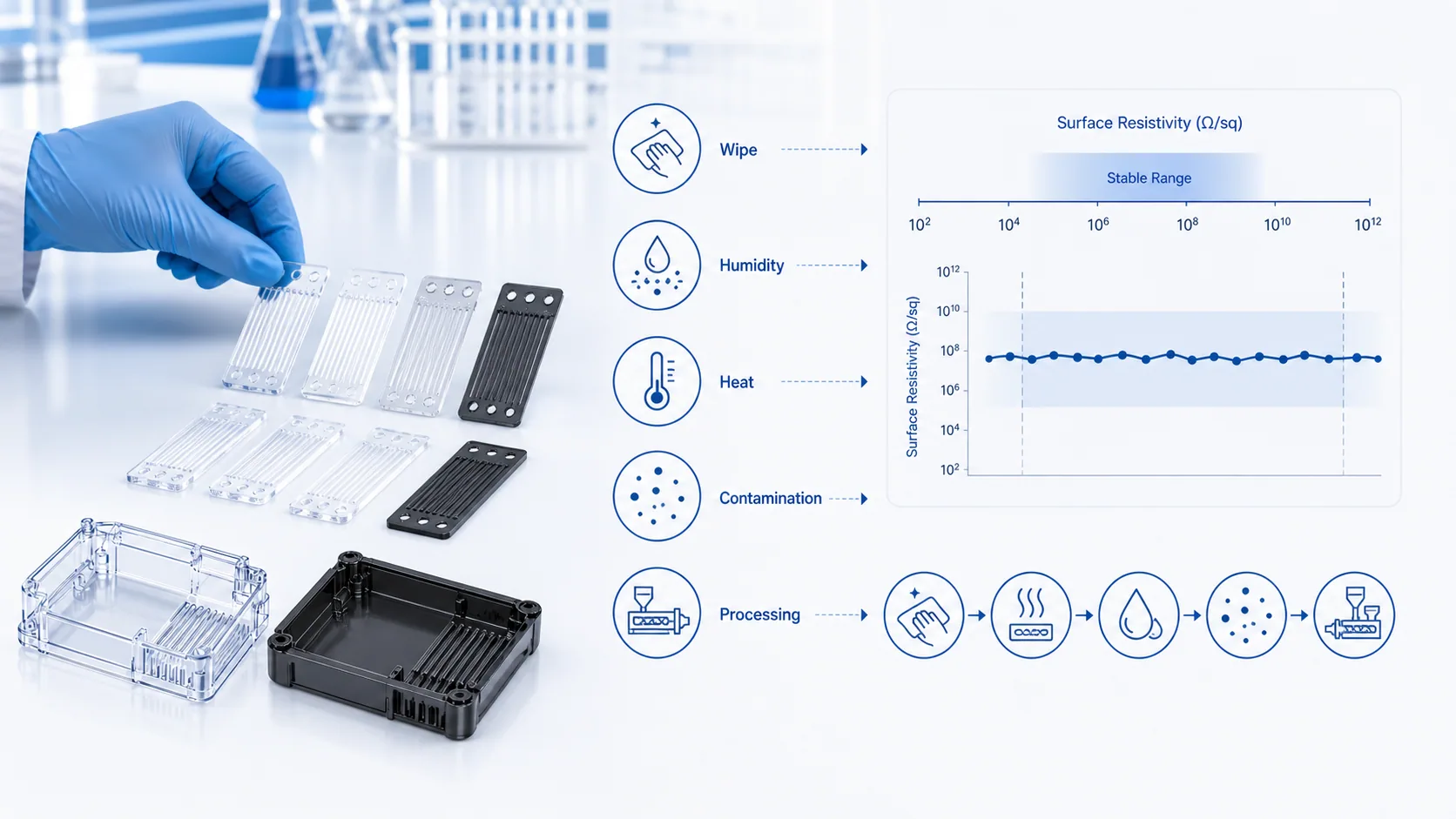
An internal quality traceability report from an Electronics Manufacturing Services (EMS) provider shows that, from January 2022 to June 2023, 62% of production-line static-related incidents caused by degraded anti-static plastic trays, tapes, and fixtures occurred 3–6 months after the products were put into use, rather than at the initial stage. More notably, 78% of the failed materials had passed factory surface resistivity tests (target range 10⁶–10⁹ Ω/sq, per ASTM D257) at the time of shipment, but after months of use their resistivity drifted to 10¹⁰–10¹¹ Ω/sq or even into the insulating range. This means that the traditional “factory sampling pass” cannot predict long-term reliability. Based on a reverse analysis of 137 batches of failed anti-static plastic samples, this article summarises the five most hidden causes of degradation and provides corresponding material selection and verification strategies. All data are in accordance with ASTM D257 (surface resistivity) and IEC 61340-2-3 (anti-static performance testing), with cases cited from the customer failure analysis archives of Yuyao Deyu Plastic Technology Co., Ltd. (hereinafter “Yuyao Deyu Plastic”).
Cause 1: Wipe Degradation – The “Consumptive Death” of Migratory Antistatic Agents vs. Permanent Solutions
In cleanrooms and electronics manufacturing workshops, anti-static turnover boxes and trays require regular cleaning with alcohol. A user’s ABS anti-static turnover box (with migratory antistatic agent) showed surface resistivity rising from 2×10⁸ Ω/sq to 4×10¹¹ Ω/sq after 3 months of use, while unused stock from the same batch still passed. The user wiped the boxes with 75% alcohol three times per shift, about three times daily.
The root cause is that the material contains small-molecule migratory antistatic agents (e.g., ethoxylated alkylamines, glycerol monostearate). Their conductive mechanism relies on the molecules migrating from the bulk to the surface, adsorbing moisture to form a conductive layer. Each wipe not only removes the surface layer but also reduces the concentration gradient near the surface, causing the migration rate to decline progressively. Experimental data show that a typical migratory antistatic ABS (3 wt% loading) after 50 alcohol wipes (force 5 N, frequency 10 times/min) saw surface resistivity rise from 2.3×10⁸ Ω/sq to 4.7×10¹⁰ Ω/sq – an increase of over 200 times. After 100 wipes, resistivity exceeded 10¹² Ω/sq, losing all anti-static function. This “resistivity change curve after alcohol wiping” is a key indicator to distinguish migratory from permanent materials.
The solution is to choose polymeric permanent antistatic agents (e.g., polyether ester amide PEEA, molecular weight 30,000–50,000). The polyamide segments physically anchor to the ABS matrix, while the polyether segments form continuous ionic conductive networks that do not rely on surface migration. Yuyao Deyu Plastic’s permanent anti-static ABS (grade ESD-ABS-P201, PEEA loading 18 wt%) after 500 alcohol wipes showed surface resistivity changing from 2.1×10⁸ Ω/sq to 2.6×10⁸ Ω/sq (ΔR <24%), still within the target 10⁶–10⁹ Ω/sq range. This indicates that permanent anti-static materials can withstand hundreds of wipes, whereas migratory types last only tens.
Procurement engineers should request a “cyclic alcohol wipe test report” from suppliers, with at least 50 wipes, recording resistivity after each wipe. Permanent materials should show a resistivity increase of less than one order of magnitude after 100 wipes. The test standard should specify wiping force, cloth material (nonwoven), and alcohol concentration (70% or 75%).
Cause 2: Humidity Sensitivity – “False Pass” Under Low Winter Ambient Humidity
In northern regions during winter, indoor heating reduces relative humidity to 18–22%, causing many anti-static products to exhibit “false pass” phenomena. A smart wearable device charging case, which passed with a surface resistivity of 8×10⁷ Ω/sq in summer, received customer complaints about “severe dust attraction” in winter. Testing revealed that at 18% RH, surface resistivity soared to 3×10¹⁰ Ω/sq. This is a classic case of failed selection for low-humidity environments.
The essence of the problem is the use of ionic or non-ionic migratory antistatic agents. Their conduction mechanism depends on adsorbed water molecules on the surface to form a continuous water film, providing ionic migration paths. When relative humidity drops below 40%, water adsorption decreases sharply, ionic mobility drops, and resistivity rises by 1–3 orders of magnitude. The table below compares the surface resistivity performance of different antistatic types at various humidities (test temperature 23°C, ABS substrate, initial target resistivity 10⁸–10⁹ Ω/sq):
| Relative Humidity | Migratory (Non-ionic, Ethoxylated Amine) | Migratory (Cationic, Quaternary Ammonium) | Permanent (PEEA, Yuyao Deyu Plastic) | Conductive Filler (Carbon Black) |
|---|---|---|---|---|
| 50% RH | 2.1×10⁸ | 1.5×10⁸ | 3.2×10⁸ | 8.5×10⁴ |
| 30% RH | 8.7×10⁹ | 3.2×10⁹ | 4.0×10⁸ | 9.1×10⁴ |
| 15% RH | 4.3×10¹⁰ | 1.8×10¹⁰ | 4.8×10⁸ | 9.5×10⁴ |
| Resistivity rise multiplier (50%→15%) | 205× | 120× | 1.5× | 1.1× |
The data show that migratory types rise by more than two orders of magnitude at 15% RH, while permanent types rise only 1.5 times. Therefore, for applications where environmental humidity is uncontrollable (e.g., consumer electronics, home appliances, cleanrooms in northern regions), permanent antistatic agents or conductive filler types (carbon black/carbon fibre) must be selected. Conductive filler types are almost unaffected by humidity, but are limited to black colour. RH-dependency data is a critical document to request during selection.
Verification: suppliers should provide a “low-humidity resistivity test report” covering at least 25% RH and 15% RH, with 48 hours of equilibration. Desiccators with saturated salt solutions (LiCl for 15% RH, MgCl₂ for 33% RH) can be used.
Cause 3: Thermal Aging – Irreversible Degradation During Baking Processes and Antioxidant Modification
Semiconductor packaging and testing plants often use anti-static PC trays for 125°C baking dehumidification (2 hours per cycle, once daily). A user found that after 10 baking cycles, the initial surface resistivity of 4×10⁸ Ω/sq rose to 2×10¹⁰ Ω/sq, exceeding the upper specification limit (10⁹ Ω/sq). This “resistivity change after 125°C baking” is common in high-temperature processes.
The cause is that polymeric antistatic agents (especially PEEA) undergo thermal oxidative degradation of polyether segments (PEO) upon prolonged exposure above 120°C: ether bonds break to form carbonyls and peroxides, disrupting ionic conductive channels. Thermogravimetric analysis (TGA) shows that PEEA without antioxidants loses about 2.3% mass after 500 hours at 125°C in air, while FTIR reveals a significant increase in the carbonyl peak at 1730 cm⁻¹, indicating oxidation. In contrast, conductive filler types (carbon fibre, stainless steel fibre) are unaffected and can withstand above 200°C.
Three solution paths: (1) Choose antistatic systems with higher heat resistance, such as polyetherimide block copolymers (tolerate 150°C) or ionic-liquid composites; (2) Add an antioxidant package: primary antioxidant (hindered phenol 1010, 0.3–0.5 wt%) combined with secondary antioxidant (phosphite 168, 0.2–0.3 wt%); (3) If baking temperature exceeds 130°C or cumulative time exceeds 200 hours, switch to conductive filler types (e.g., stainless steel fibre/PC, volume resistivity <10² Ω·cm).
Yuyao Deyu Plastic’s heat-resistant anti-static PC (with 1010/168 antioxidant package) after 500 hours at 125°C in air showed surface resistivity rising from 3.2×10⁸ Ω/sq to 5.1×10⁸ Ω/sq (ΔR=59%), still within 10⁶–10⁹ Ω/sq; the control without antioxidants rose to 2.3×10⁹ Ω/sq, out of spec. This shows that a proper antioxidant system can significantly delay thermal aging of permanent antistatic agents.
For products involving high-temperature processes, request a “thermal aging resistivity curve” from the supplier, simulating actual temperature and time (e.g., 125°C, 0–500 hours, measurements every 100 hours). TGA and FTIR reports may also be requested to evaluate antioxidant effectiveness.
Cause 4: Exudation Contamination – The “Invisible Killer” of Migratory Agents on Electronic Components and Ionic Contamination Testing
In MLCC (multi-layer ceramic capacitor) manufacturing, a customer used anti-static PS tape (migratory antistatic agent) to package capacitors. During placement, a large number of “cold solder joints” appeared, with a defect rate as high as 8%. Analysis revealed that the capacitor end electrodes were contaminated with a white waxy substance; EDS showed N and O elements, matching the antistatic agent (ethoxylated alkylamine). This is a classic case of anti-static plastic exudation contaminating electronic components.
The root cause is that migratory antistatic agents (especially amides and ethoxylated amines) accelerate exudation to the surface under high temperature and humidity (e.g., summer warehouse 35°C, 70% RH) and can transfer to component surfaces upon contact. These organic residues reduce solder wettability, causing poor joints. Even without direct contact, volatilised small-molecule components can condense and contaminate sensitive parts. Per IPC-J-STD-003, ionic contamination on pad surfaces should be below 1.56 μg NaCl eq./in². Migratory anti-static PS tape typically gives dynamic extraction ionic contamination of 2–5 μg, well above the limit.
Solution: For sensitive electronic component packaging (e.g., MLCC, ICs, wafers), permanent antistatic agents are preferred – their large molecular weight (tens of thousands) means very low volatility and minimal exudation. Yuyao Deyu Plastic’s permanent anti-static PS tape compound has ionic contamination <0.5 μg NaCl eq./in², meeting the highest IPC level. An alternative is conductive filler materials (e.g., carbon black/PS), which completely avoid organic exudation. If migratory types must be used, strict storage conditions (temperature <30°C, humidity <60%) and use within 3 months of packaging are required.
Ionic contamination testing follows IPC-TM-650 2.3.25 (dynamic extraction). For anti-static packaging in direct contact with components, request an ionic contamination report for each batch.
Cause 5: Processing Degradation – Improper Process Destroys the Anti-Static Network – Window Control
The same batch of permanent anti-static ABS pellets (Yuyao Deyu Plastic ESD-ABS-P201) processed at two different injection moulding plants gave vastly different product resistivities: Plant A produced 3×10⁸ Ω/sq (pass), Plant B produced 5×10¹⁰ Ω/sq (fail). This demonstrates that “processing temperature range” and “residence time effect on resistivity” for permanent anti-static ABS must be strictly controlled.
The essence is that the conductive network of polymeric antistatic agents relies on microphase separation morphology during melt compounding. Excessive temperature, prolonged residence time, or high shear can destroy the phase-separated structure of polyether segments, preventing the formation of continuous conductive pathways. Key process window parameters are shown below:
| Process Parameter | Recommended Range (ABS-based Permanent Anti-static) | Consequences of Exceeding |
|---|---|---|
| Drying temperature | 80–90°C | >100°C causes pre-migration of antistatic agent |
| Drying time | 3–4 hours | Insufficient – residual moisture (>0.02%) hydrolyses polyether ester bonds |
| Barrel temperature (rear-middle-front) | 200-220-230°C | >250°C causes antistatic agent decomposition |
| Nozzle temperature | 220-230°C | >240°C produces mould deposits |
| Residence time | <5 minutes | >8 minutes causes thermal degradation, resistivity rises 10× |
| Back pressure | 3–5 bar | Excessive shear destroys phase morphology |
| Mold temperature | 40–60°C | Too low causes insufficient surface enrichment of antistatic agent |
Solutions: When purchasing, request a “recommended processing parameter sheet” from the supplier; perform first-article validation using the actual injection moulding machine, testing resistivity at shots 1, 50, and 500 to assess process stability, requiring Cpk ≥1.33. Yuyao Deyu Plastic provides a processing window card with every batch of permanent anti-static material and can offer customised process advice based on customer equipment. Their testing laboratory can assist with resistivity uniformity scanning of injection-moulded samples.
Material Selection Decision Matrix: Choosing Anti-Static Technology Based on Five Failure Dimensions
The table below scores different anti-static technology routes across the five failure dimensions (1 = low risk / excellent performance, 5 = high risk / poor performance). Data from Yuyao Deyu Plastic’s internal evaluations and industry general databases.
| Failure Risk Dimension | Migratory (Non-ionic) | Migratory (Cationic) | Permanent (PEEA) | Conductive Filler (Carbon Black/Fibre) |
|---|---|---|---|---|
| Wipe degradation risk (ΔR after 50 alcohol wipes) | 5 (>200×) | 4 (~100×) | 2 (<1.5×) | 1 (no change) |
| Low-humidity failure risk (15% vs 50% RH) | 5 (>200×) | 4 (~120×) | 2 (<2×) | 1 (<1.2×) |
| Thermal aging risk (125°C×500h) | 3 (migrant volatilises) | 3 (decomposes) | 3 (needs antioxidant) | 1 (inorganic, stable) |
| Exudation contamination risk (ionic contamination) | 5 (2-5 μg) | 4 (1-3 μg) | 2 (<0.5 μg) | 1 (inorganic, no exudation) |
| Processing window tolerance | 3 (relatively wide) | 3 (relatively wide) | 4 (requires strict control) | 2 (relatively wide) |
| Transparency retention (3mm transmittance) | 4 (>85%) | 4 (>85%) | 3 (80-88%) | 1 (opaque) |
| Relative material cost (baseline = 1) | 1 (low) | 1.2-1.5 | 2.0-2.5 | 1.5-3.0 |
| Recommended application scenarios | Single-use / short-term packaging | Short-term bins (<6 months) | Cleanroom equipment, medical devices, electronic trays, long-term use | High conductivity, high temperature, black allowed, zero-tolerance for exudation |
Real Failure Case Review: Replacement from Migratory to Permanent for a Medical Monitor Housing
Yuyao Deyu Plastic’s failure analysis laboratory conducted a full investigation:
Alcohol wipe test: after 50 wipes, resistivity rose to 4×10¹⁰ Ω/sq.
Low-humidity test: from 60% RH (factory) to hospital air-conditioned environment (25% RH), resistivity rose to 2×10¹⁰ Ω/sq.
XPS showed surface antistatic agent (characteristic N element) concentration dropped from initial 4.2% to 1.1% after use.
Conclusion: The migratory antistatic agent failed due to the combined effects of wipe consumption and low humidity.
Solution: Switch to permanent anti-static ABS (Yuyao Deyu Plastic, grade ESD-ABS-P201, PEEA type, 18 wt% loading). Key parameters: initial surface resistivity 2.5×10⁸ Ω/sq; after 500 alcohol wipes 3.8×10⁸ Ω/sq; after 48h equilibration at 15% RH 4.0×10⁸ Ω/sq; processing window 220-230°C, drying 90°C/4h. After the replacement, continuous supply for 18 months, with 120,000 housings delivered – no further electrostatic complaints. The customer’s internal quality report showed static-related production line downtime dropped from an average of 6 hours/month to 0.
Summary: From Five Hidden Causes to a Selection Checklist – Six Test Reports Procurement Engineers Should Request
Based on the above analysis, procurement engineers and product managers should not accept only the factory resistivity certificate when selecting anti-static plastics. It is recommended to request the following six extended test reports from the supplier to verify long-term reliability:
Cyclic alcohol wipe report: at least 50 wipes, recording surface resistivity after each, specifying wiping force, cloth, and alcohol concentration.
Low-humidity dependency report: include at least 25% RH and 15% RH conditions, 48-hour equilibration, with resistivity change multiplier relative to 50% RH.
Thermal aging curve: simulate actual service temperature (e.g., 70°C, 85°C, or 125°C), 0–500 hours, with measurements every 100 hours.
Ionic contamination report: for packaging materials contacting electronic components, use dynamic extraction (IPC-TM-650 2.3.25), target value <1.0 μg NaCl eq./in².
Processing window card: includes drying conditions, barrel temperature profile, residence time limit, mould temperature, back pressure range.
Batch consistency report: resistivity Cpk for at least 5 batches, target Cpk ≥1.33.
Yuyao Deyu Plastic Technology Co., Ltd. provides standardised test data templates for each of the above requirements and can customise verification plans according to customer-specific scenarios (humidity, temperature, wipe frequency, component sensitivity). Its permanent anti-static ABS, PC, HIPS, PMMA, and HDPE series cover surface resistivity from 10⁶ to 10¹⁰ Ω/sq, with transparent and colour options available, and all batches come with the above six reports to support data-driven material selection decisions by procurement engineers.
Technical process illustration