
How Can Plastics Achieve Both Antistatic and Flame-Retardant Performance?
Anti-static flame-retardant plastics combine electrical control systems with flame-retardant systems, but resistance, V-0 rating, toughness, color and processing must be balanced together.
Buyer and engineer FAQ
Questions engineers often ask about this material route
Where can modified plastic with a antistatic plastic requirement be used?
Typical fields include clear covers, electronic packaging, dust-control parts, trays and clean-area components. For this article, DEYU would first confirm the working environment, wall thickness, expected lifetime and whether DGK-PP DD4-5A-JC flame-retardant conductive PP, DGK-PA6 KJD789R-G30F flame-retardant antistatic PA6 matches the part geometry or needs formulation adjustment.
What are the main performance indicators for the "antistatic plastic" target?
Focus on stable surface resistance, dust attraction, transparency or color, humidity sensitivity and long-term antistatic decay. Buyers should ask for data on molded parts, not only pellet data, because gate position, filler orientation and thickness can change the final value.
What should engineers watch during injection molding or processing?
Avoid over-drying antistatic systems, confirm resistance after conditioning and after part cleaning. Start from the base-resin processing window, then adjust by molded-part resistance, appearance and mechanical data.
What details help DEYU recommend DGK-PP DD4-5A-JC flame-retardant conductive PP, DGK-PA6 KJD789R-G30F flame-retardant antistatic PA6 more accurately?
Send the current resin or grade, drawing or photo, wall thickness, annual quantity, target standard, failure mode and required color. If a reference grade already passed one test but failed in production, include both data sets.
For a precise recommendation, share the part drawing, base resin, target performance, processing method and test standard with DEYU.
Short Answer
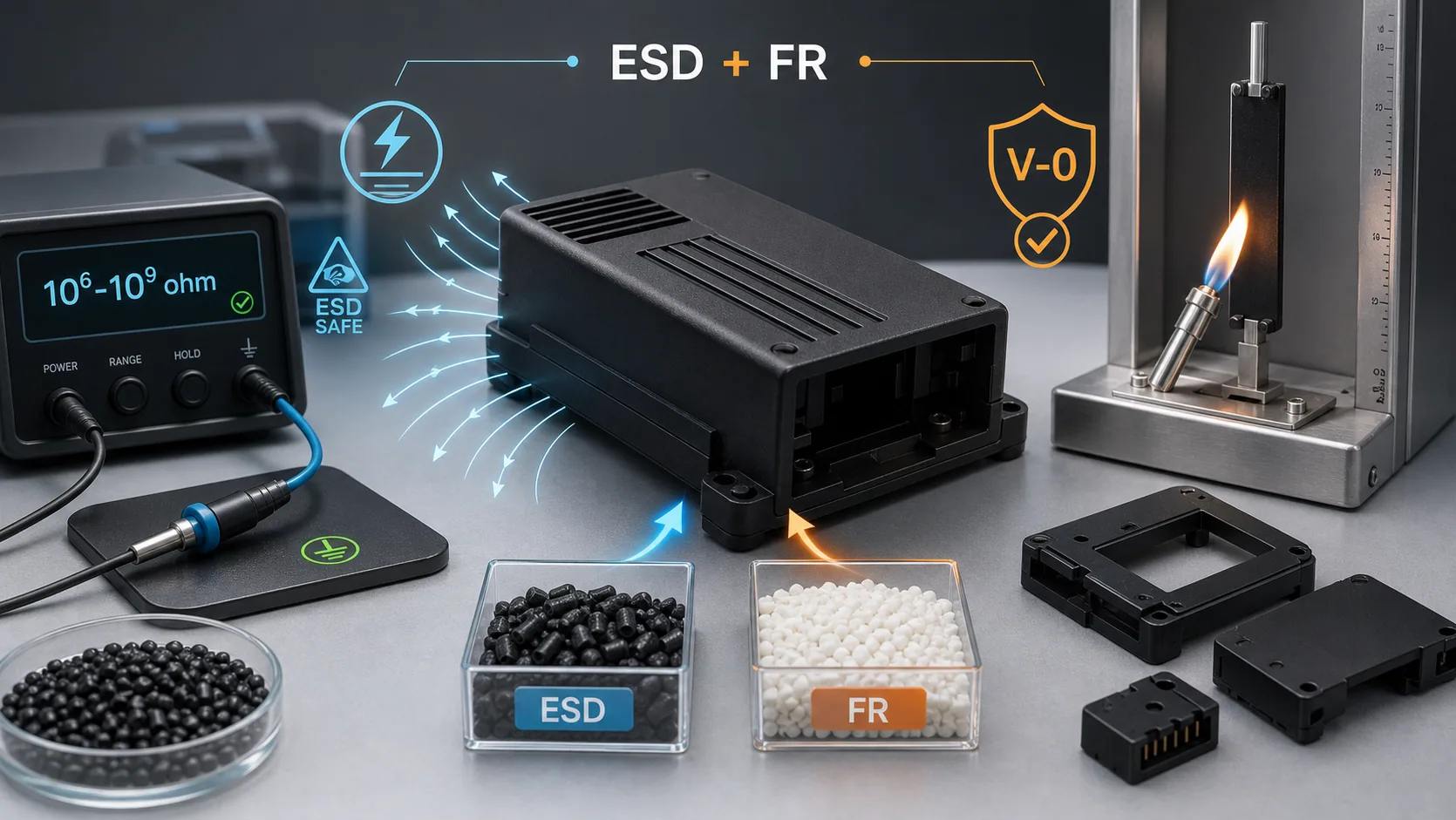
Plastics can achieve both anti-static and flame-retardant performance by combining an electrical control system with a flame-retardant system inside the same resin matrix. The electrical system may use permanent anti-static agents, conductive carbon black, carbon nanotubes, carbon fiber, conductive polymers or hybrid conductive networks. The flame-retardant system may use halogenated flame retardants, halogen-free phosphorus-nitrogen systems, mineral systems, synergists or flame-retardant masterbatch technology.
The difficulty is that these two systems often conflict. Anti-static or conductive fillers may change melt flow, color, mechanical strength and flame behavior. Flame retardants may reduce toughness, interfere with conductivity, increase moisture sensitivity or affect surface resistance. Therefore, the formulation must balance resistance, flame rating, resin type, part thickness, impact strength, color, molding process and final application.
Yuyao Deyu DEYU plastics develops DGK anti-static flame-retardant material solutions according to resistance range, UL94 target, color, mechanical strength and molded-part validation. Existing related directions include DGK-PP DD4-5A-JC flame-retardant conductive PP and DGK-PA6 KJD789R-G30F flame-retardant antistatic PA6.
Why Anti-Static and Flame Retardancy Are Often Required Together
In many electrical and electronic products, plastic materials must not only prevent static charge accumulation but also reduce fire risk. This is common in ESD protection parts, electronic housings, charging equipment, connectors, battery-related parts, appliance components, industrial control housings, automation equipment and components used near circuits.
If a plastic part only has anti-static performance but no flame retardancy, it may still have safety risks near electrical components. If a plastic part only has flame retardancy but no anti-static performance, static accumulation may damage electronic components, attract dust, cause handling problems or create discharge risk.
Many customers therefore ask for anti-static flame-retardant PP, static-dissipative V-0 ABS, ESD flame-retardant PC/ABS, conductive flame-retardant PA66, anti-static flame-retardant PBT, colored anti-static flame-retardant housing materials and low-dust flame-retardant industrial components.
Combining these two functions is not as simple as adding an anti-static agent and a flame retardant into plastic. The two systems must be compatible and must still work after injection molding, aging, humidity change and actual product use.
1. What Is Anti-Static Performance in Plastics?
Anti-static plastic is designed to prevent static charge accumulation or dissipate static electricity in a controlled way. In practice, customers may use terms such as anti-static, static-dissipative, conductive, ESD-safe, surface resistance controlled and volume resistance controlled. These terms are related but not the same.
A practical reference is: anti-static range around 10^9-10^12 ohm, static-dissipative range around 10^6-10^9 ohm, conductive range around 10^3-10^6 ohm, and highly conductive range below that. The final target should be defined by the customer’s application and test method.
For flame-retardant anti-static plastics, resistance stability is important. The material should not only pass one surface resistance test. It should also maintain acceptable resistance after molding, storage, humidity change and actual use.
2. What Is Flame Retardancy in Plastics?
Flame retardancy means the ability of a plastic to resist ignition, slow flame spread, reduce burning time, reduce dripping risk or self-extinguish under defined test conditions.
Customers often specify UL94 HB, V-2, V-1 or V-0, flame rating at 3.0 mm, 1.5 mm or 0.8 mm, glow wire requirements, halogen-free requirements or low-smoke directions.
Thickness must always be defined. A material that reaches V-0 at 3.0 mm may not reach V-0 at 1.5 mm or 0.8 mm. A material that passes standard test bars may still fail in a thin-wall molded part with weld lines, ribs or sharp corners.
For anti-static flame-retardant materials, the challenge becomes greater because the anti-static system can change burning behavior, while the flame-retardant system can change electrical resistance.
3. Why the Two Systems Are Difficult to Combine
Conductive Fillers May Affect Flame Retardancy
Conductive fillers such as carbon black, carbon nanotubes, carbon fiber, graphite or metal fiber build electrical pathways in plastic. They can also change burning behavior. Carbon fillers may change heat absorption and thermal conductivity, carbon fiber may affect dripping and char structure, high filler loading may reduce melt flow and poor dispersion may create weak points.
In some systems, carbon-based fillers help char formation. In other systems, they interfere with flame retardant performance or make processing unstable. The result depends on resin, filler type, flame-retardant system and formulation balance.
Flame Retardants May Affect Electrical Resistance
Flame retardants can interrupt conductive networks, change surface resistance, increase moisture sensitivity, change migration behavior of anti-static agents, affect filler dispersion, change polymer crystallization, reduce mechanical strength or create surface defects.
For example, a conductive carbon network may become unstable if the flame-retardant package changes filler dispersion. A permanent anti-static system may lose efficiency if the flame-retardant package affects surface mobility or compatibility.
Toughness Often Decreases
Both conductive fillers and flame retardants may reduce impact strength. If the formulation contains too much conductive filler, the material can become brittle. If flame-retardant loading is too high, toughness may decrease. If both systems are added without balancing, screw bosses, snap-fits, thin walls and weld lines may crack.
DEYU usually evaluates impact strength, screw boss reliability, weld line strength and actual part assembly when developing anti-static flame-retardant materials.
Color Becomes More Difficult
Anti-static and conductive systems often make the material black or gray, especially when carbon black or carbon fiber is used. Flame retardants may also affect color stability, especially in white or light-colored materials. Colored anti-static flame-retardant plastics are therefore more difficult than black materials.
4. Main Technical Routes
Permanent Anti-Static + Flame Retardancy
This route is suitable when the customer needs anti-static or static-dissipative performance but does not require very low resistance. It gives better color possibility, lower blackening effect and compatibility with white, gray or colored housings. The risks are long-term stability, environmental sensitivity and compatibility with flame retardants.
Conductive Carbon Black + Flame Retardancy
This is a common route for black conductive flame-retardant plastics. It offers good conductivity, mature processing and more controllable cost. The risks are black color only, reduced toughness at high loading, lower flowability and surface quality changes.
Carbon Nanotube or High-Efficiency Conductive Network + Flame Retardancy
Carbon nanotubes or high-efficiency conductive systems can build conductive networks at lower loading in some resins. They may preserve mechanical performance better than high carbon black loading and can leave more formulation space for flame retardancy. The risks are cost, dispersion difficulty, color darkening and resistance variation with flow direction or part thickness.
Carbon Fiber + Flame Retardancy
Carbon fiber can improve stiffness, dimensional stability, conductivity and heat deformation resistance. When combined with flame retardancy, it can be used in high-strength functional materials such as conductive flame-retardant PA66, ESD engineering plastics and high-stiffness electrical parts. The risks are dark color, brittleness, surface roughness and weld-line strength.
Hybrid Conductive System + Flame Retardancy
Hybrid systems combine different conductive routes to reduce total loading and improve stability. Possible combinations include carbon nanotube plus carbon black, carbon fiber plus carbon black, permanent anti-static agent plus conductive filler and conductive polymer plus carbon network.
5. Material Selection by Resin System
Anti-Static Flame-Retardant PP
PP is low density, cost-effective and chemically resistant. It is used in trays, containers, covers, housings and industrial parts. Black conductive flame-retardant PP can use carbon-based systems. Colored anti-static PP may need a permanent anti-static route. For flame-retardant PP, thickness and V-0 target must be defined first.
Anti-Static Flame-Retardant ABS
ABS has good appearance, processability and impact performance. It fits housings and appliance parts. The challenges are impact reduction from flame retardants, black color from conductive carbon systems and surface gloss or color stability.
Anti-Static Flame-Retardant PC/ABS
PC/ABS is practical for electronic housings, electrical enclosures, appliance covers and automotive components. It can balance impact strength, heat resistance and flame retardancy. If the customer needs V-0, impact and appearance together, PC/ABS is often preferred over standard ABS.
Anti-Static Flame-Retardant PA6 and PA66
PA6 and PA66 are used in structural electrical parts, connectors and industrial components. They support conductive flame-retardant PA6, anti-static flame-retardant PA66 and carbon fiber reinforced conductive flame-retardant nylon. The main challenges are moisture absorption, impact strength, flame-retardant compatibility and conductivity stability after conditioning.
PBT, PPS and High-Performance Resins
PBT, PPS, PPA and other engineering resins are used in connectors, electrical parts, automotive components and high-temperature applications. These systems are suitable when heat resistance, dimensional stability, chemical resistance and electrical safety are required together.
6. Technical Balance Table
| Requirement | Main technical focus | Common risk | DEYU development direction |
|---|---|---|---|
| Anti-static + V-0 | Balance anti-static agent and flame retardant | Resistance drift, lower impact | Resin-specific additive matching |
| Conductive + V-0 | Build conductive network without damaging flame rating | High filler loading, brittleness | Hybrid conductive network + flame system |
| Colored + anti-static + FR | Reduce color impact | Color darkening, unstable resistance | Permanent anti-static or low-color-impact route |
| Black conductive + FR | Stable carbon network and flame rating | Flow loss, brittle parts | Conductive filler dispersion control |
| Thin-wall FR + ESD | 0.8-1.5 mm flame rating plus resistance control | Difficult V-0 and resistance balance | Thin-wall formulation and part validation |
| High-strength ESD + FR | Reinforcement plus electrical safety | Weld-line weakness, brittleness | Carbon fiber / PA / PC/ABS composite design |
7. Evaluation Methods
Electrical evaluation should include surface resistance, volume resistance, resistance after molding, resistance after storage, resistance after humidity conditioning, resistance at different part positions and resistance at weld lines or thin-wall areas.
Flame-retardant evaluation should include UL94 rating, specified thickness, glow wire test if required, burning time, dripping behavior, afterflame, afterglow and real part flame-risk area evaluation. Thickness must always be recorded.
Mechanical and processing evaluation should include impact strength, tensile strength, flexural modulus, heat resistance, flowability, molding shrinkage, surface appearance, weld line strength, screw boss assembly, snap-fit reliability and color stability.
Anti-static flame-retardant material must be a usable injection molding material, not only a material that passes one electrical and one flame test.
DEYU Application Cases
Anti-Static Flame-Retardant PC/ABS Housing
A customer produced an electronic control housing. The original PC/ABS material reached flame-retardant requirements, but the surface resistance was too high and static charge accumulated during use. The target was static-dissipative performance, V-0 direction at specified wall thickness, gray color, good appearance and acceptable impact strength.
DEYU integrated a static-control system into the flame-retardant PC/ABS base. The first trial improved resistance but uniformity was unstable. The second trial improved additive compatibility and dispersion. The third trial adjusted the flame-retardant and anti-static balance to keep both flame rating direction and surface resistance target.
Black Conductive Flame-Retardant PA66 Structural Part
A customer needed black PA66 for an industrial electrical component requiring conductivity, flame retardancy, stiffness and stable molding. DEYU recommended a carbon-based conductive network plus flame-retardant PA66 formulation.
The first trial achieved conductivity but impact strength was lower than expected. The second trial adjusted conductive filler dispersion and toughness balance. The third trial optimized flame-retardant loading and processing stability. After small-batch validation, the material reached the target conductive direction and maintained flame-retardant performance direction.
8. DEYU DGK Anti-Static Flame-Retardant Platform
DEYU can support DGK-PP anti-static flame-retardant series, DGK-PP conductive flame-retardant series, DGK-ABS anti-static flame-retardant series, DGK-PC/ABS ESD flame-retardant series, DGK-PA6 conductive flame-retardant series, DGK-PA66 anti-static flame-retardant series, DGK-PBT ESD flame-retardant series, DGK-PPS conductive flame-retardant series, colored anti-static flame-retardant materials, black conductive flame-retardant materials and halogen-free anti-static flame-retardant materials where applicable.
Customizable factors include base resin, surface resistance range, volume resistance range, flame-retardant system, target UL94 thickness, halogenated or halogen-free direction, conductive filler system, permanent anti-static system, carbon nanotube or carbon fiber system, color, impact strength, flowability, heat resistance, surface appearance and molding process.
DEYU recommends customers provide target resin, target surface or volume resistance, anti-static / static-dissipative / conductive target, flame rating, required thickness, part wall thickness, color, halogen-free requirement, current material problem, application, molding process, impact requirement, heat resistance requirement, part drawing or sample and approval standard.
Conclusion
To make plastics both anti-static and flame-retardant, the formulation must balance electrical performance and fire safety in the same resin system. The key is not simply adding an anti-static agent and a flame retardant, but designing a compatible system around resistance range, flame rating, thickness, resin type, toughness, flowability, color and actual molded part performance.
Yuyao Deyu DEYU plastics provides DGK customized anti-static flame-retardant material solutions based on PP, ABS, PC/ABS, PA6, PA66, PBT, PPS, PC and other resin systems. For ESD housings, electrical components, conductive trays, industrial covers, connectors, appliance parts, battery-related structures and colored anti-static flame-retardant applications, DEYU can support formulation development, small-batch trials and real-part validation.